

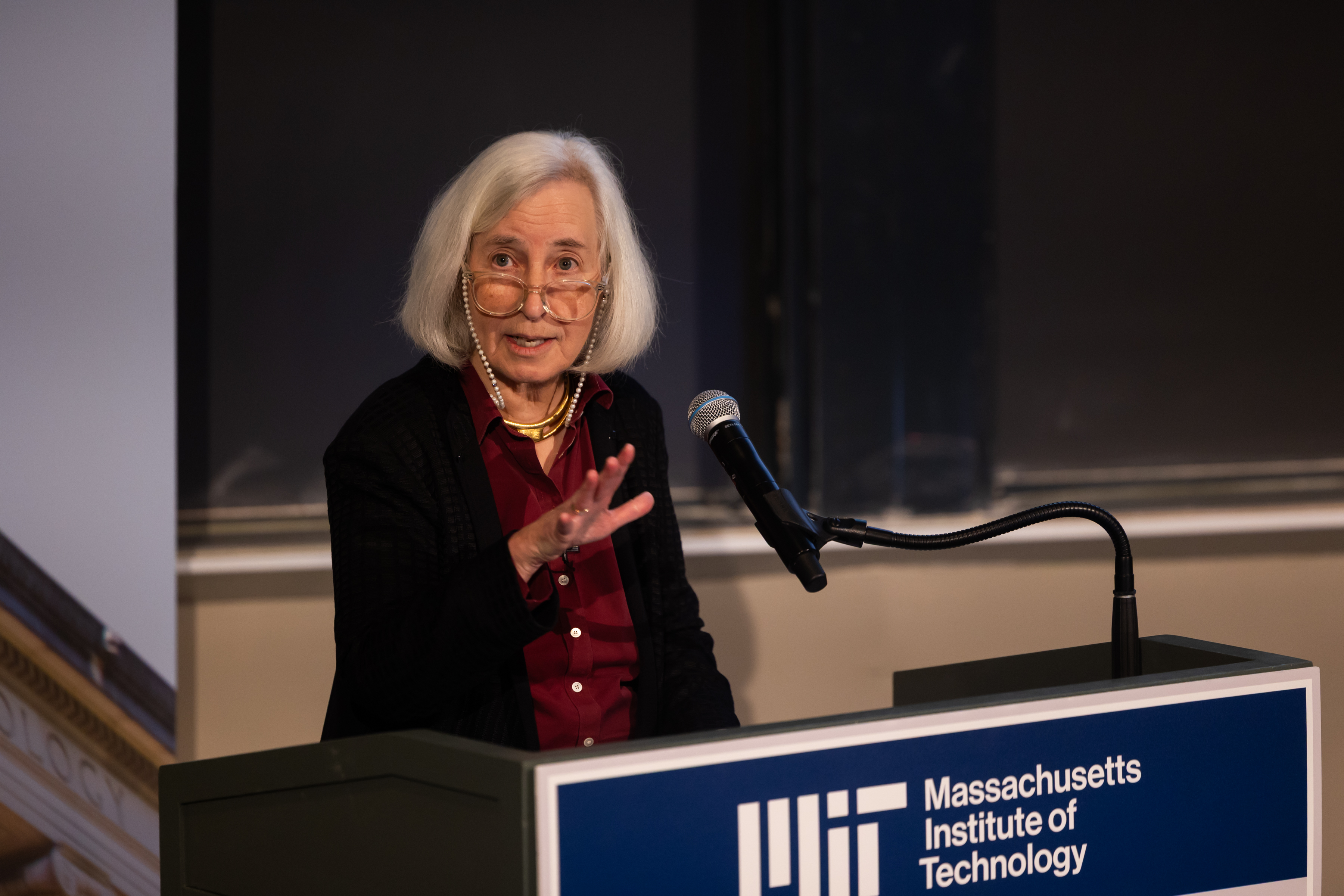
Legal scholar Martha Minow delivered this fall’s Compton Lecture at MIT on Thursday, examining the civic foundations of democracy — and describing how artificial intelligence is undermining it, but could be used to help reinforce traditional U.S. governance.
“It’s not a good time for democracy or constitutionalism,” said Minow, who is the 300th Anniversary University Professor at Harvard University, and a prominent expert in constitutional law and human rights. She noted a litany of challenges to democracy in recent years, including violations of laws and norms, the stifling of free speech, a diminution of congressional authority, disregard of legal rulings, the common vilification of others in society, and more.
Recent Gallup polling, Minow observed, shows 77 percent of people saying that the founders of the U.S. would be disappointed in the contemporary condition of the country.
“Many people genuinely wonder whether this nation’s system of government and rule of law, ignited 250 years ago, will survive,” Minow said.
Her remarks assessed the state of the U.S. in terms of what she called four key “ingredients” of democracy: education, reliable and accessible information, security from violence, and fairness. Minow evaluated how AI has, among other things, influenced these areas of life — but also suggested ways people could use contemporary technology to help.
“It’s very familiar to hear blame attributed to digital technologies and experts of all stripes, but a turnaround, I believe, is genuinely possible if people at MIT and elsewhere pour time and talent towards real and much-needed solutions,” Minow said.
A substantial portion of her remarks focused on the pitfalls of AI in education. That issue compounds some other troubling trends: The U.S. already has large local and regional disparities in educational funding, Minow noted, while schools have actually become significantly more segregated in economic and ethnic terms over the last three decades.
In this context, AI threatens to further weaken independent-thinking skills, Minow suggested, just when greater understanding of civic issues is absolutely vital.
“As AI surges, I think we have to learn to be smarter about how to use it, how to regulate it, and how to actually educate people about the costs of mindless using,” Minow said. She added: “Dominant AI platforms supercharge the strategies that are deployed by social media companies, inducing passivity in people … Leading AI models and interfaces and sycophantic elements endanger the development particularly of young people’s capabilities to think, to remember, and to engage in critical thinking.”
That trend away from cognitive effort, she suggested, can be changed — perhaps through AI tools that act more like tutors and are designed to enhance people’s deep thinking.
“Existing LLMs, model training, and interface design can offer nudges and questions and hints rather than replacing student work, but there’s so much more that could be developed, and more effectively, to be trustworthy, and to deepen human activities and curiosity, rather than replacing people,” Minow said.
To the audience, she added, “AI tools could do much more of that … And I believe that you, the people here, could develop better tools than the ones that are out there. And make better assessments, more meaningful and cheating-resistant.”
Minow’s talk, “Constituting Democracy in the Era of AI,” was delivered to a large audience in MIT’s Huntington Hall, Room 10-250 on campus.
MIT President Sally A. Kornbluth delivered introductory remarks to the audience. The Karl Taylor Compton Lecture Series, introduced in 1957, is the highest-profile event of its kind at MIT. Karl Taylor Compton was MIT’s ninth president, serving from 1930 to 1948, and then becoming chair of the MIT Corporation from 1948 to 1954.
“He guided MIT through the Great Depression and World War II,” Kornbluth said, “transforming the Institute from an outstanding school for training job-ready engineers to a great global research university.”
She added: “He was also a deeply committed patriot who helped harness the intellectual power of America’s research universities to serve the nation during World War II.”
Kornbluth called Minow “a legal scholar of extraordinary intellectual scope,” and a “dedicated educator whose work has shaped how we think about the law and our own humanity, as individuals and as a society.”
Minow has been a faculty member at Harvard Law School since 1981, and served as dean of the school from 2009 through 2017. Minow earned her BA in history from the University of Michigan, an MA in education from Harvard, and a JD from Yale University.
Minow’s books include “Making All the Difference” (1990), “Partners Not Rivals” (2002), and “When Should Law Forgive?” (2020).
In her talk, Minow also discussed the civic effects of misinformation, threats of violence, and multiple dimension of societal fairness. Modern media technology has led to a 75 percent reduction in journalists in recent decades, Minow observed, with an attendant rise in corruption in places without local media. Civic-minded technologists, she proposed, should work towards establishing a widely-used “information commons,” or many forms of them, to help people access more reliable information.
Meanwhile, when it comes to basic security in society, Minow warned, “We’re on the brink right now. I know a lot of judges, and every one of them has a credible threat of violence against them. In America. This is not acceptable.”
For all the challenges to democracy and traditional civic norms, however, Minow sounded positive notes throughout her remarks, pointing out that there are many opportunities to create new forms of reliable information, education, and community relations.
“We have to actually invent the world that we want to live in,” she offered.
Minow’s remarks were followed by a Q&A session in which Kornbluth read aloud questions submitted by the audience — and asked her to characterize her concerns about present trends.
“I worry about the loss of the Enlightenment,” Minow said. “I worry about the loss of the belief that reason, and testing hypotheses, and rejecting myths in the face of evidence, and the toleration and rights and expansion of participation that came along with the Enlightenment, that’s what concerns me the most. That’s why the disinformation issue for me is so important, that’s why the loss of critical thinking in schools is so important.”
She added: “I’ve spent much of my own career thinking about mass violence. What happens when people don’t understand each other, and are afraid. And it’s terrible, and we don’t want to be there. And I do view the Enlightenment as a time when people learned that actually having mass wars is a bad thing, and coming up with toleration is a good thing, and testing our ideas in light of evidence other people can share can produce a better life for everybody. I worry we’re abandoning that right now.”
