
Close Menu

    Subscribe to Updates

    Get the latest creative news from infofortech

    What's Hot

    Home Batteries: How They’re Installed and How Much They Cost

    June 21, 2026

    NASA Is Testing A Rover That Can Drive Faster And Lift Its Wheels To Climb Obstacles

    June 21, 2026

    AI, user data and the asymmetry of understanding

    June 20, 2026
    Facebook X (Twitter) Instagram
    InfoForTech
    • Home
    • Latest in Tech
    • Artificial Intelligence
    • Cybersecurity
    • Innovation
    Facebook X (Twitter) Instagram
    InfoForTech
    Home»Innovation»AI’s Next Bottleneck Isn’t Physical Infrastructure But Water.
    Innovation

    AI’s Next Bottleneck Isn’t Physical Infrastructure But Water.

    InfoForTechBy InfoForTechJune 10, 2026No Comments3 Mins Read
    Facebook Twitter Pinterest Telegram LinkedIn Tumblr WhatsApp Email
    AI’s Next Bottleneck Isn’t Physical Infrastructure But Water.
    Share
    Facebook Twitter LinkedIn Pinterest Telegram Email


    A new analysis shows that most planned AI data centers in the US are being built in drought-stricken regions, creating an insurmountable challenge.

    The AI industry has been obsessed with one resource- compute.

    Who has the most GPUs? Who can build data centers the fastest? Who can secure enough power to stay ahead in the AI race?

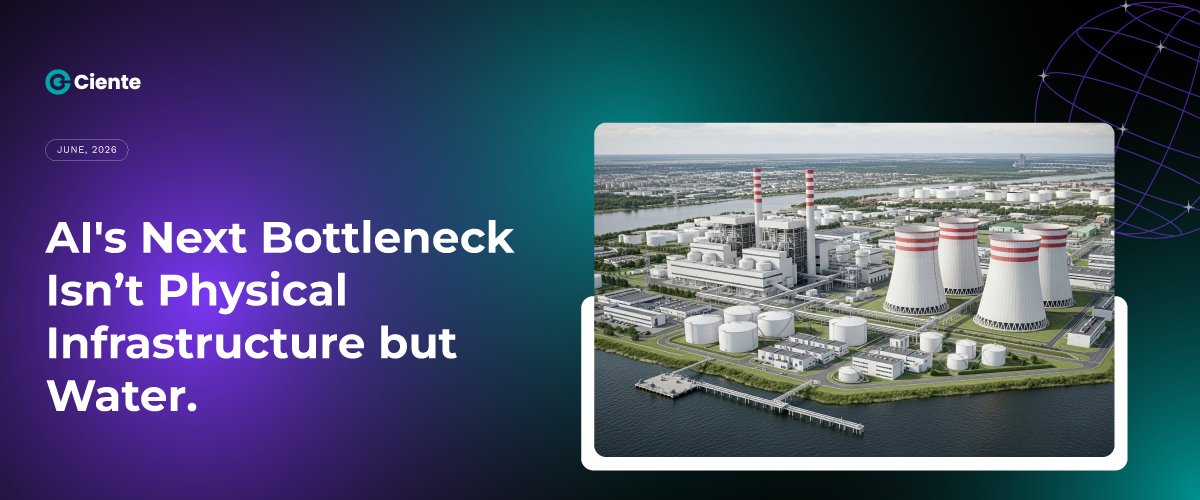
    But a new analysis from The Guardian suggests the industry may have overlooked another resource that is becoming just as important: water. About two-thirds of planned AI datacenters in the US will be built in regions already experiencing severe drought conditions, even as demand for water-intensive cooling continues to rise.

    That creates an uncomfortable contradiction.

    The AI industry talks about intelligence as if it exists in the cloud. In reality, every AI model ultimately runs on physical infrastructure. Servers need electricity. Chips generate heat. Heat needs cooling. And cooling requires enormous amounts of water in several cases. Some large data centers consume millions of gallons daily, and overall, this water use could rise dramatically over the next few years.

    That is where the story becomes larger than sustainability.

    It becomes an investment story.

    Investors evaluated AI companies based on model capabilities, adoption rates, and infrastructure scale. The assumption was straightforward: more infrastructure meant a stronger competitive position.

    Now, a new variable is entering the equation.

    Resource constraints.

    The challenge is building a data center that communities, regulators, and local ecosystems tolerate. Opposition to new projects is already growing, with concerns over water use helping drive political pushback and even proposals to pause large data center developments in some regions.

    That creates a risk many investors aren’t accustomed to pricing.

    The AI boom is largely valued as a software revolution. Increasingly, it looks like an infrastructure business. And infrastructure businesses are constrained by land, energy, permitting, and natural resources.

    The industry understands the problem. Companies are experimenting with closed-loop cooling systems, water-recycling initiatives, and alternative datacenter designs to reduce consumption. Microsoft recently claimed some of its newest facilities use less water than older designs.

    But efficiency alone may not solve the issue.

    The problem isn’t that individual data centers are becoming less efficient. It’s that demand is growing faster than efficiency gains can offset. Every improvement seems to unlock another wave of construction.

    That may be the most important takeaway for tech investors.

    The AI race is often framed as a battle for chips and talent. Yet some of the biggest winners over the next decade may be companies that solve a much less glamorous problem: how to scale AI without exhausting the resources that support it.

    The future of AI will now be determined by who can find efficient ways to instill regular water inflow.

    Share. Facebook Twitter Pinterest LinkedIn Tumblr Email
    InfoForTech
    • Website

    Related Posts

    Home Batteries: How They’re Installed and How Much They Cost

    June 21, 2026

    AI, user data and the asymmetry of understanding

    June 20, 2026

    Platform Engineering Is What Happens When Developer Chaos Gets A Structure

    June 20, 2026

    Sony’s wild PSN login patent could turn the DualSense into a security gatekeeper

    June 20, 2026

    The Most Promising Ebola Vaccine Has Been Sitting on the Shelf for 15 Years

    June 20, 2026

    US energy regulator moves to speed up data center projects

    June 19, 2026
    Leave A Reply Cancel Reply

    Advertisement
    Top Posts

    DoJ Disrupts 3 Million-Device IoT Botnets Behind Record 31.4 Tbps Global DDoS Attacks

    March 20, 202638 Views

    Microsoft is bringing an AI helper to Xbox consoles

    March 14, 202616 Views

    This is the tech that makes Volvo’s latest EV a major step forward

    January 24, 202616 Views

    Why Security Validation Is Becoming Agentic

    March 16, 202615 Views
    Stay In Touch
    • Facebook
    • Twitter
    • Pinterest
    • Instagram
    • YouTube
    • Vimeo
    Advertisement
    About Us
    About Us

    Our mission is to deliver clear, reliable, and up-to-date information about the technologies shaping the modern world. We focus on breaking down complex topics into easy-to-understand insights for professionals, enthusiasts, and everyday readers alike.

    We're accepting new partnerships right now.

    Facebook X (Twitter) YouTube
    Most Popular

    DoJ Disrupts 3 Million-Device IoT Botnets Behind Record 31.4 Tbps Global DDoS Attacks

    March 20, 202638 Views

    Microsoft is bringing an AI helper to Xbox consoles

    March 14, 202616 Views

    This is the tech that makes Volvo’s latest EV a major step forward

    January 24, 202616 Views
    Categories
    • Artificial Intelligence
    • Cybersecurity
    • Innovation
    • Latest in Tech
    © 2026 All Rights Reserved InfoForTech.
    • Home
    • About Us
    • Contact Us
    • Privacy Policy

    Type above and press Enter to search. Press Esc to cancel.

    Ad Blocker Enabled!
    Ad Blocker Enabled!
    Our website is made possible by displaying online advertisements to our visitors. Please support us by disabling your Ad Blocker.