

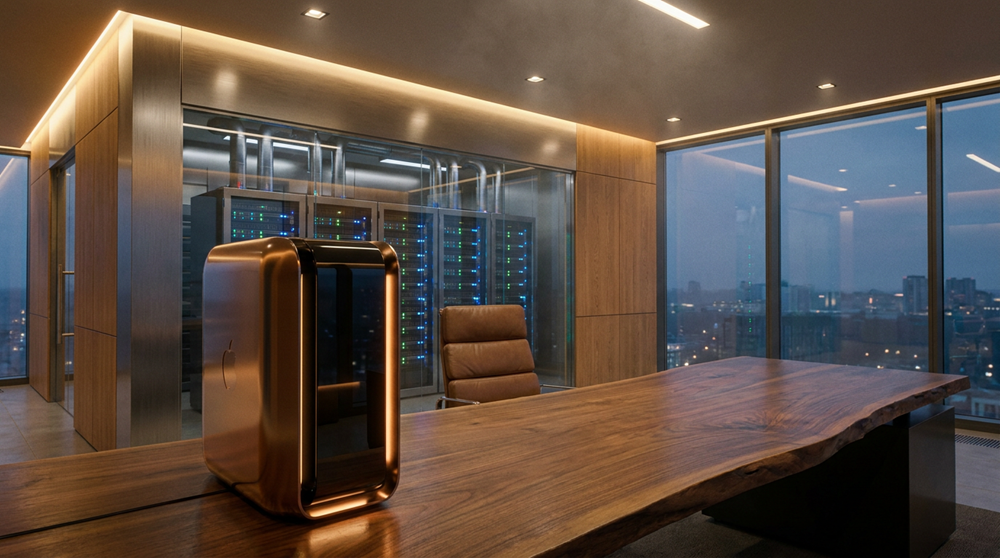
AMD is aggressively reshaping local AI development with massive memory capabilities in its new Ryzen AI Halo platform and Max PRO processors, leaving competitors scrambling to match this raw power.
Here in my home office in the high desert of Bend, Oregon, I regularly build around two to three desktop systems a year. It is a necessary, hands-on practice to keep a firm, tactile understanding of where PC hardware is heading, rather than relying solely on sanitized press releases and corporate roadmaps. When you are frequently up to your elbows in motherboards, cooling loops, and bare silicon, you notice the stark contrast between what enterprise developers truly need and what consumer hardware typically provides. For the past couple of years, the technology industry has been obsessively fixated on cloud-based generative AI, leaving the local desktop—the actual, physical workspace of developers—starved for dedicated, integrated AI acceleration.
That paradigm is finally fracturing. We are rapidly transitioning away from simple, cloud-dependent generative models and moving toward true Agentic AI. These are autonomous “Agent Computers” that can deeply understand complex prompts, plan multi-step actions, and execute concurrent tasks with minimal human intervention. To make this leap, the industry requires Physical AI—systems that run locally to ensure low latency, high data security, and massive memory bandwidth without incurring astronomical cloud hosting bills.
This week, the AMD Ryzen AI Halo developer platform officially bridged that critical gap, and its underlying capabilities are nothing short of industry-altering.
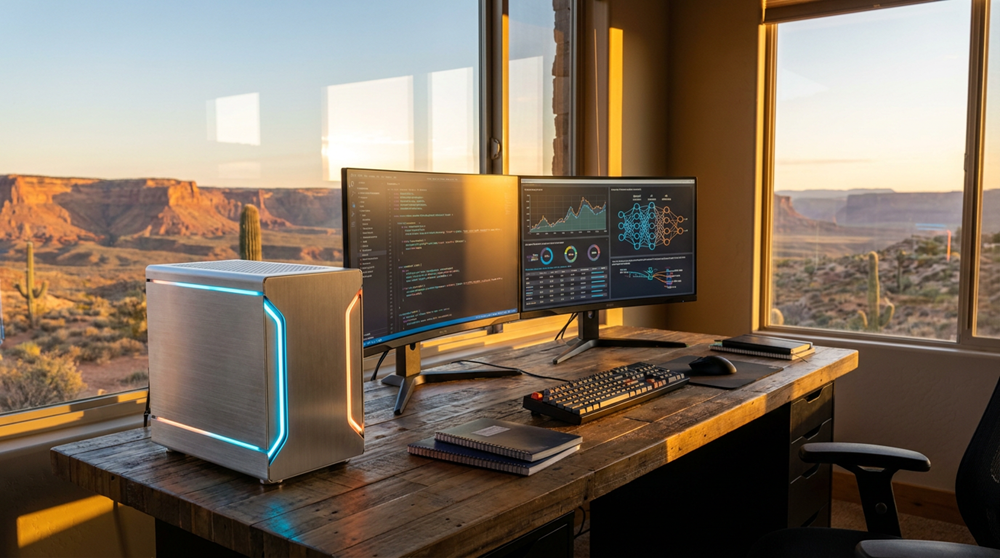
The Ryzen AI Halo: A Local Execution Powerhouse
For Agentic AI to move securely out of the public data center, the host machine must be capable of handling real-time, compute-heavy tasks locally while simultaneously protecting sensitive proprietary data. The newly announced Ryzen AI Halo platform is a compact developer ecosystem expressly engineered for this exact purpose.
Powered initially by the Ryzen AI Max+ 395 processors, the Halo platform brings up to 128GB of unified system memory to the developer’s desk. This is a massive leap for a client machine, providing the critical hardware headroom required to run models with up to 200 billion parameters completely locally. When you consider that most developers have historically been forced to rent expensive cloud instances just to test models of this size, bringing this capability to a local desk represents a massive cost and time savings.
Furthermore, the platform actively supports the exact tools developers are already utilizing—PyTorch, vLLM, llama.cpp, Ollama, ComfyUI, and LM Studio—all of which are heavily optimized for the AMD ROCm software stack. It effectively allows a seamless, frictionless transition from Linux prototyping and fine-tuning all the way through to final Windows deployment on a single piece of hardware.
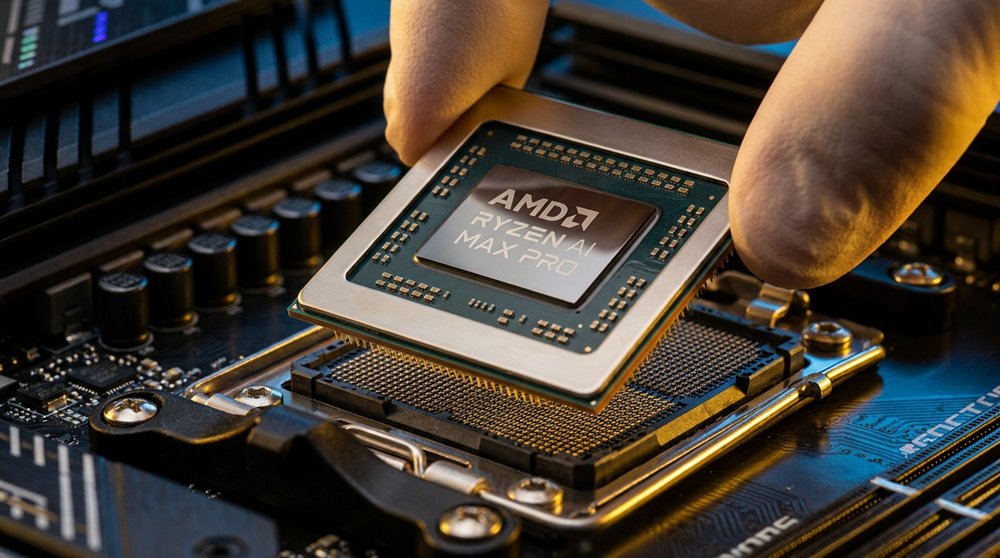
Ryzen AI Max PRO 400 Series: Rescuing the Desktop
In the third quarter of 2026, AMD is stepping on the gas even harder with the Ryzen AI Max PRO 400 Series processors. These chips are the real heroes for the traditional PC form factor. Historically, desktop machines have been strangely ignored during the initial AI boom. We’ve seen low-power NPUs slapped into ultra-thin laptops for basic video conferencing background blurring, and massive discrete GPUs deployed in server racks, but the workstation desktop—the very tool developers use to build our digital future—has been left waiting in the wings.
The Max PRO 400 series corrects this oversight violently. Built on the highly efficient “Zen 5” architecture, the flagship Ryzen AI Max+ PRO 495 features 16 cores, 32 threads, 40 AMD RDNA 3.5 graphics compute units, and a staggering 55 NPU TOPS.
What makes these processors absolutely critical to the desktop ecosystem is their unified memory architecture. They support up to 192GB of unified system memory and 160GB of VRAM. This allows the system to seamlessly run 300-billion-parameter models locally at 4-bit quantization. For AI developers, engineers, and creators working on massive environmental simulations or data-intensive workflows, having an XDNA 2 NPU integrated directly with this much memory eliminates the data bottleneck that typically chokes discrete systems.
While I personally prefer 16-inch notebooks when I’m traveling or covering industry events because the larger display brings the experience far closer to a desktop, you simply cannot replicate the thermal headroom, expansive I/O, and sustained data throughput of a dedicated workstation desktop armed with a Max PRO 400 processor. Developers need uncompromised power delivery, and this platform finally delivers it to the desk.
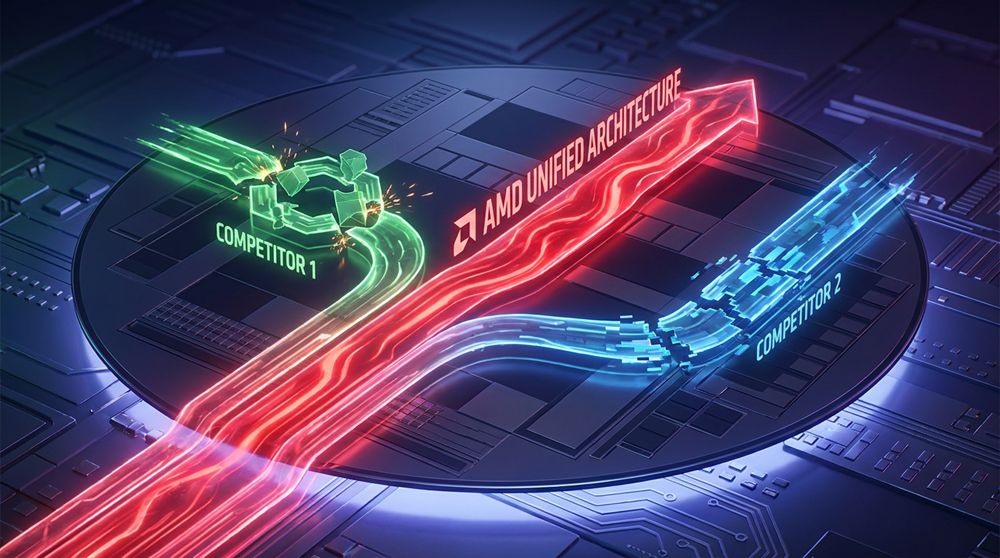
The Competitive Battlefield: Qualcomm, NVIDIA, and Intel
When you look at the Ryzen AI Halo and the Max PRO 400 series side-by-side with the rest of the market, AMD’s strategic divergence from its competitors becomes glaringly obvious.
Qualcomm has done an admirable job bringing its Snapdragon X series to market, effectively jump-starting the AI PC category for ultra-mobile users who prioritize battery life. However, their ARM-based architecture is not currently positioned to tackle the brute-force, workstation-class workflows required by enterprise AI developers. They are building excellent consumer devices, but they aren’t building Agentic Computers capable of running 300-billion-parameter models natively on an x86 stack.
NVIDIA remains the undisputed heavyweight champion of cloud AI and data center training. Yet, in the local desktop space, their approach still relies heavily on discrete graphics cards. While an RTX 4090 or the impending RTX 50-series are phenomenally powerful, adding 160GB of VRAM via discrete cards to a single desktop workstation is prohibitively expensive, thermally challenging, and spatially demanding. AMD’s unified memory approach on a single APU architecture elegantly sidesteps the discrete VRAM tax, democratizing access to massive models for everyday developers.
Then there is Intel. Under the leadership of their current CEO, Lip-Bu Tan, Intel has been working furiously to right the ship, correct past foundry missteps, and regain its engineering footing. They have aggressive AI roadmaps, but AMD’s decision to push up to 192GB of unified memory and 55 NPU TOPS specifically tailored for commercial desktops feels like it has caught Intel slightly off-guard in the workstation segment. Intel is fiercely competitive and has immense resources, but AMD has delivered a highly integrated, ready-to-deploy developer platform right now, while Intel is still navigating its structural transitions.
AMD’s Market Positioning: Architecting the Future
Overall, AMD is executing with a level of foresight and precision that should make its competitors very uncomfortable. By focusing relentlessly on Agent Computers—machines that don’t just generate conversational text, but act as autonomous, secure digital workers—AMD is skating to where the puck is going. They aren’t just selling silicon; they are actively seeding the software and hardware ecosystem.
By partnering with heavyweights like HP and Lenovo to deploy the Ryzen AI Max PRO 400 Series into commercial PCs and mobile workstations by the third quarter of 2026, AMD is ensuring its hardware gets directly into the hands of the people actually building the AI future. They have recognized that the cloud is too expensive, too insecure, and too slow for real-time Agentic AI. By pulling that compute power down to the local, physical level, they are fundamentally altering the economics of AI development.
Furthermore, their commitment to an open software environment through the ROCm stack is a brilliant, necessary counter to NVIDIA’s proprietary CUDA lock-in. Enterprise developers demand flexibility, and by providing massive unified memory, top-tier NPU performance, and an open software ecosystem, AMD is positioning itself not just as a hardware vendor but as the foundational platform for the next decade of enterprise computing.
Wrapping Up
The transition from cloud-dependent generative AI to localized, Agentic AI is the most significant computing shift we will see this decade. For far too long, the desktop has been neglected in this equation, forcing developers to rely on compromised, low-memory local hardware or endlessly expensive cloud instances. The introduction of the AMD Ryzen AI Halo developer platform and the Ryzen AI Max PRO 400 Series processors fundamentally fixes this glaring market gap. By delivering up to 192GB of unified memory and integrating powerful XDNA 2 NPUs directly into workstation-class x86 architecture, AMD has given developers the precise, heavy-duty tools they need to build the future locally. While Qualcomm, NVIDIA, and Intel all possess formidable strengths in their respective lanes, AMD’s unified, developer-first approach to the desktop workstation makes it uniquely positioned to dominate the impending era of Agent Computers.

As President and Principal Analyst of the Enderle Group, Rob provides regional and global companies with guidance in how to create credible dialogue with the market, target customer needs, create new business opportunities, anticipate technology changes, select vendors and products, and practice zero dollar marketing. For over 20 years Rob has worked for and with companies like Microsoft, HP, IBM, Dell, Toshiba, Gateway, Sony, USAA, Texas Instruments, AMD, Intel, Credit Suisse First Boston, ROLM, and Siemens.
