

The deployment of automated software systems called AI agents has recently exploded. A November 2025 report by MIT Sloan School of Management and Boston Consulting Group found that 35 percent of surveyed businesses had already deployed AI agents, while another 44 percent planned to implement agentic AI soon.
To understand the fundamentals and potential impacts of these increasingly popular tools, MIT News spoke with Phillip Isola, an associate professor in the Department of Electrical Engineering and Computer Science (EECS) and a member of the Computer Science and Artificial Intelligence Laboratory (CSAIL), who studies the intelligence AI agents possess, as well as the underlying models and mechanisms that power agentic AI systems.
Q: What is agentic AI and how is it different from generative AI models like ChatGPT and Claude?
A: Agentic AI is AI that takes actions in the world. These actions could be a physical action, like robotic manipulation, or a digital action, like booking a flight. On the other hand, we think of generative AI as making up stories, poems, art, and images, rather than taking actions for us.
The word “agent” is just a brand name. It usually means AI that is going to help people interact with an application, a website, or the physical world. Most agents we encounter today are digital agents, like customer service agents you can talk with about product complaints.
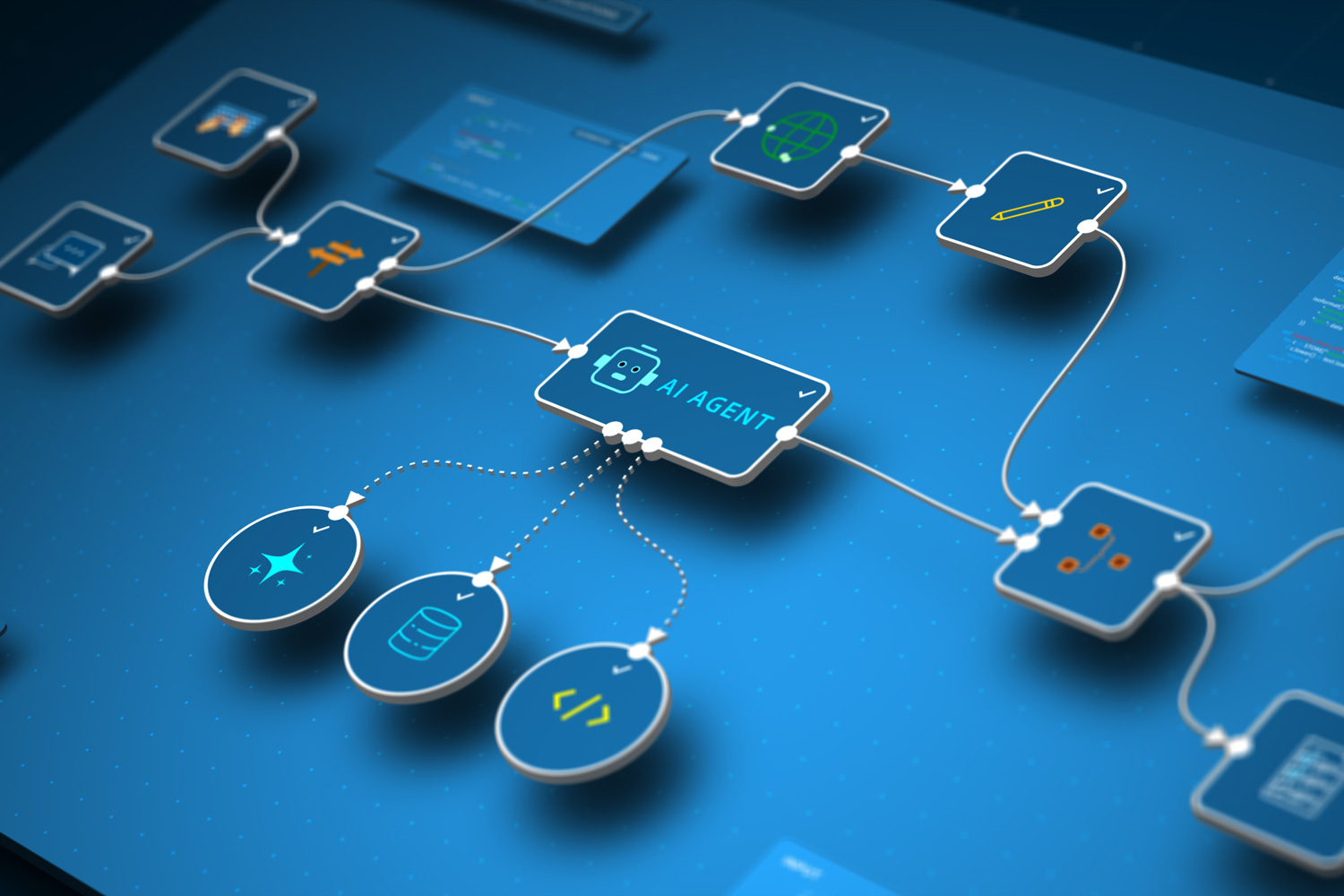
Most companies that offer agents use the same few AI models under the hood and give them the ability to take actions and remember what happened. An agent starts with a fundamental generative AI system, like Claude, at the core. Then companies put different wrappers around that foundation model for their product or application. Those wrappers might be specific tools that agent can use, and those tools depend on the application. Maybe the agent has access to a calculator so it can solve math problems, or maybe it has access to a more complicated hard drive and operating system so it can remember a firm’s financial data and past business negotiations.
The biggest challenge in developing agentic AI comes from a lack of training data. If I want to create a system that can go online and book a flight for me, that seems pretty simple. But we don’t have a lot of data that spells out exactly how to do that — where to move the mouse, which buttons to click on, what to do if something goes wrong, or how to call somebody and negotiate about the price of the airline ticket. One way to train a system like this is to have the AI agent visit airline websites, try things out, and see what works and what doesn’t work. These environments are hard to model, so often the agent must learn by trial and error.
Q: What are some promising applications of agentic AI?
A: I think the area where we’ve seen the most success has been with coding agents. This is something that evolved from generative AI. People trained language models on code, and then they can predict what a human would do to solve a coding problem. In addition, an agent can learn to do this by going through a feedback loop where it tries out different solutions and checks to see if it got the answer right. As long as it can check the answer, the AI agent can perform this trial-and-error loop until it figures out a good strategy.
But there is always a balance between automating decision making versus simply assisting and informing humans. Analytical AI methods, like the systems that help predict possible outcomes of decisions, are not agentic in nature, but are very informative to human decision-makers. For cases that are either high-stakes or safety-critical, like medicine, security, high-level business policies, etc., the technology might not be ready for AI to completely automate those processes, or we might not even be comfortable with that.
Q: Are there risks we should be thinking about when using AI agents?
A: One big risk area comes from the fact that it is often very easy to get agents to do certain types of work for you. With coding agents, you can “vibe code” and just ask the agent to make a code for you, so you don’t have to do the hard work yourself. There is a big risk that, because it is so easy, people will not put enough effort into verifying that it is doing the right thing. Bugs will be introduced, private data will get leaked — this is already happening.
Agents aren’t perfect, in the sense that they might make mistakes because they are not well-trained and don’t know what to do. But even if they are very competent, if a human doesn’t use them appropriately or gives them an instruction that is too vague, the AI agent could make a mistake because the human made a mistake. If humans are less involved in thinking through all the consequences, I think we might be more prone to making those mistakes.
An additional aspect is the risk of de-skilling. It is unclear how far this will go, but when we are relying on agents to do our homework, our coding, and our math, we might lose the ability to do that ourselves, and we might lose that ability too soon because the technology is not yet ready to fully automate those processes.
Q: What does the future hold for agentic AI?
A: What we think of now as agentic AI refers to large language models using tools to interact with digital and physical systems. One obvious limitation is that, under the hood, these have the architecture of a language model and are trained on text data. To make even more powerful AI agents, we might need to model videos, physical forces, time series, radar scans, and other modalities. We might need to have models with fundamentally different architectures that can handle continuous data, high-dimensional data, stochastic data, and so on.
But, on the other hand, maybe an extremely good coding model could act as a puppeteer to interface with sensors, actuators, and web APIs? Perhaps, once you have a super-smart reasoning system that understands math, language, and code, you can give it a camera and a keyboard and it will figure out what to do in the spatial domain. Is the next wave of AI just going to be Claude with sensors, actuators, and tools, or is it going to be something built in a new way from the ground up? That’s the big question a lot of people in AI are grappling with right now.
