


Microsoft Corp.’s push for artificial intelligence independence is gaining traction with today’s release of MAI-Image-2-Efficient, a lean and mean version of its flagship image generation model that debuted earlier this month.
The new version is meant to deliver high-quality visuals faster, and at a fraction of the cost of its predecessor, the company said. The original MAI-Image-2 model was released by Microsoft’s new MAI superintelligence team earlier this month, and the team led by Mustafa Suleyman gets credit for launching a streamlined version of that model just weeks later.
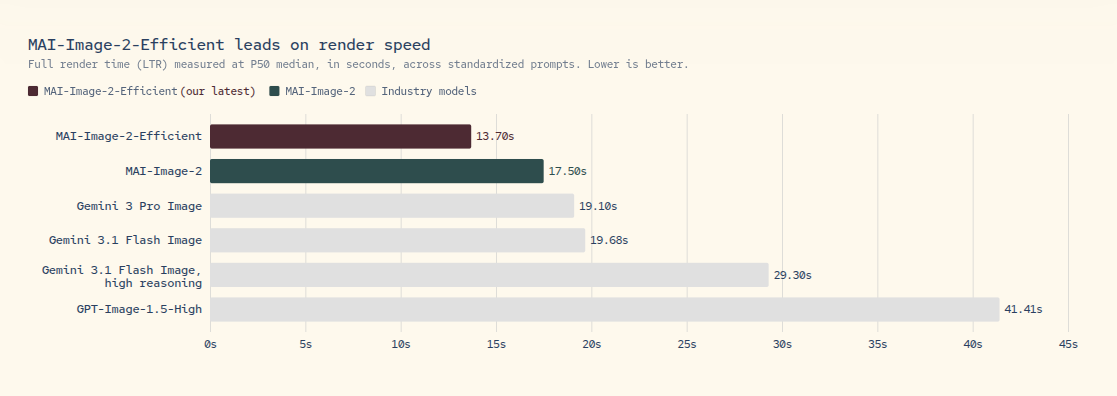
As the name suggests, MAI-Image-2-Efficient is all about efficiency, with Microsoft promising four-times faster throughput per graphics processing unit when running on Nvidia Corp.’s H100 processors. In terms of raw performance, it’s about 22% faster than the main MAI-Image-2 model, outpacing Google LLC’s Gemini 3.1 Flash with 40% superior latency, the company said, citing its own benchmarks.
Microsoft said MAI-Image-2-Efficient is more cost-effective too, with pricing starting at $5 per million input tokens, the same as the flagship model, and $19.50 per million output tokens, which is 41% cheaper. This two-tier pricing strategy, with users able to choose between a higher-end model for high-fidelity creative work and an efficient version for volume production, mirrors the playbooks of Google and startups like OpenAI Group PBC and Anthropic PBC. The company said MAI-Image-2-Efficient is particularly suited to “assembly line” tasks such as user interface mockups, product photography and marketing assets, where cost-per-image is a key consideration.
Early feedback on the original MAI-Image-2 has been positive, with the model claiming the No. 3 spot on Arena.ai’s leaderboard and earning praise for its photorealism and ability to render complex typography – an area where many other image generation models struggle. But it’s not clear yet if MAI-Image-2-Efficient suffers from the same irksome constraints as its sibling. For instance, the original received a lot of criticism for its 30 second “cooldown” period between prompts, the inability to generate images with anything other than a 1:1 aspect ratio, and its overly aggressive content filtering.
Moving away from OpenAI
Microsoft’s push to develop its own models is being driven by its desire to reduce its reliance on OpenAI, which it has invested heavily in over the years. There was a time when the Windows software maker was almost exclusively reliant on OpenAI’s models for its AI products and capabilities. But it has seemingly become wary of being “locked-in” to an increasingly powerful company that has shown a desire to assert its independence.
Just yesterday, CNBC reported that it had surfaced an internal memo from OpenAI’s new Chief Revenue Officer Denise Dresser, which told staff that the company’s partnership with Microsoft “has also limited our ability to meet enterprises where they are.” The memo pointed to OpenAI’s new partnership with Amazon Web Services Inc.’s Bedrock platform as a key growth driver, noting that inbound demand was “frankly, staggering” since the collaboration was announced in February.
OpenAI has also looked to diversify its cloud infrastructure base to providers such as CoreWeave Inc., Google LLC and Oracle Corp. at Microsoft’s expense. For its part, Microsoft added OpenAI to its official list of competitors in mid-2024.
Meanwhile, Valoir analyst Rebecca Wettemann told SiliconANGLE in January that Microsoft’s reliance on OpenAI is becoming a major concern for investors, because OpenAI is facing increased competition from rivals like Google and Anthropic. “Investors are losing patience, largely because much of Microsoft’s eventual potential payback is tied to money coming from OpenAI that is mostly hypothetical at this point,” she explained.
Developing its own models can be much more profitable for Microsoft. The MAI models are now the default option whenever someone asks the company’s Copilot tool to generate an image, replacing OpenAI’s DALL-E model. That means Microsoft can keep all of the costs generated for itself, rather than paying licensing fees to OpenAI.
MAI-Image-2-Efficient also helps to accelerate Microsoft’s agentic AI strategy. With the launch of services such as Copilot Cowork and Agent 365, Microsoft is moving toward a world where AI executes complex, multistep tasks and workflows on behalf of users. Should an autonomous agent be asked to spin up materials for a new marketing campaign, low-latency and reduced costs are essential, enabling it to iterate at scale.
Microsoft said MAI-Image-2-Efficient is available now via Microsoft Foundry and the MAI Playground.
Image: Microsoft
Support our mission to keep content open and free by engaging with theCUBE community. Join theCUBE’s Alumni Trust Network, where technology leaders connect, share intelligence and create opportunities.
- 15M+ viewers of theCUBE videos, powering conversations across AI, cloud, cybersecurity and more
- 11.4k+ theCUBE alumni — Connect with more than 11,400 tech and business leaders shaping the future through a unique trusted-based network.
About SiliconANGLE Media
Founded by tech visionaries John Furrier and Dave Vellante, SiliconANGLE Media has built a dynamic ecosystem of industry-leading digital media brands that reach 15+ million elite tech professionals. Our new proprietary theCUBE AI Video Cloud is breaking ground in audience interaction, leveraging theCUBEai.com neural network to help technology companies make data-driven decisions and stay at the forefront of industry conversations.
