
Close Menu

    Subscribe to Updates

    Get the latest creative news from infofortech

    What's Hot

    How to Claim Your Cut of Apple’s $250 Million Siri Settlement

    September 22, 2026

    Poitras Center to fuel early careers of 50 young scientists dedicated to psychiatric disorders research | MIT News

    September 22, 2026

    Who owns the customer relationship when an agent does the buying? – GeekWire

    September 22, 2026
    Facebook X (Twitter) Instagram
    InfoForTech
    • Home
    • Latest in Tech
    • Artificial Intelligence
    • Cybersecurity
    • Innovation
    Facebook X (Twitter) Instagram
    InfoForTech
    Home»Artificial Intelligence»from words to reality in minutes
    Artificial Intelligence

    from words to reality in minutes

    InfoForTechBy InfoForTechJanuary 23, 2026No Comments3 Mins Read
    Facebook Twitter Pinterest Telegram LinkedIn Tumblr WhatsApp Email
    from words to reality in minutes
    Share
    Facebook Twitter LinkedIn Pinterest Telegram Email


    The line between science fiction and reality is getting blurrier thanks to
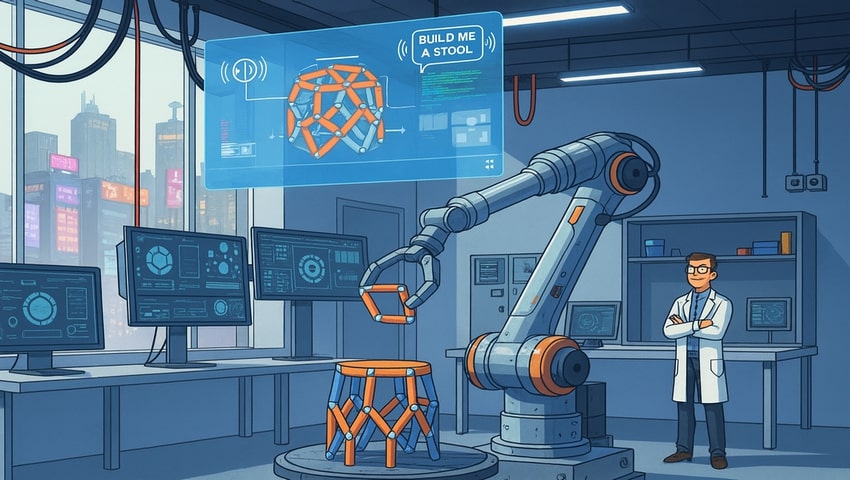
    MIT researchers who have developed a system that can turn spoken commands
    into physical objects within minutes. The
    “Speech-to-Reality” platform
    integrates natural language processing,
    3D generative AI, geometric analysis, and robotic assembly. The platform
    enables on-demand fabrication of furniture, functional and decorative items
    without requiring users to have expertise in 3D modeling or robotics.

    The system workflow begins with speech recognition, converting a user’s
    spoken input into text. A large language model (LLM) interprets the text to
    identify the requested physical object while filtering out abstract or
    non-actionable commands. The processed request serves as input to a 3D
    generative AI model, which produces a digital mesh representation of the
    object.

    Because AI-generated meshes are not inherently compatible with robotic
    assembly, the system applies a component discretization algorithm that
    divides the mesh into modular cuboctahedron units. Each unit measures 10 cm
    per side and is designed for magnetic interlocking, enabling reversible,
    tool-free assembly. Geometric processing algorithms then verify assembly
    feasibility, addressing constraints such as inventory limits, unsupported
    overhangs, vertical stacking stability, and connectivity between components.
    Directional rescaling and connectivity-aware sequencing ensure structural
    integrity and prevent collisions during robotic assembly.

    An automated path planning module, built on the Python-URX library, generates
    pick-and-place trajectories for a six-axis UR10 robotic arm equipped with a
    custom gripper. The gripper’s passive alignment indexers ensure precise
    placement even with slight component wear. Assembly occurs layer by layer,
    following a connectivity-prioritized order to guarantee grounded and stable
    construction. A conveyor system recirculates components for subsequent
    builds, enabling sustainable, circular production.

    The system has demonstrated rapid assembly of various objects, including
    stools, tables, shelves, and decorative items like letters or animal
    figures. Objects with large overhangs, tall vertical stacks, or branching
    structures are successfully fabricated thanks to constraint-aware geometric
    processing. Calibration of the robotic arm’s velocity and acceleration
    further ensures reliable operation without inducing structural instability.

    While the current implementation uses 10 cm modular units, the system is
    modular and scalable, allowing for smaller components for higher-resolution
    builds and potential integration with hybrid manufacturing techniques.
    Future iterations could incorporate augmented reality or gesture-based
    control for multimodal interaction, as well as fully automated disassembly
    and adaptive modification of existing objects.

    The Speech-to-Reality platform represents a technical framework for bridging
    AI-driven generative design with physical fabrication. By combining language
    understanding, 3D AI, discrete assembly, and robotic control, it enables
    rapid, on-demand, and sustainable creation of physical objects, providing a
    pathway for scalable human-AI co-creation in real-world environments.

    Share. Facebook Twitter Pinterest LinkedIn Tumblr Email
    InfoForTech
    • Website

    Related Posts

    Poitras Center to fuel early careers of 50 young scientists dedicated to psychiatric disorders research | MIT News

    September 22, 2026

    Why AI Adaptation, Not Adoption, Is the Real Work Ahead

    September 22, 2026

    AI in Business: Overcoming Deployment Challenges

    September 21, 2026

    A new chapter for MIT Reads | MIT News

    September 19, 2026

    AI that knows its limits

    September 18, 2026

    How OpenAI’s GPT-6 Astra Can Help You Build Presentations

    September 17, 2026
    Leave A Reply Cancel Reply

    Advertisement
    Top Posts

    A Billionaire-Backed Startup Wants to Grow ‘Organ Sacks’ to Replace Animal Testing

    March 23, 2026375 Views

    DoJ Disrupts 3 Million-Device IoT Botnets Behind Record 31.4 Tbps Global DDoS Attacks

    March 20, 202641 Views

    Mayiduo spent S$1M to produce his movie. It broke even & that’s a win in S’pore.

    March 31, 202634 Views

    How is Luckin Coffee expanding rapidly in S’pore while keeping its coffee so cheap?

    April 23, 202622 Views
    Stay In Touch
    • Facebook
    • Twitter
    • Pinterest
    • Instagram
    • YouTube
    • Vimeo
    Advertisement
    About Us
    About Us

    Our mission is to deliver clear, reliable, and up-to-date information about the technologies shaping the modern world. We focus on breaking down complex topics into easy-to-understand insights for professionals, enthusiasts, and everyday readers alike.

    We're accepting new partnerships right now.

    Facebook X (Twitter) YouTube
    Most Popular

    A Billionaire-Backed Startup Wants to Grow ‘Organ Sacks’ to Replace Animal Testing

    March 23, 2026375 Views

    DoJ Disrupts 3 Million-Device IoT Botnets Behind Record 31.4 Tbps Global DDoS Attacks

    March 20, 202641 Views

    Mayiduo spent S$1M to produce his movie. It broke even & that’s a win in S’pore.

    March 31, 202634 Views
    Categories
    • Artificial Intelligence
    • Cybersecurity
    • Innovation
    • Latest in Tech
    © 2026 All Rights Reserved InfoForTech.
    • Home
    • About Us
    • Contact Us
    • Privacy Policy

    Type above and press Enter to search. Press Esc to cancel.

    Ad Blocker Enabled!
    Ad Blocker Enabled!
    Our website is made possible by displaying online advertisements to our visitors. Please support us by disabling your Ad Blocker.