

Hello Cyber Builders 🖖
The customer wants a mature supplier. The supplier needs customers to become mature.
Someone needs to take the first real step.
Imagine a European cybersecurity startup that passes a large company’s technical evaluation. The team likes the product. Then procurement asks for references it does not yet have. Nobody owns the deployment budget. Another year goes to the incumbent.
Each decision makes sense on its own, but the outcome is still frustrating.
Europe needs stronger cybersecurity companies and more control over the technology its businesses use. Most people now see this as obvious. The challenge is turning it into reality.
I find sovereignty unhelpful when it is just a slogan. Show me a real purchasing decision, a dependency to fix, or a deployment with funding. Then we have something concrete to address.
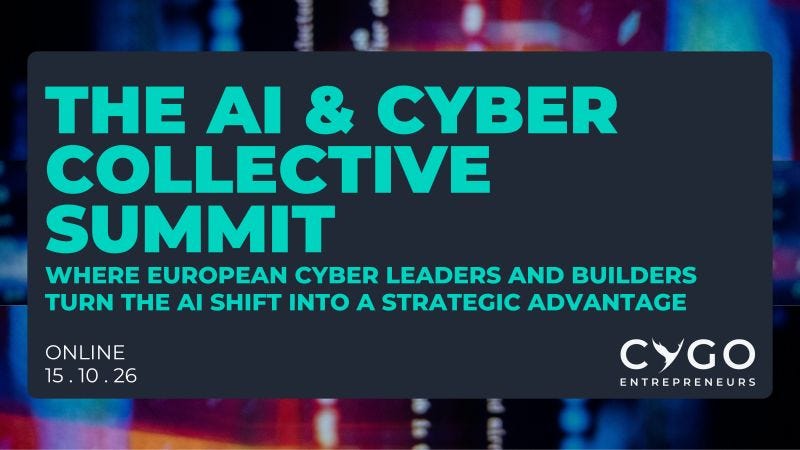
That is the conversation I will moderate on October 15 at the CyGO Entrepreneurs’ AI & Cyber Collective Summit: Europe 2031, “How do we secure cyber and technological independence?”
I’m bringing together three people who can examine the problem from different sides.
Cristina Caffarra 🇮🇹 (LinkedIn)— economics and demand. A competition economist, co-founder, and Chair of the EuroStack Foundation, Cristina challenges European buyers to turn interest in alternatives into committed demand. Her starting point: European components exist, but remain fragmented and too small. Boards have a role in changing that.
Nolwenn Le Ster 🇫🇷 (LinkedIn)— security operations and adoption. COO of Almond, former leader of Capgemini’s cybersecurity activities in France, and Chair of Numeum’s Cybersecurity Commission. Nolwenn brings the delivery perspective: making technologies work inside real organizations, building the teams, and coordinating an industry that needs to scale.
Malte Pollmann 🇩🇪 (LinkedIn) — building and investment. Malte served as CEO of Utimaco between 2011 and 2022. Today, he advises several funds on enterprise software and cybersecurity. He brings experience growing a European cyber company and assessing what makes the next investment credible.
Italy, France, Germany. An economist, a service company leader, a company builder. My goal is to connect their views on the decisions that help European suppliers grow.
A buyer can help by funding a deployment, signing a multi-year contract, providing engineering support, or giving a reference that opens new markets. Each step gives the supplier something real to build on.
Demand also needs a closer look. Where are European products ready to deliver? Where do they still lack capital, talent, certification, or maturity? Often, procurement wants more than investors are willing to fund before revenue comes in.
To close that gap, agree on what can improve during deployment. If integrations are missing, a funded engineering plan can help. But missing a key security requirement is a bigger problem. Contracts need to spell out responsibilities and risks.
Scaling up means looking beyond borders. Shared standards, joint purchasing, partnerships, and consolidation are all options. I want to see which of these will really help customers use European products and help suppliers reach more than one major client.
If you manage security operations, caution is your responsibility. You are accountable if a migration fails.
Pick a specific dependency: certificate management, identity, detection software, firewall and networks, software updates, or an AI service your team uses more and more. Identify who controls it, what it would take to change, and how it links to other systems. Set a practical six-month goal and a longer-term target.
Then weigh the risks. Moving brings integration and continuity challenges. Staying can mean facing new terms, limited access, or high exit costs.
A European address is not enough to prove control. You need proof of keys, data, maintenance, and supplier access, especially for critical infrastructure. Your systems must also stay interoperable.
Who owns that decision? The board needs to assign authority, budget, and accountability to someone, and define which dependencies are acceptable and which are not. Regulation cannot make these choices for your company.
The round table will focus on the practical conditions needed to remove barriers and help Europe’s future cybersecurity champions emerge:
-
Which technological dependencies should Europe address first?
-
What can organizations shift now, layer by layer, while managing operational risk?
-
How can European buyers create enough demand for credible alternatives to scale?
-
What must change in procurement, investment, and integration?
-
Where must technological control become non-negotiable?
This discussion is for the boards, CISOs, service providers, founders, and investors who make these decisions. I will ask for real examples and practical first steps: actions you can decide, test, or fund soon.
October 15, 2026 · 10:45–11:20 CEST · Online · In English
You know I am passionate about these topics, and we are shaking up our ecosystems and networks to drive change.
If you are leading security at your organization, consider your next purchase or renewal. What would it take to give a credible European alternative a real chance? Reply with the obstacle you face. I want to bring those realities into the discussion.
Invite the person responsible for that purchasing decision.
Laurent 💚
