
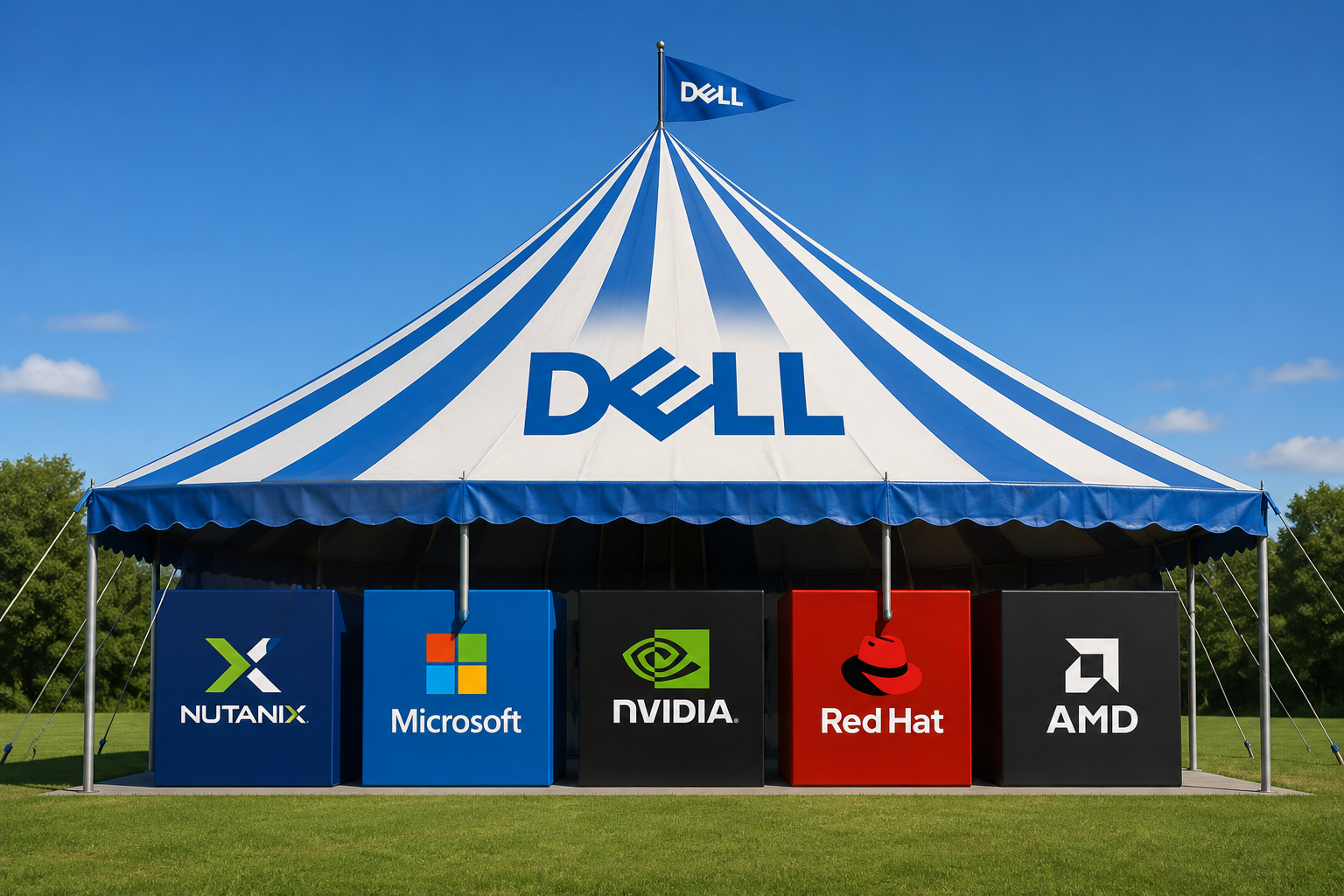
A significant reorganization is currently taking place within the enterprise infrastructure market, which means that Dell Technologies Inc. will play a prominent role in the outcome. To be successful, however, Dell must continue to expand its “big tent” of collaborators.
Dell has made strategic partnerships a central part of its enterprise AI approach, forming key alliances with chipmakers, virtualization leaders, cloud providers, and a host of leading software platforms. As theCUBE Research analysts have recently documented, AI has fostered the need for a platform that makes compute, storage, networking, and workloads work cohesively across hybrid and multicloud worlds.
Dell’s partnership activity over the past two years demonstrates why this will be crucial, and its collaboration with Nutanix Inc., rather than VMware, to deliver turnkey, scalable systems for virtualized workloads, private clouds, and hybrid cloud environments, is just one example of the shifting dynamic taking place.
“This is the first infrastructure disruption in which displacing the virtualization layer unlocks a full-stack reconsideration of compute, storage, networking, and management,” noted theCUBE Research’s John Furrier. “The Dell [Nutanix] XC partnership momentum is the clearest public signal: When an OEM of Dell’s scale accelerates a competing virtualization platform, the market has moved.”
This feature is part of SiliconANGLE Media’s exploration of the architectural shifts powering continuous, production-grade AI. Be sure to check out SiliconANGLE’s extensive coverage of Dell Technologies World, May 18–20, featuring interviews with Dell executives and other industry leaders. (* Disclosure below.)
Nutanix enterprise infrastructure deployment
The extensive partnership between Dell and Nutanix offers the capability to scale compute and storage separately in hyperconverged infrastructure. This has become an important consideration as AI applications command IT resources and a larger share of computing budgets.
The release of Dell’s PowerEdge XC Plus and the integration of PowerFlex software-defined storage into the Nutanix stack marked a key step forward for Dell and Nutanix in the hybrid cloud market. From Dell’s perspective, this is about providing joint customers with hypervisor and performance options at scale, according to Travis Vigil, senior vice president of product management at Dell, in an exclusive interview with theCUBE, SiliconANGLE Media’s livestreaming studio.
“From our perspective, customers need a modern data center that’s smart, flexible and resilient,” said Vigil. “Those last two, flexibility and resiliency, are top of mind for us at Dell Technologies, because we’re continuing to build out a virtualization portfolio that offers customers choice. Dell PowerFlex with Nutanix Cloud Platform … provides customers with a flexible approach that includes bare metal, hypervisors, Kubernetes distributions and more.”
In February, Dell expanded its Private Cloud offering to support Nutanix deployments, offering customers additional flexibility and workload suitability without having to commit to one virtualization stack. The move highlighted how IT executives are continuing to prioritize maximum flexibility for infrastructure to meet application needs.
Powering the AI Factory with Nvidia
Dell’s partnership with Nvidia Corp. runs deep, as evidenced by the presence of Nvidia CEO Jensen Huang on the agenda as a keynote speaker at Dell Technologies World in Las Vegas this month. The Dell AI Factory with Nvidia, unveiled in 2024, has been a key driver of AI initiatives for both of the tech giants.
The AI Factory combines Dell’s server and data storage infrastructure with Nvidia’s latest AI chips to create end-to-end solutions, and over 4,000 customers are already deploying these systems. One of the components of the AI Factory with Nvidia is the Dell Lightning File System, a high-performance parallel architecture, formerly known as Project Lightning, for the large-scale data throughput demands of AI model training and inference.
Lightning and its integration with the Dell/Nvidia AI Factory are an example of how the partner ecosystem is shifting to meet the new realities of AI processing, according to theCUBE Research’s Dave Vellante.
“If the system is going to run at AI-factory speeds, the old approach of routing data movement and I/O orchestration through the CPU becomes a bottleneck,” Vellante noted. “The new architecture normalizes things like RDMA and direct communication, so the system doesn’t have to bounce through traditional chokepoints. This is why you see Vast, DDN, Weka and other high-performance-computing-native players well positioned in the middle of the conversation – and why incumbents such as Dell Technologies are moving with things such as Project Lightning.”
AMD supports PowerEdge deployment
Despite Dell’s close ties with Nvidia, there are other chipmakers who have formed meaningful alliances with the infrastructure giant. One of these is Advanced Micro Devices Inc., which has collaborated with Dell for over 20 years, focusing on the PowerEdge server portfolio to support larger AI workloads.
Near the end of 2024, AMD announced the integration of fifth-generation Turin processor technology in PowerEdge with PCIe Multi-Segment for scalability, and 12-channel DDR5 memory to handle data-heavy applications. Joint engineering between Dell and AMD’s EPYC processor line team has allowed customers to expand server output in virtualized environments and reduce infrastructure sprawl.
“When we look into what we are offering between Dell PowerEdge and our AMD EPYC portfolio, basically we are getting that customers are able to run a larger number of virtual machines per server versus what they used to do in the past,” according to Juan Martinez, senior director of OEM/ODM enterprise and HPC at AMD, during an interview with theCUBE. “They are able to get up to 192 cores of performance, high memory bandwidth, and on top of that, we are able to bring a comprehensive path for migration.”
Dell has continued to pursue its work with AMD to help organizations scale from pilot AI solutions to full production. Earlier this month, Dell announced that its PowerEdge servers will support AMD Instinct MI350P PCIe GPUs. Both firms are targeting enterprises that want predictable performance at scale for continuous AI workloads.
Integration of PowerStore with Microsoft Azure
Dell’s evolving relationship with Microsoft Corp. has centered on an ability to translate the software giant’s platform vision into fully-deployed enterprise architecture. Two areas where this is most apparent involve Dell PowerStore and PowerScale.
The integration of Dell PowerStore into Azure Local, rebranded from Microsoft’s Azure Stack HCI, enables customers to adopt a hybrid cloud solution without the need to purchase new hardware. Compute and storage can be scaled independently, with PowerStore bringing the advantage of advanced data efficiency, which can lower storage costs without impacting performance.
Dell PowerScale for Microsoft Azure is a packaged solution that brings Dell’s unstructured data product, OneFS, into the cloud platform, enabling customers to provision Dell’s file storage directly from the Azure portal. The complexity of operational silos is reduced by delivering a single, unified user experience across the Azure data and on-premises environments.
“The Dell + Microsoft ecosystem, from Azure Local to PowerScale running natively as an Azure service, is becoming essential to delivering AI where customers actually are,” said Rob Strechay, principal analyst at theCUBE Research. “These partnerships aren’t peripheral; they’re becoming the delivery mechanism for real-world AI outcomes in hybrid and multicloud environments.”
Capitalizing on Red Hat OpenShift
Another example of how Dell’s partnerships are enabling AI in hybrid and multicloud environments can be found in its relationship with Red Hat Inc. The two companies have approached the integration of containers, AI workloads and virtualization with solutions that prioritize simplicity and consistency.
The Dell APEX Cloud Platform for Red Hat OpenShift is a jointly engineered solution to run containerized applications and virtual machines on premises. The unification of Dell’s scalable infrastructure with OpenShift simplifies the process of managing hardware and Kubernetes clusters from a single console.
“We’ve been doing business with Red Hat for 25 years,” Travis Zhao, director of product management at Dell, explained during an interview with theCUBE. “We decided to go deeper with the relationship. We jointly created a product that is really about taking OpenShift container orchestration platforms on Dell infrastructure and putting them in an easier-to-consume and easy-to-run package. We allow customers to purchase it very easily, support it from one single point of support and provide all the automation for the full stack.”
Zhao’s point around the full stack captures the significance behind the replatforming shift described by theCUBE Research’s Furrier. The emerging organizing principle is the unified control plane: the software layer that abstracts compute, storage, networking, and AI workloads across hybrid and multicloud environments. The goal is to create a platform that makes everything work together, and this will take the kind of ecosystem that Dell is developing through a range of partnerships and alliances.
“No single vendor owns the full stack — and the era of pretending otherwise has ended,” Furrier said. “The new platform model is loosely coupled technically, commercially aligned through joint go-to-market motions and operationally unified at the customer experience layer. This is a harder model to execute than a vertically integrated stack — but it is also harder to displace. Ecosystem depth is the new defensibility.”
(* Disclosure: TheCUBE is a paid media partner for Dell Technologies World 2026. Sponsors of theCUBE’s event coverage do not have editorial control over content on theCUBE or SiliconANGLE.)
Image: SiliconANGLE/ChatGPT
Support our mission to keep content open and free by engaging with theCUBE community. Join theCUBE’s Alumni Trust Network, where technology leaders connect, share intelligence and create opportunities.
- 15M+ viewers of theCUBE videos, powering conversations across AI, cloud, cybersecurity and more
- 11.4k+ theCUBE alumni — Connect with more than 11,400 tech and business leaders shaping the future through a unique trusted-based network.
About SiliconANGLE Media
Founded by tech visionaries John Furrier and Dave Vellante, SiliconANGLE Media has built a dynamic ecosystem of industry-leading digital media brands that reach 15+ million elite tech professionals. Our new proprietary theCUBE AI Video Cloud is breaking ground in audience interaction, leveraging theCUBEai.com neural network to help technology companies make data-driven decisions and stay at the forefront of industry conversations.
