

Stanford University researchers today released their highly anticipated 2026 AI Index Report, revealing a global landscape where artificial intelligence technology is being adopted at record-breaking pace, even as public trust in AI oversight and transparency hits new lows.
The report by the Stanford Institute for Human-Centered Artificial Intelligence, known as Stanford HAI, is now into its ninth year. It’s a comprehensive annual study that tracks the dizzying evolution of the AI industry, documenting a world in which America’s lead over Chinese innovation has all but evaporated, and where the technology is already reshaping global workforces and changing the course of scientific discovery.
The race for global dominance
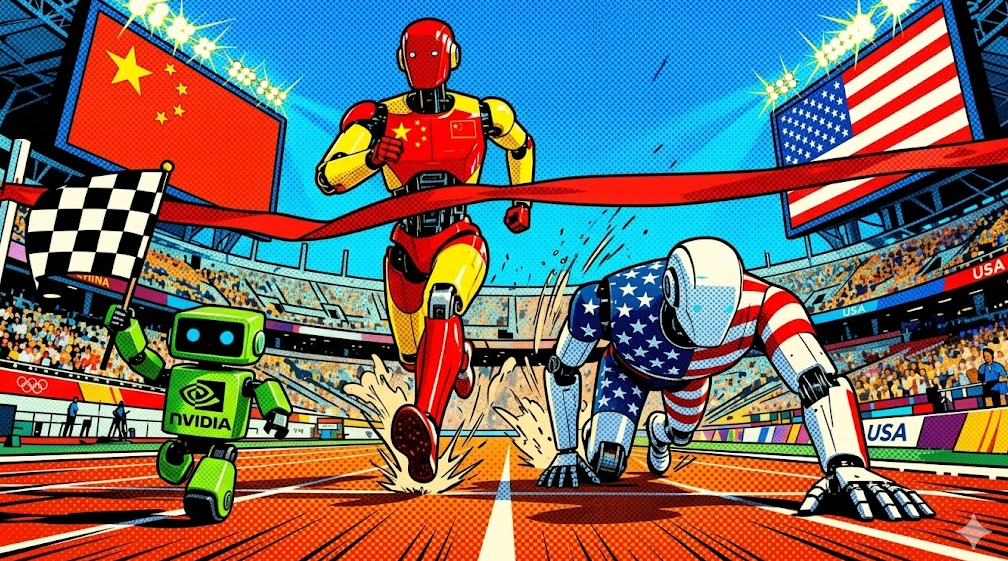
One of the most striking – and potentially concerning – takeaways from this year’s report is the way China has reportedly erased the AI performance gap between itself and the U.S. In previous year’s reports, the U.S. had always held a solid lead over Chinese innovators, but now the countries are neck-and-neck, with U.S. and Chinese models constantly trading places at the top of benchmarks ranking AI performance.
Although the U.S. maintains a significant edge in terms of capital, infrastructure buildout and AI chips, China now holds sway in other key areas, such as patents, publications and autonomous robotics development, also known as “physical AI.”
However, the report notes that it’s no longer a two-horse race, with other nations also striving to be seen as “AI superpowers.” These include South Korea, which has emerged as the world’s leader in terms of “innovation density,” filing more patents per capita than any other country.
As these countries all scramble for AI supremacy, the issue of “sovereignty” has become a top policy priority for many governments. A number of European and Central Asian countries have invested significantly in their AI infrastructure over the last year, bringing the number of nations with “state-backed supercomputing clusters” to 44.
However, the push for sovereign AI is not universal. South American and Middle Eastern nations lag far behind. According to Stanford’s researchers, this could lead to a new kind of “digital divide,” where those nations that struggle to shape AI development are less likely to see the economic benefits.
Growing corporate influence as transparency erodes
More than 90% of all notable AI models are now created by private companies, and Stanford’s researchers warn that this is leading to less transparency than before. Concerns about AI “black boxes” are nothing new, but the most powerful new models being released today are even more mysterious than their predecessors.
According to the report, AI leaders including Google LLC, Anthropic PBC and OpenAI Group PBC have all abandoned the practice of disclosing their latest model’s dataset sizes and training duration. Moreover, 80 of the 95 most notable models launched last year were released without their training code.
Meanwhile, these leading AI companies are now trying to flex their political muscles. AI industry representatives have become pervasive in AI congressional hearings, with their share of witnesses tripling since 2017, while the presence of neutral academics has plummeted.
This shift, perhaps unsurprisingly, comes at a time when public trust in AI hits a new low. The report found that just 31% of U.S. citizens now trust their government to regulate AI properly, which was the lowest score of all surveyed nations except China, where just 27% of people trust their government. EU citizens remain much more confident, with 53% of people voicing confidence.
There are also concerns about hardware supply chains, with almost the entire global AI industry still being dependent on a single chipmaking foundry operated by Taiwan Semiconductor Manufacturing Co. in Taiwan.
Adoption explodes, but friction ignites
The adoption of generative AI has grown faster than any other technology in history, the report found. Some 53% of the world’s population now uses it regularly, outpacing the pace of innovations such as personal computers, the internet and smartphones. But opinions of the technology are mixed, with 59% saying it provides more benefits than drawbacks, and 52% saying it makes them nervous.
Of concern, perhaps, is that while the U.S. leads in AI development, it only ranks 24th globally in terms of adoption, with just 28.3% of Americans using generative AI regularly. That compares with China, Malaysia, Thailand, Indonesia and Singapore, where more than 80% of people expect AI to have a profound impact on their lives within the next three to five years.
The economic impact of AI is staggering too: Since 2013, corporate investment has increased by 40-fold, while the consumer surplus associated with generative AI in the U.S. rose to $172 billion this year.
Another highlight of the report is the growing “vibe shift” between experts and the general public. While 73% of AI experts are optimistic about the technology’s impact on jobs, just 23% of the public shares that belief. The skepticism of average citizens does seem justified, though, as the report notes that employment among younger workers in “AI-exposed fields” has already started to decline.
In addition, the report touches on the physical costs of AI’s incredible growth. The industry’s energy and water demands are becoming worryingly excessive. For instance, xAI Corp. is estimated to have created more than 72,000 tons of CO2 just to train its latest model, Grok 4. Meanwhile, the amount of water required for GPT-4o inference workloads is said to be enough to sustain 12 million people.
Finally, there are concerns about AI’s impact on science, particularly in terms of its scope. Though AI tools have helped to make individual scientists three times more productive, this appears to be happening at the expense of the scope of AI research, which increasingly favors data-rich topics, meaning less diversity than before.
Image: SiliconANGLE/Gemini
Support our mission to keep content open and free by engaging with theCUBE community. Join theCUBE’s Alumni Trust Network, where technology leaders connect, share intelligence and create opportunities.
- 15M+ viewers of theCUBE videos, powering conversations across AI, cloud, cybersecurity and more
- 11.4k+ theCUBE alumni — Connect with more than 11,400 tech and business leaders shaping the future through a unique trusted-based network.
About SiliconANGLE Media
Founded by tech visionaries John Furrier and Dave Vellante, SiliconANGLE Media has built a dynamic ecosystem of industry-leading digital media brands that reach 15+ million elite tech professionals. Our new proprietary theCUBE AI Video Cloud is breaking ground in audience interaction, leveraging theCUBEai.com neural network to help technology companies make data-driven decisions and stay at the forefront of industry conversations.
