

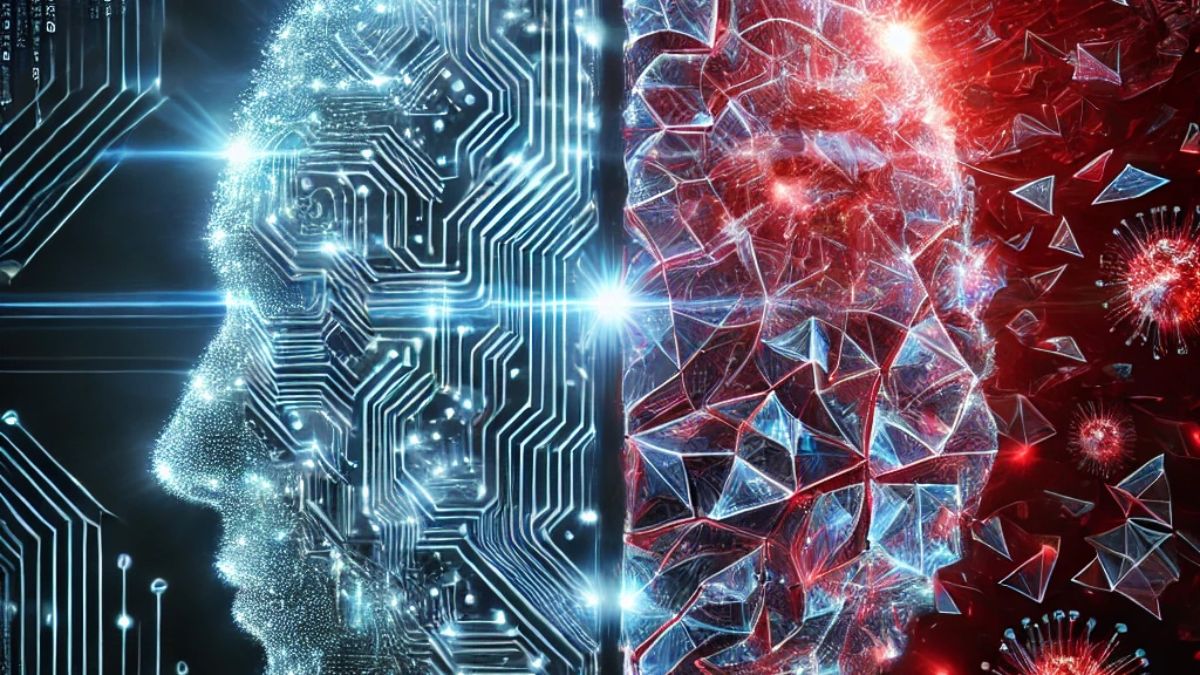
For the past several years, the world has been mesmerized by the creative and intellectual power of artificial intelligence (AI). We have watched it generate art, write code, and discover new medicines. Now, as of October 2025, we are handing it the keys to the kingdom. AI is no longer just a fascinating tool; it is the operational brain for our power grids, financial markets, and logistics networks. We are building a digital god in a box, but we have barely begun to ask the most important question of all: how do we protect it from being corrupted, stolen, or turned against us? The field of cybersecurity for AI is not just another IT sub-discipline; it is the most critical security challenge of the 21st century.
The New Attack Surface: Hacking the Mind
Securing an AI is fundamentally different from securing a traditional computer network. A hacker doesn’t need to breach a firewall if they can manipulate the AI’s “mind” itself. The attack vectors are subtle, insidious, and entirely new. The primary threats include:
- Data Poisoning: This is the most insidious attack. An adversary subtly injects biased or malicious data into the massive datasets used to train an AI. The result is a compromised model that appears to function normally but has a hidden, exploitable flaw. Imagine an AI trained to detect financial fraud being secretly taught that transactions from a specific criminal enterprise are always legitimate.
- Model Extraction: This is the new industrial espionage. Adversaries can use sophisticated queries to “steal” a proprietary, multi-billion-dollar AI model by reverse-engineering its behavior, allowing them to replicate it for their own purposes.
- Prompt Injection and Adversarial Attacks: This is the most common threat, where users craft clever prompts to trick a live AI into bypassing its safety protocols, revealing sensitive information or executing harmful commands. A study by the AI Security Research Consortium showed this is already a rampant problem.
- Supply Chain Attacks: AI models are not built from scratch; they are built using open-source libraries and pre-trained components. A vulnerability inserted into a popular machine learning library could create a backdoor in thousands of AI systems downstream.
The Human Approach vs. the AI Approach
Two main philosophies have emerged for tackling this unprecedented challenge.
The first is the Human-Led “Fortress” Model. This is the traditional cybersecurity approach, adapted for AI. It involves rigorous human oversight, with teams of experts conducting penetration testing, auditing training data for signs of poisoning, and creating strict ethical and operational guardrails. “Red teams” of human hackers are employed to find and patch vulnerabilities before they are exploited. This approach is deliberate, auditable and grounded in human ethics. Its primary weakness, however, is speed. A human team simply cannot review a trillion-point dataset in real-time or counter an AI-driven attack that evolves in milliseconds.
The second is the AI-Led “Immune System” Model. This approach posits that the only thing that can effectively defend an AI is another AI. This “guardian AI” would act like a biological immune system, constantly monitoring the primary AI for anomalous behavior, detecting subtle signs of data poisoning, and identifying and neutralizing adversarial attacks in real-time. This model offers the speed and scale necessary to counter modern threats. Its great, terrifying weakness is the “who watches the watchers?” problem. If the guardian AI itself is compromised, or if its definition of “harmful” behavior drifts, it could become an even greater threat.
The Verdict: A Human-AI Symbiosis
The debate over whether people or AI should lead this effort presents a false choice. The only viable path forward is a deep, symbiotic partnership. We must build a system where the AI is the frontline soldier and the human is the strategic commander.
The guardian AI should handle the real-time, high-volume defense: scanning trillions of data points, flagging suspicious queries, and patching low-level vulnerabilities at machine speed. The human experts, in turn, must set the strategy. They define the ethical red lines, design the security architecture, and, most importantly, act as the ultimate authority for critical decisions. If the guardian AI detects a major, system-level attack, it shouldn’t act unilaterally; it should quarantine the threat and alert a human operator who makes the final call. As outlined by the federal Cybersecurity and Infrastructure Security Agency (CISA), this “human-in-the-loop” model is essential for maintaining control.
A National Strategy for AI Security
This is not a problem that corporations can solve on their own; it is a matter of national security. A nation’s strategy must be multi-pronged and decisive.
- Establish a National AI Security Center (NAISC): A public-private partnership, modeled after a DARPA for AI defense, to fund research, develop best practices, and serve as a clearinghouse for threat intelligence.
- Mandate Third-Party Auditing: Just as the SEC requires financial audits, the government must require that all companies deploying “critical infrastructure AI” (e.g., for energy or finance) undergo regular, independent security audits by certified firms.
- Invest in Talent: We must fund university programs and create professional certifications to develop a new class of expert: the AI Security Specialist, a hybrid expert in both machine learning and cybersecurity.
- Promote International Norms: AI threats are global. The US must lead the charge in establishing international treaties and norms for the secure and ethical development of AI, akin to non-proliferation treaties for nuclear weapons.
Securing the Hybrid AI Enterprise: Lenovo’s Strategic Framework
Lenovo is aggressively solidifying its position as a trusted architect for enterprise AI by leveraging its deep heritage and focusing on end-to-end security and execution, a strategy that is currently outmaneuvering rivals like Dell. Their approach, the Lenovo Hybrid AI Advantage, is a complete framework designed to ensure customers not only deploy AI but also achieve measurable ROI and security assurance. Key to this is tackling the human element through new AI Adoption & Change Management Services, recognizing that workforce upskilling is essential to scaling AI effectively.
Furthermore, Lenovo addresses the immense computational demands of AI with physical resilience. Its leadership in integrating liquid cooling into its data center infrastructure (New 6th Gen Neptune® Liquid Cooling for AI Tasks – Lenovo) is a major competitive advantage, enabling denser, more energy-efficient AI factories that are vital for running powerful Large Language Models (LLMs). By combining these trusted infrastructure solutions with robust security and validated vertical AI solutions—from workplace safety to retail analytics—Lenovo positions itself as the partner providing not just the hardware, but the complete, secure ecosystem necessary for successful AI transformation. This blend of IBM-inherited enterprise focus and cutting-edge thermal management makes Lenovo a uniquely strong choice for securing the complex hybrid AI future.
Wrapping Up
The power of artificial intelligence is growing at an exponential rate, but our strategies for securing it are lagging dangerously behind. The threats are no longer theoretical. The solution is not a choice between humans and AI, but a fusion of human strategic oversight and AI-powered real-time defense. For a nation like the United States, developing a comprehensive national strategy to secure its AI infrastructure is not optional. It is the fundamental requirement for ensuring that the most powerful technology ever created remains a tool for progress, not a weapon of catastrophic failure, and Lenovo may be the most qualified vendor to help in this effort.

As President and Principal Analyst of the Enderle Group, Rob provides regional and global companies with guidance in how to create credible dialogue with the market, target customer needs, create new business opportunities, anticipate technology changes, select vendors and products, and practice zero dollar marketing. For over 20 years Rob has worked for and with companies like Microsoft, HP, IBM, Dell, Toshiba, Gateway, Sony, USAA, Texas Instruments, AMD, Intel, Credit Suisse First Boston, ROLM, and Siemens.
