
Close Menu

    Subscribe to Updates

    Get the latest creative news from infofortech

    What's Hot

    Boox’s new Go E Ink tablet includes a 10-inch display and runs Android 15

    March 17, 2026

    Instagram Users Urged to Save Encrypted DMs Before Feature Disappears

    March 17, 2026

    File Your Taxes With TurboTax Full Service Now Before Prices Go Up

    March 17, 2026
    Facebook X (Twitter) Instagram
    InfoForTech
    • Home
    • Latest in Tech
    • Artificial Intelligence
    • Cybersecurity
    • Innovation
    Facebook X (Twitter) Instagram
    InfoForTech
    Home»Artificial Intelligence»Artificial neuron brings robots closer to human-like awareness
    Artificial Intelligence

    Artificial neuron brings robots closer to human-like awareness

    InfoForTechBy InfoForTechJanuary 26, 2026No Comments3 Mins Read
    Facebook Twitter Pinterest Telegram LinkedIn Tumblr WhatsApp Email
    Artificial neuron brings robots closer to human-like awareness
    Share
    Facebook Twitter LinkedIn Pinterest Telegram Email


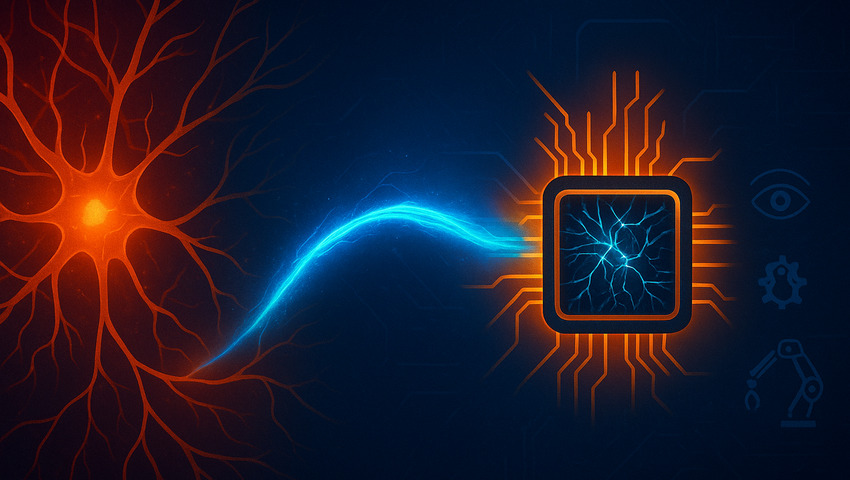
    In a significant advancement toward human-like intelligence in machines, scientists have engineered a single artificial neuron capable of performing the functions of multiple brain regions. This development could enable robots to perceive, learn, and act with adaptability and responsiveness previously thought exclusive to living brains.

    The device, dubbed a transneuron, can switch roles between brain cells involved in vision, planning, and movement. Developed by an international team led by Loughborough University, with collaborators from the Salk Institute and the University of Southern California, the transneuron represents a major leap for neuromorphic computing – technology designed to replicate the brain’s efficiency and flexibility in hardware.

    Traditional artificial neurons typically perform a single, narrowly defined function, requiring large networks to handle even basic tasks. The new transneuron breaks that limitation.

    By finely adjusting its electrical settings, a single unit can reproduce neural firing patterns from three distinct brain regions, achieving 70-100% accuracy. These ranged from steady pulses to rapid bursts, closely mirroring the variability of biological neurons.

    Beyond mimicking neural activity, the transneuron performs core computational functions. The device changes its firing rate based on input signals and responds differently when two signals arrive together versus out of sync – an ability known as temporal coding. Typically, replicating this requires multiple artificial neurons working in tandem.

    This capability is made possible by a nanoscale component called a memristor. Silver atoms within the memristor shift as electricity flows, forming and breaking conductive bridges that allow the device to retain memory of past signals and adapt its response, similar to synaptic plasticity in the brain. Changes in voltage, resistance, or temperature further tune the neuron’s behavior without software intervention.

    The next step involves integrating networks of transneurons to create a “brain cortex on a chip.” Such systems could form the foundation of artificial nervous systems for robots, enabling real-time perception, adaptation, and learning. These networks promise continuous, energy-efficient learning and dynamic responses, overcoming limitations of current AI systems.

    The technology could eventually interface directly with the human nervous system, offering new tools for studying neural communication, treating neurological disorders, or even augmenting brain function. Transneurons could serve as experimental platforms to study neural communication or explore the emergence of consciousness in controlled environments.

    Published research signals a shift in artificial intelligence from software that simulates brain function to hardware that behaves like it. With its ability to adapt, compute, and switch roles on demand, the transneuron may become a building block for future self-learning robots and next-generation computing systems that operate with the efficiency and flexibility of biological brains.

    Share. Facebook Twitter Pinterest LinkedIn Tumblr Email
    InfoForTech
    • Website

    Related Posts

    Clarifai Reasoning Engine Achieves 414 Tokens Per Second on Kimi K2.5

    March 16, 2026

    Influencer Marketing in Numbers: Key Stats

    March 16, 2026

    Tremble Chatbot App Access, Costs, and Feature Insights

    March 15, 2026

    U.S. Holds Off on New AI Chip Export Rules in Surprise Move in Tech Export Wars

    March 14, 2026

    How Joseph Paradiso’s sensing innovations bridge the arts, medicine, and ecology | MIT News

    March 14, 2026

    A better method for planning complex visual tasks | MIT News

    March 14, 2026
    Leave A Reply Cancel Reply

    Advertisement
    Top Posts

    How a Chinese AI Firm Quietly Pulled Off a Hardware Power Move

    January 15, 20268 Views

    The World’s Heart Beats in Bytes — Why Europe Needs Better Tech Cardio

    January 15, 20265 Views

    HHS Is Using AI Tools From Palantir to Target ‘DEI’ and ‘Gender Ideology’ in Grants

    February 2, 20264 Views

    Rising Digital Financial Fraud in South Africa

    January 15, 20264 Views
    Stay In Touch
    • Facebook
    • Twitter
    • Pinterest
    • Instagram
    • YouTube
    • Vimeo
    Advertisement
    About Us
    About Us

    Our mission is to deliver clear, reliable, and up-to-date information about the technologies shaping the modern world. We focus on breaking down complex topics into easy-to-understand insights for professionals, enthusiasts, and everyday readers alike.

    We're accepting new partnerships right now.

    Facebook X (Twitter) YouTube
    Most Popular

    How a Chinese AI Firm Quietly Pulled Off a Hardware Power Move

    January 15, 20268 Views

    The World’s Heart Beats in Bytes — Why Europe Needs Better Tech Cardio

    January 15, 20265 Views

    HHS Is Using AI Tools From Palantir to Target ‘DEI’ and ‘Gender Ideology’ in Grants

    February 2, 20264 Views
    Categories
    • Artificial Intelligence
    • Cybersecurity
    • Innovation
    • Latest in Tech
    © 2026 All Rights Reserved InfoForTech.
    • Home
    • About Us
    • Contact Us
    • Privacy Policy

    Type above and press Enter to search. Press Esc to cancel.

    Ad Blocker Enabled!
    Ad Blocker Enabled!
    Our website is made possible by displaying online advertisements to our visitors. Please support us by disabling your Ad Blocker.