

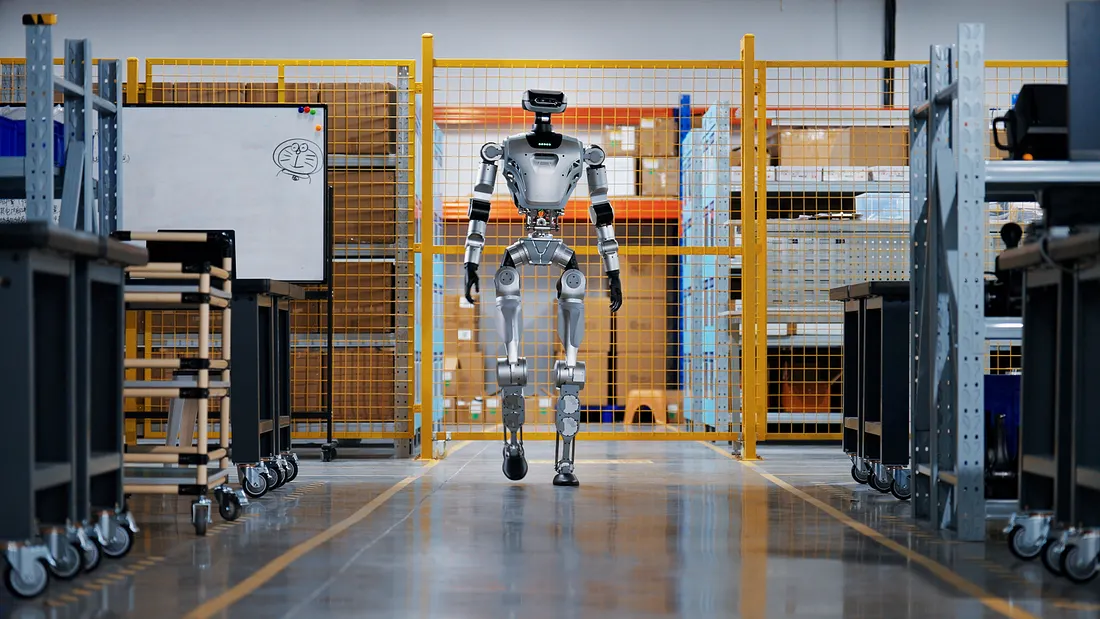
LimX Dynamics Inc., a Chinese artificial intelligence autonomous humanoid robotics company, today announced it has raised about $200 million in early-stage funding to showcase embodied intelligence for robots.
Institutional investors involved in the Series B round included UAE-based Stone Venture, Oriental Fortune Capital and Shenzhen Co-Stone Asset Management, among many. Industrial investors included JD.com, Zhongding Sealing, NRB Corp. and Kyland.
LimX builds autonomous general-purpose legged robots, including humanoids and quadrupeds. The company is working on what is called “embodied intelligence,” a type of artificial intelligence that brings interaction-based learning to AI, where gathering movement and information data from the environment improves future performance. This is part of physical AI, where AI models are combined with machines that adapt to the real world.
To bring its robots to life, LimX brings together both hardware and software. Its software platform is called COSA, or Cognitive OS of Agents, a physical-world-native agentic operating system that provides the “brain” for robots along with whole-body motion control for humanoid robots. Combined with a hardware platform called Tron 2, which is a modular system of limbs and a torso, builders can create humanoid robots for various tasks.
LimX likened COSA to the “cerebellum” controlling the central nervous system, integrating low-level models managing complex physics to create fluid movement. This helps eliminate jerky movements and hesitation.
The company’s humanoid robot is called Oli. It stands 165 centimeters tall and weighs 55 kilograms. It can walk over obstacles, navigate fairly complex terrain, identify and pick up fairly small objects, including tennis balls. Although its motions do seem a little uncanny from demonstrations, it’s surprisingly nimble compared with many other robots on the market.
It should be noted that the “demonstration” above is staged, and a bit smoothed, and it’s an office environment where there’s very little chaos. However, it is a very good example of how well many of these companies have delivered on this technology. Another demonstration does a better job of showing the rough edges, displaying how COSA and the hardware platform must work around the limitations when picking up tennis balls.
According to LimX, COSA and the Tron 2 platform permit building varied robotic designs to tackle numerous modular assemblies for office and industrial projects, including dual-arm, bipedal and wheeled-biped configurations.
This allows companies to choose what configuration to address task-specific needs. For example, permitting them to quickly prepare builds for inspection, warehouse, palletizers, hazardous work or domestic and office work.
Image: LimX Dynamics
Support our mission to keep content open and free by engaging with theCUBE community. Join theCUBE’s Alumni Trust Network, where technology leaders connect, share intelligence and create opportunities.
- 15M+ viewers of theCUBE videos, powering conversations across AI, cloud, cybersecurity and more
- 11.4k+ theCUBE alumni — Connect with more than 11,400 tech and business leaders shaping the future through a unique trusted-based network.
About SiliconANGLE Media
Founded by tech visionaries John Furrier and Dave Vellante, SiliconANGLE Media has built a dynamic ecosystem of industry-leading digital media brands that reach 15+ million elite tech professionals. Our new proprietary theCUBE AI Video Cloud is breaking ground in audience interaction, leveraging theCUBEai.com neural network to help technology companies make data-driven decisions and stay at the forefront of industry conversations.
