

How to Access Ministral 3 via API
TL;DR
Ministral 3 is a family of open-weight, reasoning-optimized models available in both 3B and 14B variants. The models support multimodal reasoning, native function and tool calling, and a huge 256K token context window, all released under an Apache 2.0 license.
You can run Ministral 3 directly on Clarifai using the Playground for interactive testing or integrate it into your applications through Clarifai’s OpenAI-compatible API.
This guide explains the Ministral 3 architecture, how to access it through Clarifai, and how to choose the right variant for your production workloads.
Introduction
Modern AI applications increasingly depend on models that can reason reliably, maintain long context, and integrate cleanly into existing tools and APIs. While closed-source models have historically led in these capabilities, open-source alternatives are rapidly closing the gap.
Among globally available open models, Ministral 3 ranks alongside DeepSeek and the GPT OSS family at the top tier. Rather than targeting leaderboard performance on benchmarks, Ministral prioritises performances that matter in production, such as generating structured outputs, processing large documents, and executing function calls within live systems.
This makes Ministral 3 well-suited for the demands of real enterprise applications, as organisations are increasingly adopting open-weight models for their transparency, deployment flexibility, and ability to run across diverse infrastructure setups, from cloud platforms to on-premise systems.
Ministral 3 Architecture
Ministral 3 is a family of dense, edge-optimised multimodal models designed for efficient reasoning, long-context processing, and local or private deployment. The family currently includes 3B and 14B parameter models, each available in base, instruct, and reasoning variants.
Ministral 3 14B
The largest model in the Ministral family is a dense, reasoning-post-trained architecture optimised for math, coding, STEM, and other multi-step reasoning tasks. It combines a ~13.5B-parameter language model with a ~0.4B-parameter vision encoder, enabling native text and image understanding. The 14B reasoning variant achieves 85% accuracy on AIME ’25, delivering state-of-the-art performance within its weight class while remaining deployable on realistic hardware. It supports context windows of up to 256k tokens, making it suitable for long documents and complex reasoning workflows.
Ministral 3 3B
The 3B model is a compact, reasoning-post-trained variant designed for highly efficient deployment. It pairs a ~3.4B-parameter language model with a ~0.4B-parameter vision encoder (~4B total parameters), providing multimodal capabilities. Like the 14B model, it supports 256k-token context lengths, enabling long-context reasoning and document analysis on constrained hardware.
Key Technical Features
- Multimodal Capabilities: All Ministral 3 models use a hybrid language-and-vision architecture, allowing them to process text and images simultaneously for tasks such as document understanding and visual reasoning.
- Long-Context Reasoning: Reasoning variants support up to 256k tokens, enabling extended conversations, large document ingestion, and multi-step analytical workflows.
- Efficient Inference: The models are optimised for edge and private deployments. The 14B model runs in BF16 on ~32 GB VRAM, while the 3B model runs in BF16 on ~16 GB VRAM, with quantised versions requiring significantly less memory.
- Agentic Workflows: Ministral 3 is designed to work well with structured outputs, function calling, and tool-use, making it suitable for automation and agent-based systems.
- License: All Ministral 3 variants are released under the Apache 2.0 license, enabling unrestricted commercial use, fine-tuning, and customisation.
Pretraining Benchmark Performance
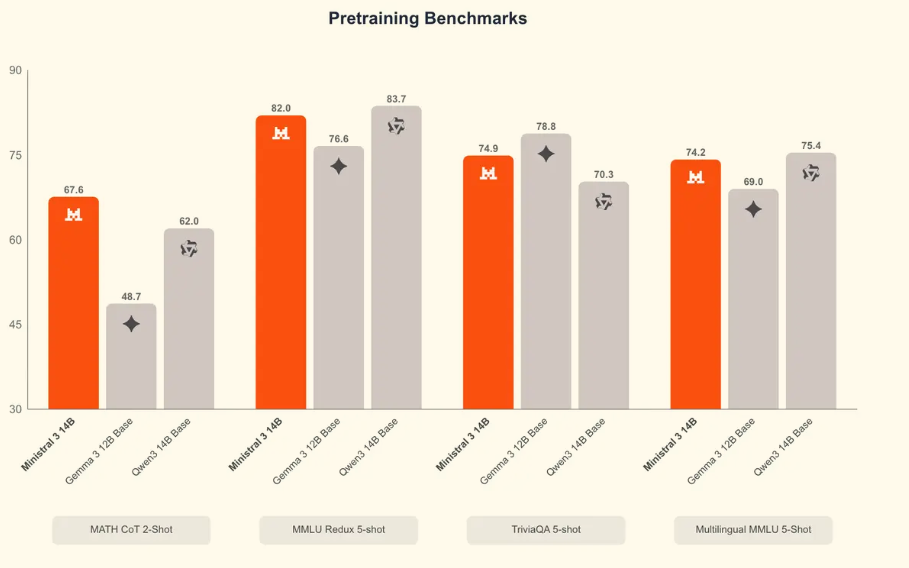
Ministral 3 14B demonstrates strong reasoning capabilities and multilingual performance compared to similarly sized open models, while maintaining competitive results on general knowledge tasks. It particularly excels in reasoning-heavy benchmarks and shows solid factual recall and multilingual understanding.
|
Benchmark |
Ministral 3 14B |
Gemma 3 12B Base |
Qwen3 14B Base |
Notes |
|
MATH CoT |
67.6 |
48.7 |
62.0 |
Strong lead on structured reasoning |
|
MMLU Redux |
82.0 |
76.6 |
83.7 |
Competitive general knowledge |
|
TriviaQA |
74.9 |
78.8 |
70.3 |
Solid factual recall |
|
Multilingual MMLU |
74.2 |
69.0 |
75.4 |
Strong multilingual performance |
Accessing Ministral 3 via Clarifai
Prerequisites
Before runing Ministral 3 with the Clarifai API, you’ll need to complete a few basic setup steps:
- Clarifai Account: Create a Clarifai account to access hosted AI models and APIs.
- Personal Access Token (PAT): All API requests require a Personal Access Token. You can generate or copy one from the Settings > Secrets section of your Clarifai dashboard.
For additional SDKs and setup guidance, refer to the Clarifai Quickstart documentation.
Using the API
The examples below use Ministral-3-14B-Reasoning-2512, the largest model in the Ministral 3 family. It is optimised for multi-step reasoning, mathematical problem solving, and long-context workloads, making it well-suited for long-document useecases and agentic applications. Here’s how to make your first API call to the model using different methods.
Python (OpenAI-Compatible)
Python (Clarifai SDK)
You can also use the Clarifai Python SDK for inference with more control over generation settings. Here’s how to make a prediction and generate streaming output using the SDK:
Node.js (Clarifai SDK)
Here’s how to perform inference with the Node.js SDK:
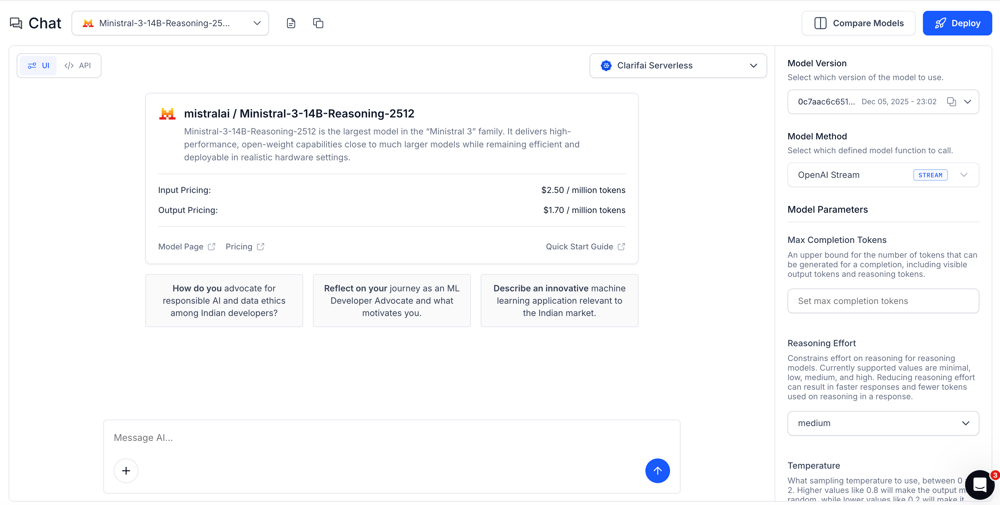
Playground
The Clarifai Playground lets you quickly experiment with prompts, structured outputs, reasoning workflows, and function calling without writing any code.
Visit the Playground and choose either:
- Ministral-3-3B-Reasoning‑2512
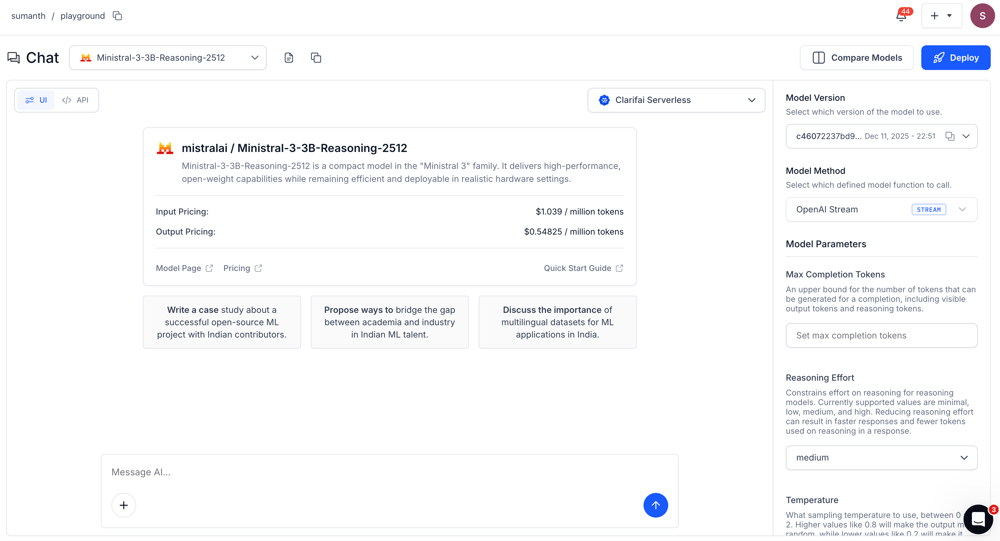
- Ministral-3-14B-Reasoning‑2512
Applications and Use Cases
Ministral 3 is designed for teams building intelligent systems that require strong reasoning, long-context understanding, and reliable structured outputs. It performs well across agentic, technical, multimodal, and business-critical workflows.
Agentic Application
Ministral 3 is well suited for AI agents that need to plan, reason, and act across multiple steps. It can orchestrate tools and APIs using structured JSON outputs, which makes it reliable for automation pipelines where consistency matters.
Long Context
Ministral 3 can analyze large documents using its extended 256K token context, making it effective for summarization, information extraction, and question answering over long technical texts.
Multimodal Reasoning
Ministral 3 supports multimodal reasoning, allowing applications to combine text and visual inputs in a single workflow. This makes it useful for image-based queries, document understanding, or assistants that need to reason over mixed inputs.
Conclusion
Ministral 3 provides reasoning-optimized, open-weight models that are ready for production use. With a 256K token context window, multimodal inputs, native tool calling, and OpenAI-compatible API access through Clarifai, it offers a practical foundation for building advanced AI systems.
The 3B variant is ideal for low-latency, cost-sensitive deployments, while the 14B variant supports deeper analytical workflows. Combined with Apache 2.0 licensing, Ministral 3 gives teams flexibility, performance, and long-term control.
To get started, explore the models in the Clarifai Playground or integrate them directly into your applications using the API.
