


Hello Cyber Builders 🖖
This week, I’m interrupting our series on AI and the 12 Cybersecurity Platforms to talk about something big — the latest release from Anthropic’s Frontier AI Labs, and how it signals a real shift in cybersecurity use cases.
Since 2022, the narrative surrounding AI and cybersecurity has largely been driven by fear: “AI will hack us,” “AI will outsmart humans,” “AI will take over our networks.”
This mindset is changing.
With Claude 4.5, Anthropic demonstrates that AI labs are finally taking enterprise-grade defense seriously. The upgrades — a stronger planning engine, longer context window, and smarter self-awareness — are moves toward AI that behaves more like a disciplined security researcher than a chat assistant.
In this post, I’ll break down three things Anthropic got right for cybersecurity builders:
-
Getting serious about security — shifting from PR to real defense.
-
Planning like a researcher — using agentic loops to fail, learn, and retry.
-
Staying in flow — managing context like a pro to handle massive data.
Each one changes how we, as Cyber Builders, can build, trust, and scale intelligent defense systems.
Anthropic’s release of Claude Sonnet 4.5 marked a change not only in model architecture but also in how they address cybersecurity. This shift presents new opportunities for Cyber Builders.
Previously, security was often treated as a threat and subject to disclaimers and general statements. For example, the GPT-5 release emphasized cybersecurity risks rather than opportunities, which was disappointing.
I covered it this year already:


With version 4.5, Anthropic positions cybersecurity as a central use case rather than a secondary concern.
For example:
-
In their “Introducing Claude Sonnet 4.5” post, they highlight that 4.5 is better at “patching vulnerabilities before exploitation” — it’s the first time a cybersecurity use case is promoted in a release announcement.
-
In their research blog, “Building AI for cyber defenders,” Anthropic confesses that they intentionally enhanced code analysis, vulnerability detection, and patching tools — but limited the enhancements to defensive tasks, avoiding advanced exploitation or assisting malicious code.
The press coverage of the release illustrated this. eWeek broke the news:
Anthropic claims that AI has reached a turning point in cybersecurity, stating that its Claude Sonnet 4.5 model can now detect, analyze, and patch software flaws that were previously handled only by human experts. The company is positioning the system as a front-line tool for defending critical code and infrastructure.
This tone shift matters: security is no longer a compliance checkbox or PR shield. With Anthropic (and other companies) conquering B2B use cases and the Enterprise segment, cybersecurity is a material concern. It’s central to the product’s identity. That signals to builders like you and me that we must treat models like 4.5 as part of our security stack — confident, pragmatic, and not driven by hype, but ready to integrate.
Anthropic has also adopted a more advanced approach to safety and alignment.
They introduce classifiers to detect dangerous inputs/outputs (e.g., chemical, biological, radiological content) and declare Claude 4.5 under their AI Safety Level 3 (ASL-3) protection regime.
Their public documentation (system card) includes detailed safety and alignment evaluations, and they share that they’ve reduced false positives in their classifiers when compared with prior versions.
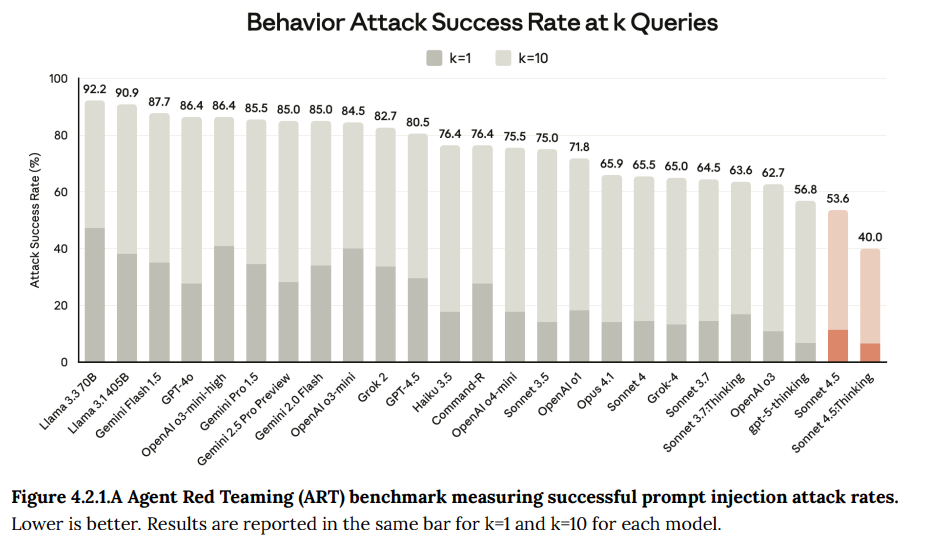
It is essential to observe Anthropic demonstrating safe usage through concrete measures, such as auditing, classifiers, fallback models, and transparency. Anthropic is taking steps in this direction.
For more information, please refer to the system card.
Claude 4.5’s primary advancement is its methodical approach. The model now plans, tests, iterates, and improves, closely reflecting the workflow of an effective security researcher.
You don’t crack a new exploit or reverse-engineer malware in one clean pass. You build hypotheses, hit walls, backtrack, and pivot. That iterative rhythm — try, fail, rewind, retry — is the lifeblood of security research. And that’s what Claude 4.5 is moving towards.
It was a major drawback of the previous model. For example, on the same CyBench benchmark that Anthropic is using to evaluate 4.5, we have seen 4.0 struggle significantly.
I covered my own test in a previous Cyber Builders edition:

One of the most significant developments in AI reasoning is the agentic loop.
Claude 4.5 can now plan across multiple steps, run tools, self-evaluate when something goes off track, and then re-enter its own reasoning loop to correct course. In plain terms: it can pause, reflect, and resume without losing context or confidence.
That’s huge for Cyber Builders. Because cybersecurity is rarely a straight line — it’s a maze of incomplete clues, false positives, and sudden dead ends. You don’t need a model that answers fast. You need one that recovers intelligently. If you don’t confirm a hypothesis, you need to evaluate another, like stepping back a bit in the maze and turning in another direction. A real threat researcher or a SOC analyst checks multiple paths, logs partial results, and discards unproductive trails.
Imagine giving Claude a bundle of firewall logs and a few threat intel feeds. Instead of returning a static summary, the model can plan an analysis:
-
Identify high-risk IP clusters.
-
Correlate with known threat actor behavior, using a tool to search within a CTI database or MITRE ATT&CK TTPs.
-
Test hypotheses — e.g., “Is this C2 beaconing?” “Is this known as a threat actor tactic?”
-
Retry if results are weak or contradictory.
That’s not just better automation. That’s adaptive reasoning — the skill every analyst spends years building.
Anthropic didn’t stop at internal improvements. They also opened the door to external builders through the Claude Agent SDK — letting you define how Claude plans, acts, and reflects.
That means you can now design agents that pause mid-investigation, save state, and resume later. For security teams, that’s gold.
Consider long-running analysis chains, such as reverse-engineering malware, mapping lateral movement, and hunting for privilege escalation paths. You rarely finish that in one sitting. An SDK-powered agent can:
-
Snapshot intermediate reasoning.
-
Store partial findings (hashes, YARA matches, decoded payloads).
-
Resume days later, exactly where it left off — no context lost.
In security, the best analysts aren’t the smartest ones — they’re the most disciplined. They manage uncertainty. They test methodically. They keep detailed notes. Claude 4.5’s planning upgrade embodies that same discipline.
And for you as a Cyber Builder, that means you can start crafting AI agents that mirror your own investigative workflows — autonomous enough to explore, grounded enough to report back responsibly.
Suppose the first upgrade was about taking security seriously, and the second was about learning to plan effectively. In that case, the third thing Anthropic nailed with Claude 4.5 is context awareness — the model’s ability to know how much it’s holding in its head.
Sounds simple, but it’s a quiet revolution.
Because every AI model, no matter how “smart,” is stateless. It forgets everything once the context is full. That’s like a security analyst losing all their notes every 30 minutes. You wouldn’t trust that person with your incident response.
Claude 4.5 is the first model that truly acts as if it understands this limitation — and manages it proactively.
Think of context as the model’s desk space. Everything you want it to “see” — your logs, reports, threat feeds, code snippets, chat history — all sit on that desk. Once the desk fills up, something has to fall off the edge.
Even with million-token contexts, that desk can still become cluttered fast. And the irony? Models with huge context windows often perform worse when they’re overloaded. They lose focus. They miss patterns buried deep in the noise.
Here’s where Anthropic made a smart move. Claude 4.5 isn’t just given a bigger desk — it’s given a sense of how full the desk is.
When the context window gets too heavy, Claude can now decide to:
-
Save critical insights to external tools.
-
Drop or summarize less relevant data.
-
Reorganize information to keep reasoning sharp.
That’s what keeps the model “in flow.” It doesn’t drown in detail. It filters, prioritizes, and continues with focus — like a seasoned analyst clearing noise before diving into the next lead.
The dirty secret of “big-context” models is that size isn’t skill. Intelligence depends on how efficiently the model uses its context — not how much it can store.
Claude 4.5’s context awareness changes that equation. It’s not just reading more; it’s reasoning better.
For Cyber Builders, that means you would now trust your AI agents with massive investigative datasets — without them going foggy halfway through. The model can keep its workspace organized, offload memory, and re-center its reasoning when complexity spikes.
I am excited to see this happening and understand that the longer task can be offloaded to AIs. Today’s AI work takes only a few minutes and then reverts to humans with a question or a partial result. With better context management, the size/time of a task will increase.
Indeed, real cybersecurity work demands:
-
Triage efficiently — sort noise from signal.
-
Maintain mental clarity — stay focused during in-depth analysis.
-
Resume investigations without re-feeding gigabytes of context.
When AI models learn to remain in “flow”, they stop being tools and start becoming partners. Don’t you think?
Anthropic didn’t lead with “smarter,” “faster,” or “bigger.” They led with discipline — and that’s precisely what cybersecurity needs.
Because real defenders don’t win by being flashy, they win by being precise, resilient, and calm in the face of chaos. Claude 4.5 mirrors that mindset.
The real question now isn’t whether AI can handle cybersecurity.
It’s whether you can build AI systems that think — and defend — with that same level of intention.
So, take the hint… and build!
Laurent 💚
PS: Two days after Anthropic, ZAI, a Chinese AI lab, released GLM 4.6, an open source model that scores better than Claude 4.5! What a time!
