

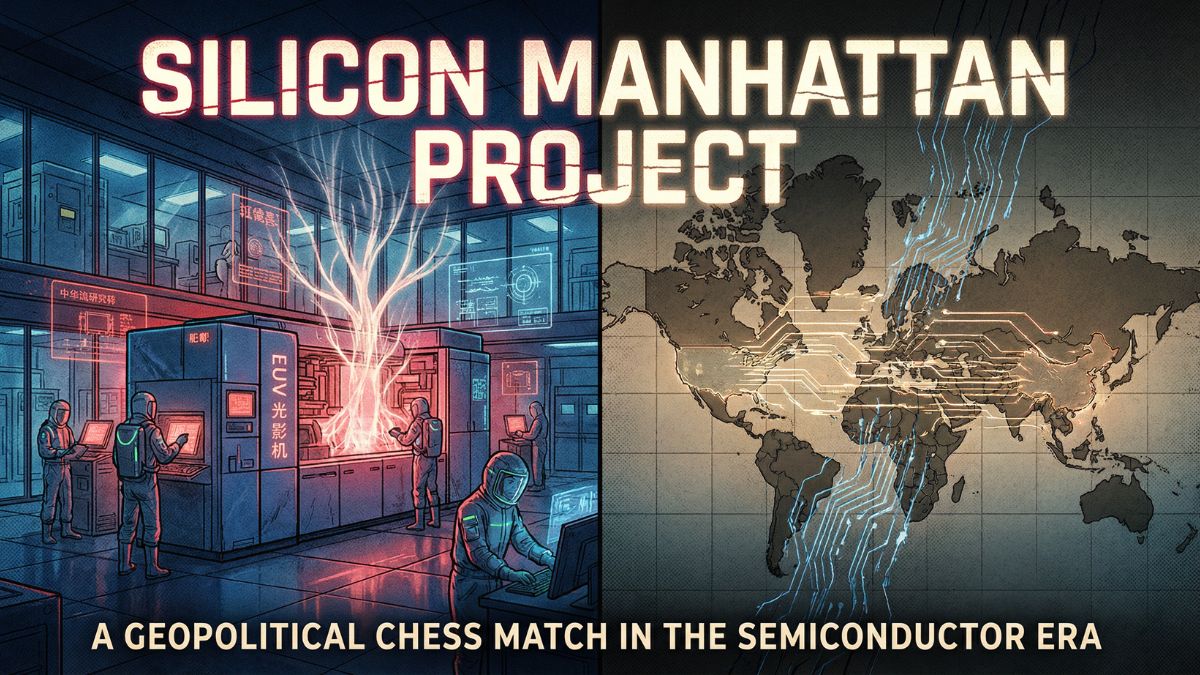
Reports surfaced this week confirming what many industry observers had long suspected but feared to articulate: China has launched a “Manhattan Project” for semiconductors. This massive, state-backed initiative has a singular, existential goal—to reverse-engineer the ultra-complex lithography machines currently monopolized by the Dutch firm ASML. By cracking the code on Extreme Ultraviolet (EUV) technology, Beijing aims to shatter the chained gates of U.S. sanctions and achieve self-sufficiency in manufacturing the chips necessary to train frontier Artificial Intelligence (AI) models.
This is not merely industrial espionage on a grand scale; it is a geopolitical inflection point. The race for AI dominance is the defining struggle of the 21st century, and the starting pistol just fired a second time. According to exclusive reports from Reuters and Taiwan News, China has already built an operational prototype in a high-security Shenzhen laboratory that is successfully generating EUV light. The implications for U.S. leadership are profound, the scale of China’s commitment is staggering and the window for the West to maintain its edge is narrowing faster than policymakers realize.
The Threat to American Hegemony
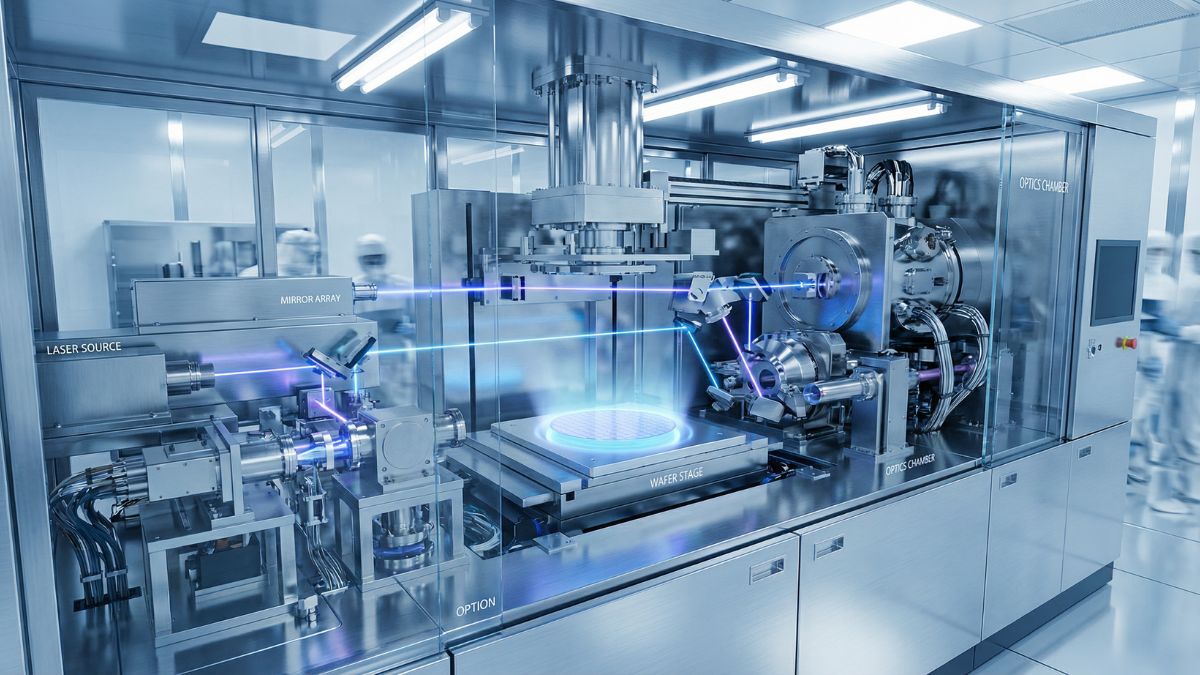
For the past few years, U.S. strategy regarding China’s technological rise has relied on weaponized interdependence. By controlling key chokepoints in the semiconductor supply chain—specifically, advanced chip design software and the irreplaceable manufacturing tools from ASML—Washington has effectively throttled China’s ability to develop cutting-edge AI. ASML’s EUV machines are engineering miracles, utilizing lasers to vaporize molten tin to create light wavelengths capable of printing transistors just nanometers wide. They are the only tools capable of making the chips that power today’s most advanced generative AI models.
If China’s “Manhattan Project” succeeds in replicating or bypassing this technology, the primary lever of U.S. technological power snaps. American leadership in semiconductors is currently defined not just by innovation like NVIDIA’s, but by the ability to deny adversaries access to that innovation. A self-sufficient China, armed with indigenous lithography capable of sub-7nm production, would immediately negate current export controls. This would unleash a flood of Chinese-developed AI capabilities with direct military and economic applications, effectively ending the unipolar moment in tech dominance. As noted by Asia Times, this effort is designed to kick the U.S. out of the supply chain entirely.
A Tale of Two Scales: Asymmetry of Effort
Comparing Western efforts to revitalize chip manufacturing with China’s new initiative reveals a startling asymmetry. The United States celebrated the passage of the CHIPS and Science Act, a $52 billion package designed to lure manufacturing back to American soil. While significant in a Western legislative context, it is a market-based incentive program restrained by political infighting and corporate red tape.
China’s approach, conversely, appears to massively exceed anything the West is currently undertaking. This is not a subsidy program; it is national mobilization on a war footing. The project is reportedly overseen by Ding Xuexiang, a close ally of President Xi Jinping, and coordinated by Huawei. Beijing is deploying state capitalism with unlimited liability, recruiting former ASML engineers with massive bonuses and, in some cases, providing them with fake identities to evade detection.
Where the U.S. relies on private companies like Intel or Micron to make business decisions aligned with national security, China is directing state resources to solve a physics problem regardless of the immediate return on investment. The Chinese government recognizes that this is not about market share; it is about sovereignty. The scale of resources Beijing can mandate toward a single technological hurdle dwarfs the patchwork of incentives currently offered by the U.S. and its European allies.
The Ticking Clock on Western Leadership
How long do the U.S. and its allies have before China bypasses them? It is tempting to dismiss the effort by pointing to the immense complexity of ASML’s machines, which took decades of global collaboration to perfect. ASML’s own CEO stated earlier this year that China would need “many, many years” to replicate this technology.
However, underestimating China’s technological velocity is a historical error. While the prototype currently struggles with optical precision and has not yet produced working chips, the timeline is compressing. Sources close to the project indicate a goal of producing working chips by 2028, with a “realistic” target of 2030. This is potentially years ahead of Western forecasts. If China throws hundreds of billions of dollars and its best scientific minds at the problem, the decade-long lead the West enjoys could shrink to three to five years. Furthermore, China may not need to perfectly replicate ASML’s machines; it only needs a “good enough” alternative that allows it to train competitive AI models, even at a higher cost or lower yield. The danger zone for the West isn’t in 2035; it begins before 2030.
The American Imperative: Beyond Defense
To prevent being overtaken, the United States must accept that defensive measures—sanctions and export controls—are delaying actions, not a strategy for victory. The current leaks in the sanctions regime, evidenced by China’s ability to source components from secondary markets, show that determined actors find workarounds.
The U.S. needs an offensive strategy that matches the urgency of China’s mobilization. First, this requires radically increasing federal R&D funding for next-generation semiconductor technologies, moving beyond silicon to areas like advanced packaging and novel materials where the U.S. still leads. Second, the alliance with the Netherlands and Japan must be tightened, ensuring that the technology denial regime doesn’t fracture under Chinese economic pressure. Finally, the U.S. must win the war for talent, reforming immigration policies to ensure the world’s brightest engineers choose Silicon Valley over Shenzhen.
Wrapping Up
China’s semiconductor “Manhattan Project” is a clear signal that Beijing views technological dependence on the West as an intolerable vulnerability and is willing to spend any amount to close the gap. The U.S. cannot win this race by merely trying to trip the other runner. It must run faster, invest deeper, and recognize that the comfortable lead it enjoyed in the silicon age is over. The AI age will be contested inch by nanometer, and as these reports confirm, the race is far closer than we thought.

As President and Principal Analyst of the Enderle Group, Rob provides regional and global companies with guidance in how to create credible dialogue with the market, target customer needs, create new business opportunities, anticipate technology changes, select vendors and products, and practice zero dollar marketing. For over 20 years Rob has worked for and with companies like Microsoft, HP, IBM, Dell, Toshiba, Gateway, Sony, USAA, Texas Instruments, AMD, Intel, Credit Suisse First Boston, ROLM, and Siemens.
