

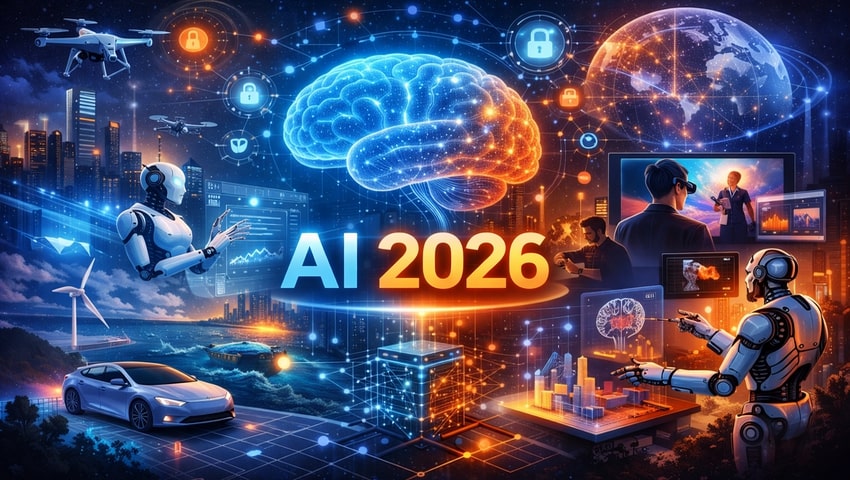
Recently, we compiled a news digest highlighting the key events and trends in AI during 2025. Now, looking ahead to 2026, artificial intelligence is set to move beyond being an experimental technology or niche productivity tool. It is rapidly emerging as the strategic backbone of enterprise workflows, creative industries, and consumer experiences. Across sectors, AI is evolving from passive assistants into autonomous, agentic systems capable of reasoning, collaboration, and multimodal understanding.
1. The shift from “bigger” to “smarter”
For over a decade, AI progress was driven by scale: more data, more parameters, more compute. That paradigm is now giving way to a more pragmatic approach. In 2026, the most valuable AI systems will not be the largest, but the most efficient and context-aware.
Advances in reasoning models, inference-time compute, and architectural optimization mean smaller, domain-tuned models can now match or outperform massive general-purpose systems. These “thinking models” pause, evaluate intermediate steps, and use tools dynamically before producing an answer.
This shift delivers three critical benefits:
AI is becoming something organizations can manage and govern – rather than merely scale.
2. Agentic AI becomes operational reality
AI is shifting from individual usage to team and workflow orchestration. 2026 marks the rise of the digital coworker, where systems no longer simply follow instructions, but agents anticipate needs, coordinate tasks across departments, and execute multi-step workflows autonomously.
- Autonomous enterprise workflows: AI agents can manage cloud infrastructure, perform quality assurance, monitor procurement, and handle customer support with minimal human input.
- Agentic operating systems: Standardized frameworks (such as the Agent-to-Agent protocol and IBM’s ACP) are enabling secure, policy-driven multi-agent collaboration, turning AI into a trusted organizational layer rather than a siloed tool.
- Democratized agent creation: Everyday business users (not just developers) will design and deploy intelligent agents, driving innovation closest to real-world problems.
This evolution positions AI as a true collaborator: capable of meaningful problem-solving, decision-making, and goal-driven execution.
3. Model context protocol – the backbone of agentic systems
As AI agents proliferate, model context protocol (MCP) will emerge as a foundational layer for the AI ecosystem in 2026.
- Standardized interoperability: MCP defines a common language for how agents access local files, Google Drive, Slack, and enterprise databases without custom API “glue” code.
- Persistent memory: It allows agents to maintain context across different sessions and platforms, making them feel like a singular, continuous assistant.
- Secure permissions: MCP acts as a governance layer, ensuring agents only see and touch the data they are strictly authorized to use.
MCP will play a role similar to what APIs and microservices played in cloud computing – quietly essential and universally adopted.
4. Spatial intelligence: moving beyond the screen
AI in 2026 will perceive the world more like humans do, bridging text, images, video, and 3D space. Multimodal reasoning enables digital workers to complete tasks that require cross-domain understanding, from analyzing healthcare scans to simulating complex environments.
- 3D AI and digital twins: Enterprises will leverage high-fidelity 3D simulations for predictive maintenance, logistics planning, and autonomous vehicle testing.
- Creative media and entertainment: Virtual actors, AI-assisted animation, and immersive environments are set to revolutionize content creation, reducing cost and speeding up production.
- Enhanced decision-making: Multimodal AI will integrate visual, textual, and spatial data, enabling applications in healthcare diagnostics, urban planning, and defense simulations.
5. Video-first workflows go mainstream
Generative video has moved from “uncanny valley” clips to professional-grade production. Advances in temporal coherence, motion modeling, and multimodal alignment are turning text-to-video and image-to-video systems into practical production tools.
Key use cases include:
- Personalized e-commerce and marketing videos;
- Automated training and educational content;
- AI-assisted animation and media production;
- Product demos generated on demand by AI agents.
As these systems mature, video creation will become faster, cheaper, and more personalized – reshaping how brands communicate and how consumers interact with digital products.
6. Open source and global model diversity
Open-source AI will continue to shape the competitive landscape in 2026. Smaller, domain-specific models – often developed outside Silicon Valley – are closing the gap with proprietary frontier systems.
Chinese open-weight models, in particular, are gaining traction globally due to:
- Strong reasoning performance;
- Broad multimodal capabilities;
- Flexibility for customization and private deployment.
At the same time, interoperability and open standards will become key differentiators, ensuring AI systems can work together rather than forming isolated silos.
7. Trust, governance, and AI resilience
As AI systems become more autonomous, trust becomes a strategic requirement. Organizations in 2026 will prioritize:
- Explainable and transparent AI decisions;
- Continuous monitoring for model drift and bias;
- Resilient architectures that avoid over-dependence on single providers;
- Clear accountability for agentic behavior.
Model context protocol, combined with modular architectures and strong MLOps practices, will enable organizations to meet regulatory expectations while still innovating at speed.
So, the AI forecast for 2026 points to AI evolving from static models into adaptive, agentic, and context-aware systems that operate across modalities, environments, and organizations.
The most successful companies will not be those with the biggest models, but those that:
- Design AI-native architectures;
- Embrace agentic workflows;
- Adopt MCP as a core layer;
- Invest in ethical governance and skilled developers.
In 2026, AI will no longer sit on the sidelines of digital transformation. It will be the operating layer of the modern enterprise, quietly orchestrating decisions, actions, and experiences across every industry.
