

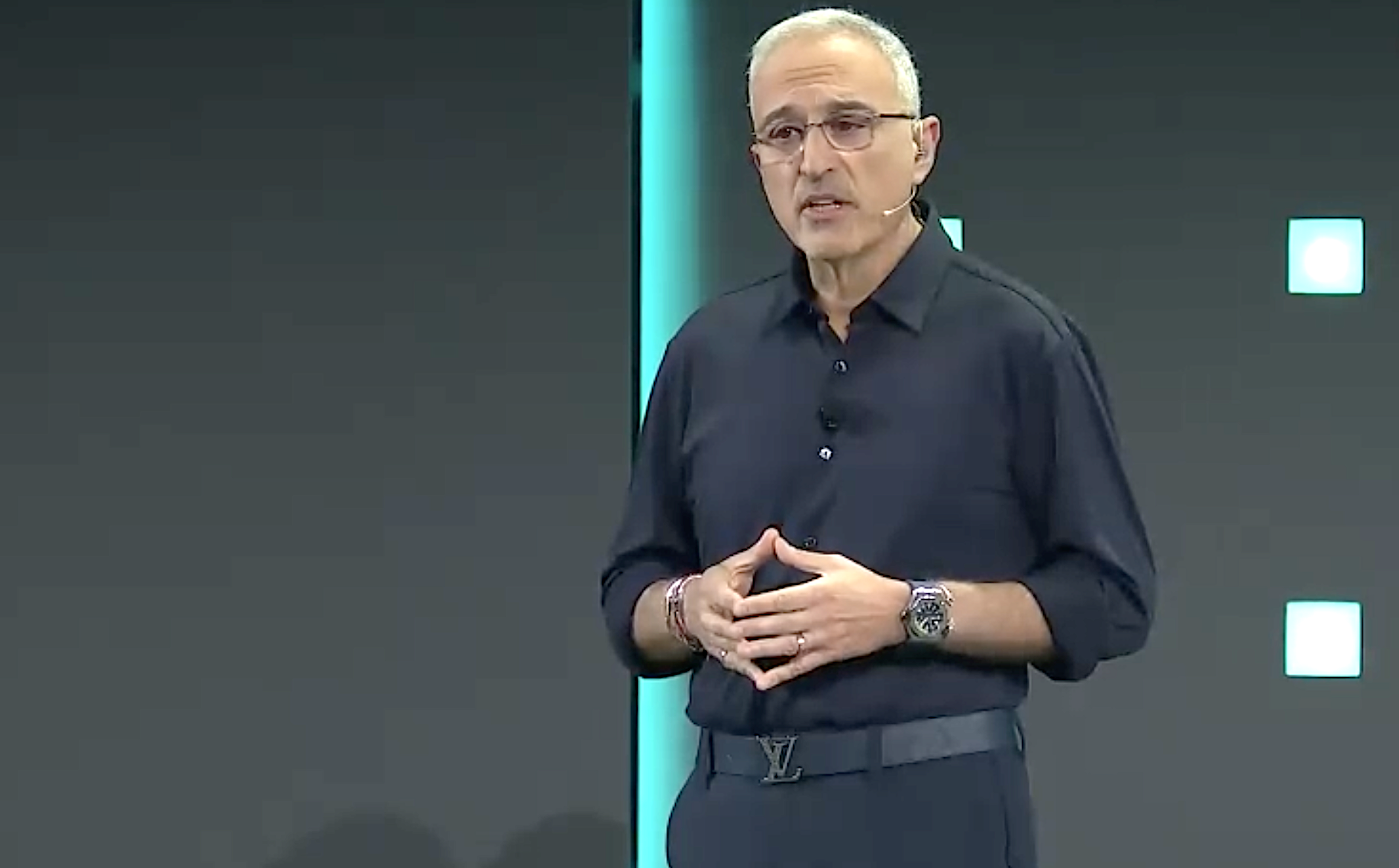
Hewlett Packard Enterprise Co. Chief Executive Antonio Neri opened the company’s annual user conference, Discover, this week in Las Vegas with a manifesto for the AI era. Though all events now discuss the changing role of AI, Neri offered a different perspective on AI through the lens of information technology.
The industry is moving from building IT systems to architecting intelligence. In that shift, the enterprise is no longer just an operator of technology but rather a designer of outcomes, a much different role for the people sitting in the audience.
Neri leaned into the architectural metaphor throughout the keynote, and it worked. AI isn’t a feature or a workload; it’s a system-level transformation. That framing set up five clear takeaways that define where HPE is placing its bets and, more importantly, where enterprise IT is headed.
1. The network is back at the center of everything
If the cloud era abstracted the network, the AI era is making it foundational again. Neri stated, “architecting for AI starts with your network.” This reflects a broader industry shift in which AI workloads, especially large-scale training and distributed inference, are fundamentally network-bound and generate massive traffic. Latency, congestion and east-west traffic patterns now directly affect model performance and cost.
The Juniper acquisition is obviously central to this strategy. HPE is positioning itself as a full-stack networking provider spanning campus, data center, and interconnect. The introduction of AI-optimized switching (such as the QFX series) and routing platforms (MX series) underscores the broader point that AI infrastructure is as much a networking problem as it is a compute problem.
During his keynote, he named a customer, Vultr, to reinforce this point. Hyperscale AI environments aren’t just about graphics processing units; they’re about how efficiently you can connect them. In that sense, HPE is betting that Ethernet, paired with software intelligence, can compete with and win against proprietary AI fabric solutions. For enterprise buyers, this reframes network investments from “plumbing” to a “performance multiplier.”
2. ‘Self-driving’ is evolving from a tag line to an operational model
Juniper Networks Inc. has discussed the concept of self-driving networks for years, but this keynote presented a more mature, credible vision. The combination of Aruba Central, Juniper Mist and GreenLake Intelligence points to a unified operational model in which AI doesn’t just monitor but actually acts. Neri emphasized systems capable of “detecting, diagnosing and remediating” issues before users notice them.
This matters because AI infrastructure dramatically increases operational complexity. IT pros need to deal with hybrid environments, distributed inference and agent-driven workflows. Human-in-the-loop IT operations won’t scale.
What’s different now is the integration of generative and agentic AI into operations. GreenLake Intelligence isn’t just correlating telemetry; it’s reasoning across domains and increasingly automating actions. A useful way to think about this: traditional AIOps was about insights. This next phase is about execution. Currently, self-driving applies to the network, but during the analyst Q&A, Neri made it crystal-clear that the intent is for agentic capabilities to span the IT stack.
3. The rise of the agentic enterprise is very real — and very messy
One of the more forward-looking parts of the keynote was Neri’s focus on the “agentic enterprise.” The idea that enterprises will soon manage thousands of AI agents isn’t speculative; it’s already underway. What’s still missing is the control plane.
Neri highlighted the looming problem of agent sprawl. Developers are building agents quickly, often outside centralized IT governance, creating risks to security, data access, and operational consistency. HPE’s response is to position Private Cloud AI as the foundation for governed agent deployment. Additions to agent registration, identity models, policy enforcement and secure runtimes are intended to bring order to what could otherwise descend into chaos.
The key insight is that managing agents will resemble managing users or applications, but with greater autonomy and higher stakes because business-impacting actions will be automated. For enterprise IT leaders, this should be a wakeup call that AI adoption is no longer just about models. It’s about managing the lifecycle of autonomous systems.
4. Data and increasingly storage architecture are the real bottlenecks
Neri made a point that often gets overshadowed by GPU headlines. AI is only as good as the data foundation it rests on. The HPE Alletra Storage MP updates, particularly those focused on unified file and object storage and Nvidia certification, highlight an important trend. Storage is becoming an active participant in AI pipelines, not just a passive repository.
Features such as real-time metadata enrichment and tighter integration with AI frameworks are designed to reduce friction between data and models. That’s critical because one of the biggest delays in enterprise AI projects is data preparation and movement.
An interesting claim was that simplifying data pipelines could significantly shorten time-to-value. Though the exact numbers will vary, the direction is clear: Whoever solves the data problem wins the AI race. This is where HPE’s full-stack story matters. Compute gets the attention, but data architecture determines outcomes.
The importance of data management was underscored in a customer Q&A with analysts. I asked Matt Messick, chief information officer of the Dallas Cowboys, about the importance of bringing data silos together, and he said it’s the top priority he thinks about now and that it’s something the organization must get right if its AI aspirations are to be met.
5. Power is the constraint no one can ignore
Perhaps the most grounded moment in the keynote was the discussion of energy. Neri cited a projected 19-gigawatt power gap in the U.S. by 2028, with data centers consuming an increasing share of that capacity. That’s not a theoretical issue; it’s a hard limit on AI expansion.
During his keynote, HPE played a Siemens Energy video illustrating how AI is both driving demand and helping optimize supply. But the broader point is that infrastructure decisions are now inseparable from energy considerations.
This has several implications:
- Efficiency becomes a competitive advantage, not just a cost metric
- Location strategy (where you build and run AI) becomes more constrained
- Cooling, power delivery and sustainability move into the core architecture conversation
In other words, the future of AI won’t just be defined by model breakthroughs but rather it will be defined by who can power them.
Final thoughts
In summary, Neri’s keynote wasn’t about a single product or announcement. It was about positioning HPE as the company that can tie together networking, compute, storage, cloud and operations into a coherent AI architecture.
That’s an ambitious claim, but it aligns with where the market is going. Enterprises don’t need more point solutions; they need integrated systems that can handle the scale and complexity of AI. The architectural framing is the right one. The open question is execution. Because in this new era, being an architect isn’t just about designing the blueprint. It’s about delivering the outcome.
Zeus Kerravala is a principal analyst at ZK Research, a division of Kerravala Consulting. He wrote this article for SiliconANGLE.
Photo: Zeus Kerravala
Support our mission to keep content open and free by engaging with theCUBE community. Join theCUBE’s Alumni Trust Network, where technology leaders connect, share intelligence and create opportunities.
- 15M+ viewers of theCUBE videos, powering conversations across AI, cloud, cybersecurity and more
- 11.4k+ theCUBE alumni — Connect with more than 11,400 tech and business leaders shaping the future through a unique trusted-based network.
About SiliconANGLE Media
Founded by tech visionaries John Furrier and Dave Vellante, SiliconANGLE Media has built a dynamic ecosystem of industry-leading digital media brands that reach 15+ million elite tech professionals. Our new proprietary theCUBE AI Video Cloud is breaking ground in audience interaction, leveraging theCUBEai.com neural network to help technology companies make data-driven decisions and stay at the forefront of industry conversations.
