

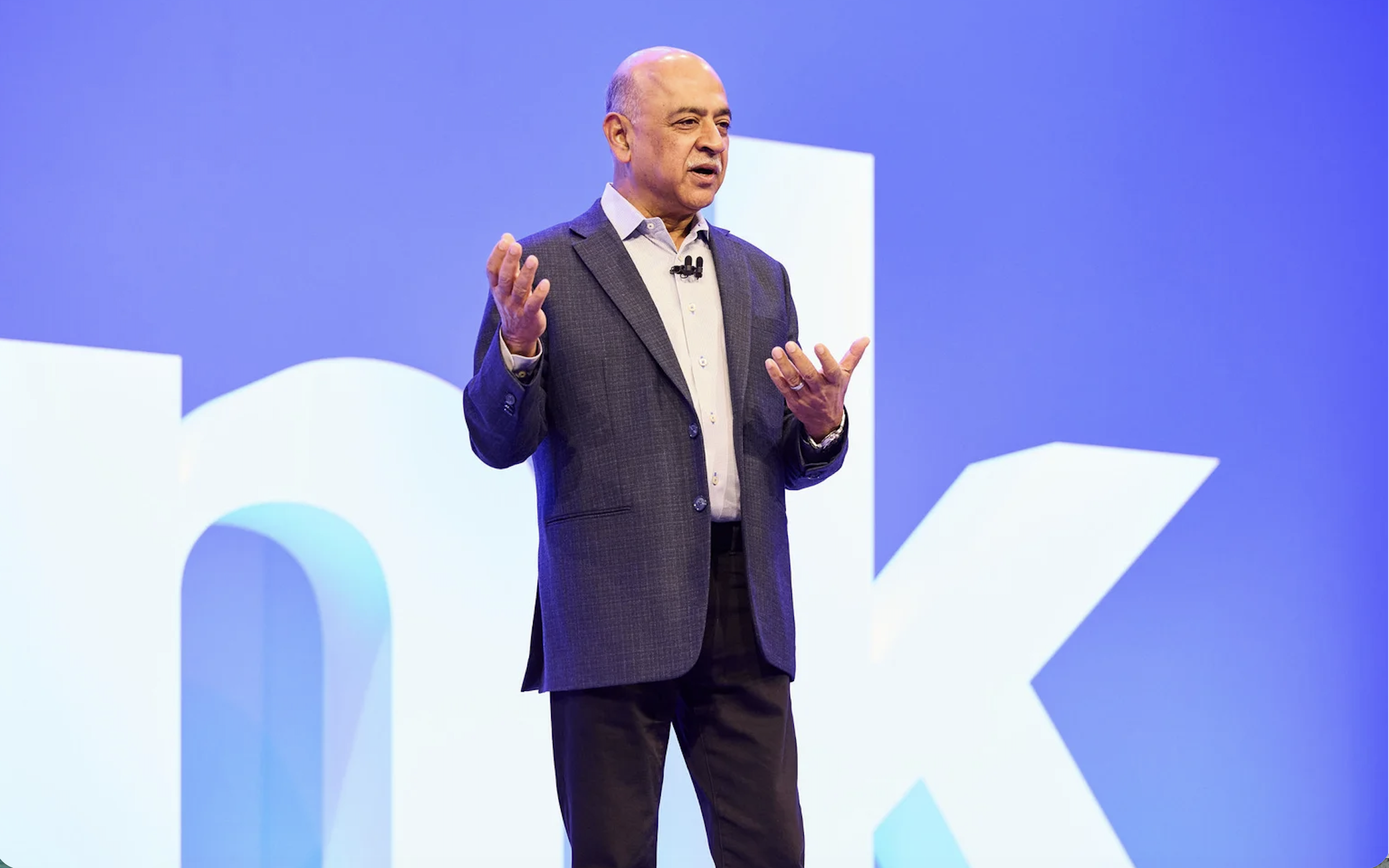
At this year’s IBM Think, Chief Executive Arvind Krishna’s keynote focused on artificial intelligence’s impact on the modern enterprise. Instead of the usual tour through features and roadmaps, his talk challenged information technology leaders.
The real divide in the next decade won’t be between those who do and don’t use AI, but between those who rebuild their operating models around AI and those who stay stuck in pilots and proofs of concept. Viewed through the lens of the old wedding rhyme — something old, something new, something borrowed, something blue — Krishna’s themes on AI, first operations, hybrid cloud, quantum and sovereignty become a practical checklist for chief information officers deciding where to place their next big bets.
Something old: Operating models, not pilots
Krishna’s core message is that the gap between “who’s winning and who’s falling behind” is widening, not because of budgets or team size, but because some organizations are using AI to “fundamentally rethink their business” while others are stuck in “little pilots and little projects.” He argued that the real question for IT leaders is “How deeply is AI embedded in your business processes? Is it part of the enterprise, or is it something on the side?”
He also quantified the stakes. Estimates point to roughly 40% productivity gains by 2030. AI infrastructure investment is up by roughly 150%, and IBM has realized “four and a half billion dollars in productivity gains” from AI and automation. He explained, “That’s not a projection. Those are reported numbers in our filings.” The lesson for IT is to treat AI as a new operating model, not a tool. Krishna went so far as to say, “AI is not helping your business. It is your business model. You’ve got to be AI-first, not AI-enabled.”
A great example came from Aramco, which Krishna called “a great example of AI-first thinking.” IBM first installed computers there in 1947 and is now helping “transform the Kingdom of Saudi Arabia into a global AI and digital hub,” including a new collaboration on using AI to address complex industrial challenges. That arc, from mainframes to AI-first operations, is the “something old”: replatforming the business around each computing paradigm shift, not treating technology as a bolt-on.
Something new: The quantum frontier
The explicit “something new” in Krishna’s framework is what he called “the quantum frontier.” He grouped it with AI-first and hybrid cloud as one of “three vectors that are important for you all to consider,” and positioned quantum not as science fiction but as an inevitable extension of current infrastructure and AI investments.
Krishna described this moment as “day zero of the AI revolution,” emphasizing that the biggest value is still ahead because most enterprises run AI “at the margin,” improving a workflow here and a use case there, while leaving core end-to-end processes largely untouched. Quantum sits just beyond that horizon: once enterprises have modernized their data, embedded AI into decision flows, and built hybrid-cloud control planes, they create the substrate for quantum to matter in areas such as optimization, materials, and risk analytics.
For IT leaders, the quantum takeaway is architectural rather than purely scientific. If you accept that quantum will become a specialized accelerator for hard problems, architect today’s AI and data platforms so they can eventually plug into quantum services without a massive rewrite. In practice, that means modular workflows, open orchestration and the assumption that tomorrow’s most valuable compute will not live in a single cloud or a single machine.
Something borrowed: Hybrid cloud and openness
The “something borrowed” in this keynote is the hybrid cloud model that enterprises have been dealing with for a decade, now recast as the backbone of AI and sovereignty. Krishna repeatedly stressed that value comes from “mixing” different models and deployments, “leveraging really big models and massive infrastructure where appropriate, and leveraging on-premise models and models at the edge where appropriate.”
He framed this as the way to avoid lock-in and unlock enterprise value. The companies best positioned are those that “really work hard on making the models work inside a real enterprise,” with “technical depth” and “decades of trust, especially for regulated industries,” plus “flexibility across providers, so you avoid lock-in.” In other words, IT should borrow the best from hyperscalers, on-premises systems and edge environments, then bind them into a single operating fabric instead of betting on any one stack.
Krishna underscored that this is where the real return on investment shows up. Most organizations, he noted, are stuck in stages one and two of the AI journeys, where manual workflows with some task augmentation and workflow optimization, while leaders move to stages three and four, where they redefine entire businesses and see “150% ROI compared to those who remain stuck in the first two.” Hybrid cloud is the “borrowed” pattern that lets IT leaders experiment broadly without sacrificing control, compliance, or portability.
Something Blue: Sovereignty as IBM’s differentiator
The “something Blue” is classic IBM territory — trust, control and sovereignty, all wrapped around advanced infrastructure. Krishna argued that “technology is as important to growth and national competitiveness as either finance or defense,” meaning that every nation and every enterprise “needs AI and cloud infrastructure that they control.”
On control, he was explicit: “Nobody else can turn it off, nobody else can tamper with it, nobody else can make it go dark when geopolitics or cable cuts under the ocean come in the way.” He warned that these are “not theoretical considerations” but “real and urgent business requirements of now,” elevating sovereignty from a compliance checkbox to a board-level resilience topic.
For IT leaders, this is where IBM’s “Blue” brand equity is being reasserted. AI-first operating models, hybrid-cloud architectures, and the quantum frontier all fall within a sovereignty envelope. If generative AI and modern infrastructure are the new engines of growth, Krishna’s challenge was stated matter-of-factly. Business and IT leaders need an architecture in which those engines cannot be shut down by anyone else, for commercial, technical, or geopolitical reasons.
Final thoughts: Day eros and the missing middle
Krishna’s “day zero of the AI revolution” framing is compelling because it makes clear that most enterprises are still running AI at the margins. That is, they are tuning tasks and workflows while core, revenue-generating processes remain largely untouched. His statistics on potential 40% productivity gains by 2030 and IBM’s 4.5 billion dollars in annualized productivity from AI and automation underscore that the value is real, not theoretical.
What the keynote left largely implicit, however, is the organizational playbook. Who owns the AI operating model at the C-level? How do business and IT co-fund end-to-end reinvention? And how do boards govern AI as “the business model” rather than just another technology program?
Several critical execution themes were also underplayed. The grind of data readiness and governance needed to safely automate end-to-end processes; the reskilling and cultural change required to turn domain experts in tax, legal, supply chain and customer service into AI-literate co-designers; and the ecosystem strategy needed to make hybrid cloud and sovereignty real, not aspirational.
Krishna did a great job setting the strategic stakes around AI-first, hybrid cloud, sovereignty and the quantum frontier and spotlighting flagship customers like Aramco. But the “missing middle” now falls to IT leaders: turning that agenda into data foundations, skills programs, partner choices, and governance structures that move AI from pilots to the heart of the business model.
Zeus Kerravala is a principal analyst at ZK Research, a division of Kerravala Consulting. He wrote this article for SiliconANGLE.
Photo: IBM
Support our mission to keep content open and free by engaging with theCUBE community. Join theCUBE’s Alumni Trust Network, where technology leaders connect, share intelligence and create opportunities.
- 15M+ viewers of theCUBE videos, powering conversations across AI, cloud, cybersecurity and more
- 11.4k+ theCUBE alumni — Connect with more than 11,400 tech and business leaders shaping the future through a unique trusted-based network.
About SiliconANGLE Media
Founded by tech visionaries John Furrier and Dave Vellante, SiliconANGLE Media has built a dynamic ecosystem of industry-leading digital media brands that reach 15+ million elite tech professionals. Our new proprietary theCUBE AI Video Cloud is breaking ground in audience interaction, leveraging theCUBEai.com neural network to help technology companies make data-driven decisions and stay at the forefront of industry conversations.
