

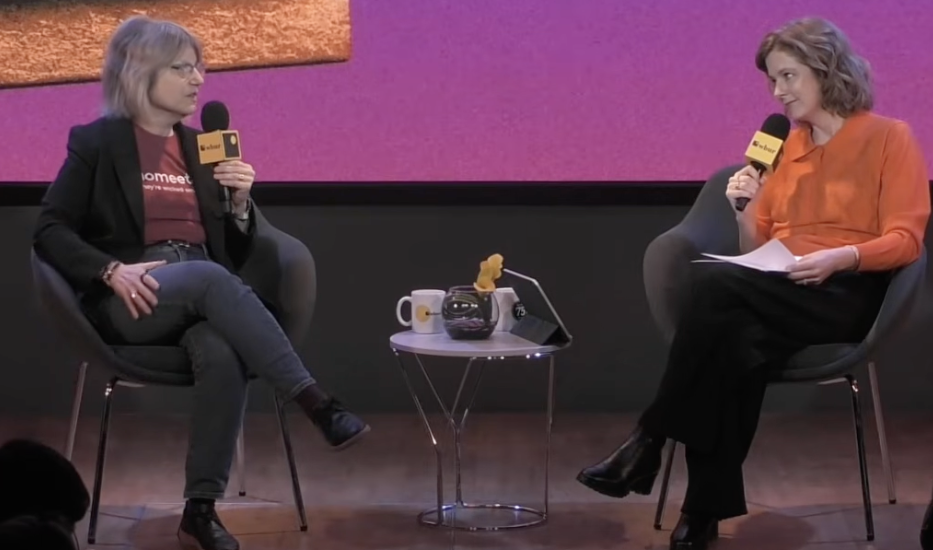
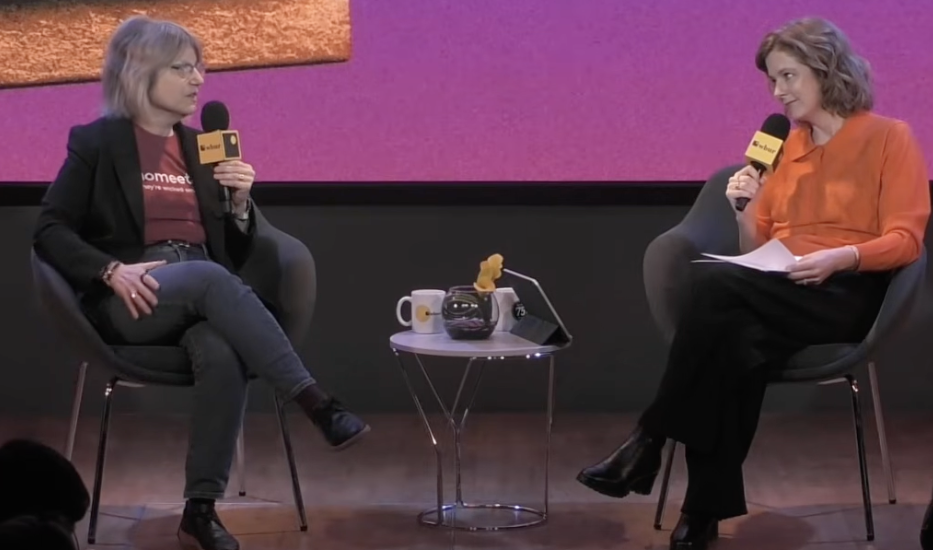
“The thing that really struck me when I came to MIT and strikes me every single day is the stuff that’s going on here is amazing. The science, the engineering… every day I hear something that makes my jaw drop,” remarked President Sally Kornbluth during a live discussion with Lizzie O’Leary of Slate’s “What Next: TBD” podcast.
Kornbluth spoke about everything from the importance of curiosity-driven science and why basic science is critical to our nation’s future, to AI and education, and even bravely joined O’Leary in a rendition of the Williams College song, “The Mountains,” in honor of their shared alma mater.
“We are in this time of incredible uncertainty,” said Kornbluth of the current state of higher education and funding for scientific research. “What we are trying to do is keep the science robust.”
Bouncing back to her time at Duke and her love of college basketball, she noted it’s a combination of zone coverage and man-to-man defense when trying to address skepticism about higher education in Washington, D.C. She emphasized: “As one of the top institutions in the world it’s part of our responsibility to articulate the importance of science. Behind the scenes, I am – along with many other [university] presidents – I am in D.C. all the time now. I want to speak to Congressmen and women, Senators, people in the executive branch to explain the importance of what we are doing.”
Kornbluth emphasized that the pipeline of basic science that flows from U.S. universities is a critical asset for our country, cautioning that to keep straining this pipeline could have enormous negative ramifications for the U.S. down the line.
“If you think about research done in this country, it’s done in in universities, it’s done in national labs, and it’s done in industry,” said Kornbluth. Universities are where most of the science with a long pathway to impact, requiring patience, starts. She pointed to immunotherapy for cancer, which began 30-40 years ago in basic immunotherapy research, as an example. With that pipeline being drained, what does the future hold for new cancer therapies or new AI and quantum technologies?
Kornbluth also underscored that uncertainty and lost funding are having a “huge impact on the talent pipeline,” delving into the unique role universities play in training graduate students, who are the next generation of scientific researchers. “We hear, ‘Oh it would be okay if research was more in industry.’ I say, ‘Would you fly on a plane with a pilot who had never flown?’ How do they think people learn how to do research? We are training the next generation… and we are losing funding for them.” She added: “I think we are going to see reverberations for many decades if we don’t rectify that issue.”
When asked how she and her colleagues are working to keep research moving forward, Kornbluth explained that at MIT, “we have tried to find alternative ways to elevate the science. We have a series of presidential initiatives that cut across the whole campus in things like health and life sciences, quantum, humanities and social sciences. The notion is that we are trying to create new opportunities.”
Still, she acknowledged that losses from the endowment tax and diminished federal funding are painful. “There are only four schools right now that are subject to the 8% endowment tax, which is a tax on our earnings. For us, that means $240 million dollars a year plus other losses in grants. So, let’s say the whole thing is, we budgeted for a loss of $300 million a year on a $1.7 billion budget… That has definitely had an impact on us. No question about it.
“The other thing about it is again there’s all this uncertainty. Our investigators are writing a ton of grants. They don’t know if they’re going off into the void or they really have the sort of competitive opportunities they’ve always had in the past.”
Asked why universities did not see this moment coming, Kornbluth offered a few thoughts. “Look at MIT – 30,000 companies have come from MIT. When you look at something like that, why would you think any government that wants economic flourishing in their country would come after MIT?” she reflected. “It just never would have occurred to us.”
Turning towards the rapid advances in AI, and how the field is impacting education, Kornbluth noted that at MIT and other universities, “we have to focus on the human element, we have to educate our students, they need to know how to write and do mathematics…they have to view AI as a tool to augment their capabilities. That is how we are thinking about it.”
In the course of the conversation, Kornbluth also expressed her unwavering support for international students, noting that most want the opportunity to stay and contribute to research in the U.S. after graduation. “The talent brought to us through our international community is unbelievable. We can attract the very best in the world. You can bet when they talk about competitiveness with China, for example, in AI, quantum, etc., they are not sitting around in China saying, ‘Oh it’s great America is taking all our students.’ They’re thinking, ‘It’s great that America doesn’t want to take as many of our students anymore because we can train them.’ It’s a competitive issue that we really should lean into.”
