


Hello, Cyber Builders 🖖
Last week, I started a series on go-to-market and cybersecurity. The key idea was that you need to build trust with your market and customers to sell a cybersecurity product.

This week, I want to focus on the second kind of trust: trust with your partners and ecosystem. These are the people and organizations you need to build bigger, stronger cybersecurity companies over time. Analysts, channel partners, consulting firms, marketplaces—every cybersecurity company has to work with at least one of these.
-
Rethinking Indirect Channels in a Cloud & AI World
How cloud and AI have changed the role of resellers and local partners, and why you still need trusted local relays to scale your security sales. -
From Features to Outcomes: How Analysts Really Think
Why analysts like Gartner and Forrester don’t care about one extra feature, but about outcomes, use cases, and clear roadmaps your customers can execute. -
How to Work With Consulting Partners as a Startup
What consulting firms actually sell, how they influence RFPs and vendor selection, and how startups can share expertise to build credibility without over-investing. -
Turning Marketplaces Into Growth Engines
How security marketplaces from AWS, Microsoft, CrowdStrike, Palo Alto, and others work, why platform consolidation matters, and how startups can pick the right platform to go deep with.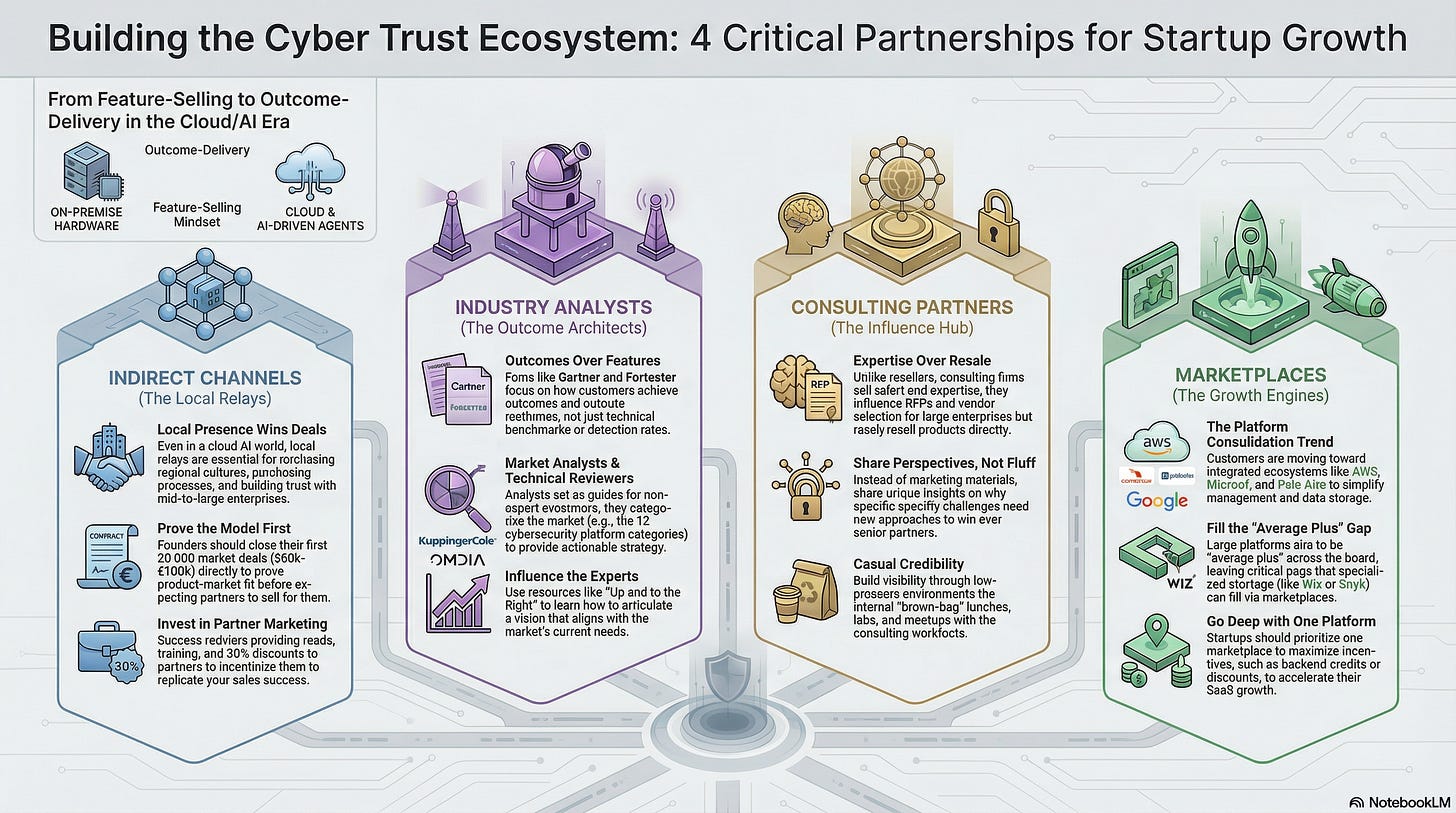
NotebookLM (sorry for the typo, AI is not yet that perfect even it’s impressive) Here is also the audio interview format generated with Notebook LM
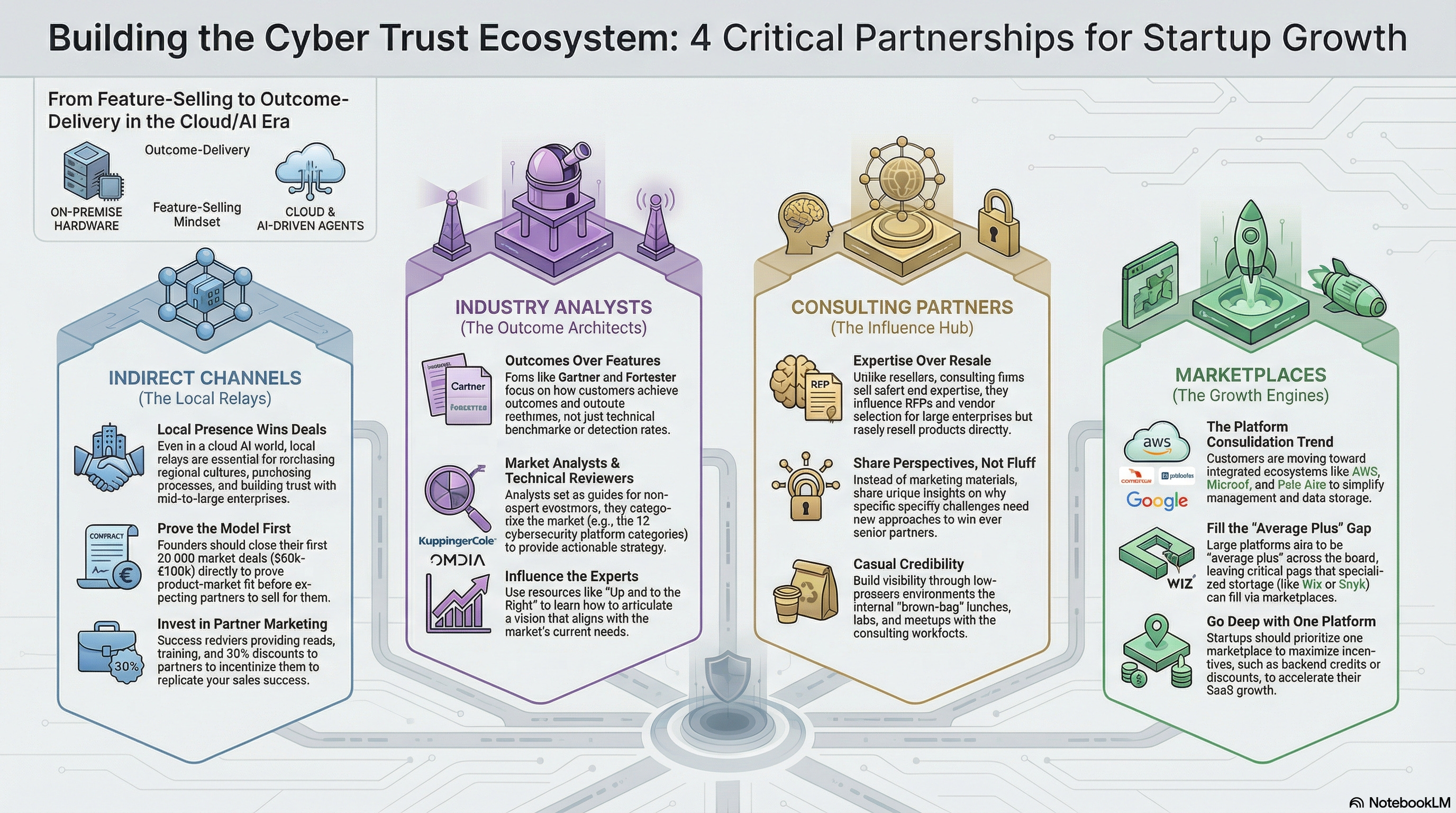
Let’s start with indirect channel partners—probably one of the most misunderstood partner types for startup founders. They are changing rapidly, with even more transformation ahead in the coming years.
I remember when, as a software publisher or network appliance vendor, the only way to reach customers was through regional resellers. This was because IT systems were deployed on-premise within enterprises and required significant expertise to set up, install, configure, and train users. It was a real skill to install Windows NT, deploy software, set up databases and application servers, and configure everything. You had to be “at your customer”, traveling with your car to their offices.
Things have changed dramatically with the cloud, where deployment is no longer a barrier, and everything is accessible via a mobile phone or laptop. Now, with AI, the landscape is evolving further. AI agents are no longer just systems of record with forms, reports, and databases; they are becoming real workers, producing incremental output and functioning almost like employees. This shift deserves its own deep dive, which we’ll tackle in a future post.
Given these changes, many founders—especially those from technical or security backgrounds—ask: Why should I partner with local players at all?
The answer is simple: you need a local trust relay for your company. If you’re based in one city but want to sell security solutions to large, mid-size, or small enterprises, you need someone local. This person helps the company understand why your tool is better than alternatives and how it fits their needs. Local presence matters.
There’s also the cost of sales to consider. You can’t hire a global army of SDRs and salespeople to cover every country. To scale as a security entrepreneur, you need local relays who understand customer culture, how projects get approved, how purchasing decisions are made, and who have their own networks.
So how do you actually start building these partnerships and earning their trust?
First, you need early references. You’ll have to sell directly to your first 20 or so mid-market companies—closing those €50k–100k deals yourself. This proves your product fits the market, addresses a real need, has genuine use cases, and shows low churn.
Many founders make the mistake of thinking that signing a partnership means the partner will start selling right away. That’s not how it works. If you’ve ever worked in retail, you know that just putting a product on the shelf doesn’t mean it will sell.
You need to invest in partner marketing. Train them. Provide tools, animations, discounts, webinars—resources they can reuse. Crucially, you need to generate leads and share them with your partners. This is often confusing for founders: Why should I do all this work, incur these costs, offer a 30% discount, and then hand over the lead for them to close?
The answer is that building a sales machine with partners takes time. You’re laying the foundation for trust. Once that trust is established, partners will replicate your success. They’ll take the deals you’ve closed together and apply the same approach to their other customers. But to reach that volume, you have to set up all these elements first.
The second type of partnership you need is with analysts. We all know their names: Gartner, Forrester, KuppingerCole, Omdia, and many others (like the great Francis Odum). These firms specialize in screening markets, categorizing them with acronyms (I’ve already covered this in my 12 cybersecurity platform categories), and providing insights into what matters in a given offering—and what doesn’t.
Analysts have a significant influence on cybersecurity. Most customers don’t have the expertise to sort through all the options, so they rely on analysts for guidance. Analysts create plans, offer advice, and share research. Their insights help move the whole market forward.
Yet, I frequently hear security founders dismiss analysts with comments like, “This is nonsense. We don’t need them. They don’t understand what we do. We’re better than the rest, and we’ll prove it.” This reaction reveals a fundamental misunderstanding of what analysts actually do.
Founders often assume it’s a technological game—where detection rates, threat analysis, and benchmark performance are the only metrics that matter. They expect analysts to act like a scientific review committee, evaluating products solely on technical superiority.
But that’s not what analysts do. They are market analysts, not technologists. Their focus is on how customers can achieve meaningful outcomes, not just on the technology itself. They value use cases, organizational impact, and practical guidance on structuring teams or projects to execute security programs effectively.
It’s not about having one more feature than a competitor; it’s about articulating a clear, actionable vision that aligns with the market’s current state. Customers want a step-by-step strategy they can implement, especially as technology evolves and new threats emerge.
They seek experience sharing, guidance, and meaning—exactly what analysts provide.
When you talk to analysts, take your time and be thoughtful. There are proven ways to work with them. Richard Stiennon’s book Up and to the Right is still a great resource, even after 15 years. I recommend reading it.
Consulting companies represent a third type of partner you need to consider. Unlike indirect channels, they typically do not resell products—it’s not part of their business model. Margins on product resale are too low for their model, and they prioritize maintaining the trust they’ve built with customers by providing workforce and expertise.
Many consulting firms assist large enterprises in drafting RFPs, setting up evaluation labs for shortlisted vendors, and advising CISOs and their teams on vendor selection. Like analysts and channel partners, consulting companies are interested in the knowledge and insights you can offer as a vendor.
However, the wrong approach is to simply share your marketing materials with them. Instead, focus on sharing your unique perspective: Why do you believe things need to change? Why is your approach better for solving specific challenges? What sets your solution apart?
I don’t believe consulting firms are inherently innovative in building groundbreaking solutions. Their core business is selling the talent and expertise of young, college-educated professionals. While they excel at this, only a limited number of individuals—usually senior partners—are capable of producing cutting-edge content on emerging threats or trends.
These senior partners may only be invoiced for a few days per deal, but they are the ones who can provide the most valuable, high-level insights.
For startups and new vendors, engaging with consulting companies is important, but it’s not where you should focus all your efforts. It won’t have an immediate, direct impact on sales. However, if you’re targeting enterprise customers, it’s better to be known by these firms than to be unknown.
Consulting companies often host brown-bag lunches, internal labs, and meetups—casual events where you can share your expertise and engage in informal discussions. These are the kinds of opportunities you should pursue. Expert exchanges with their workforce, even in informal settings, can be valuable for building credibility and visibility.
Last are the marketplaces—the newest category in the cybersecurity ecosystem. Many vendors, especially large platforms like CrowdStrike, Palo Alto, Cisco, Google, AWS, and Microsoft, offer partnership programs to join their marketplaces. These platforms attract customers by offering a wide range of pre-integrated security services, unified under a single user management, data storage, analytics, and reporting system. The goal is to simplify the customer experience: instead of managing 50 different vendors, they can consolidate most of their needs into one or two platforms.
This shift toward platform consolidation has been a major trend in the security business for years. It’s also created significant M&A opportunities for startups, as large US companies have been acquiring three to five startups per year for the past decade.
These platform builders have dedicated teams to integrate acquisitions into their platforms, align company cultures, and streamline program management—all to accelerate execution. However, they recognize they can’t do everything themselves. There will always be gaps in their platforms, not because they lack the best product or feature, but because their strategy isn’t to be the best in every category—it’s to be “average plus” across the board.
To fill these gaps, platforms open marketplaces where independent vendors can offer their products, pre-integrated with the rest of the platform. For customers, this means if their core platform lacks a critical capability, they can connect to the marketplace and deploy what they need.
The next step for these platforms is to enable seamless purchasing: customers can hit “buy and deploy,” and everything is handled automatically. This approach has been powerful, driving significant business for vendors like Wiz and Snyk, particularly on AWS, which has replicated the e-commerce marketplace model of its parent company, Amazon. Just as Amazon became the go-to place for online shopping, these platforms aim to become the default destination for IT security and infrastructure.
For startups, you need to be on these marketplaces. You’ll probably have to pick one platform to go deeper with, since they offer big incentives. For example, if you move part of your backend to AWS, they might give you discounts or credits as you grow your SaaS on their marketplace. It’s a win for them and a growth opportunity for you.
If you’re building a cybersecurity company, you can’t do it alone.
-
Indirect partners give you local trust and reach you’ll never match with your own sales team.
-
Analysts shape how buyers think about your category and what “good” looks like.
-
Consulting firms influence RFPs and shortlists long before you ever see a deal.
-
Marketplaces are becoming the default path for buying and deploying modern security stacks.
You don’t need to go all‑in on every motion from day one. But you do need a deliberate view of which partners matter for your segment, and in what order.
Start by proving you can sell directly. Then add the right partners, one layer at a time, so your credibility, distribution, and deal size grow together. That’s how you turn trust in the ecosystem into a real go‑to‑market advantage.
Happy to discuss all these topics with the Cyber Builders community
Laurent 💚
