

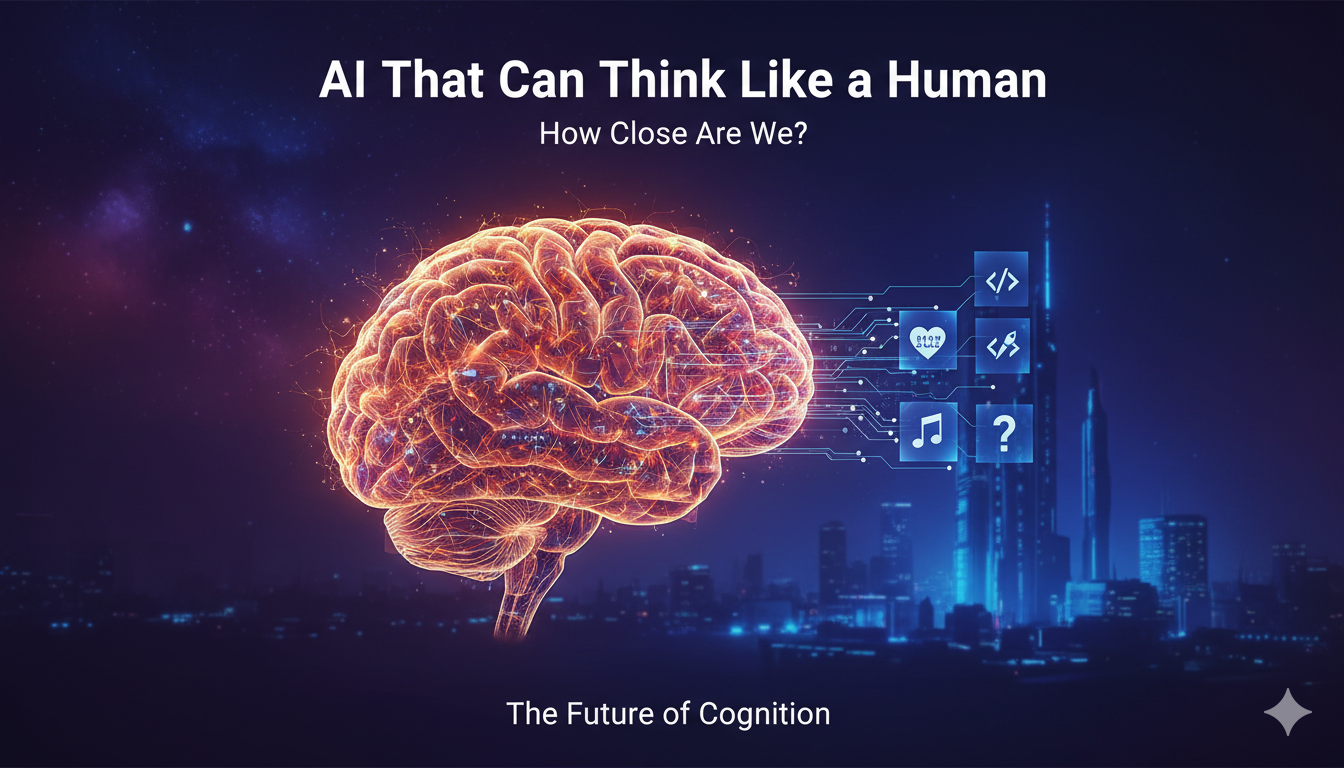
Artificial Intelligence has come a long way in recent years. From chatbots that answer questions to AI systems that compose music or create art, machines are beginning to mimic some aspects of human intelligence. But one question fascinates scientists, technologists, and the general public alike: Can AI really think like a human?
“AI can mimic thought, but it cannot feel the world the way we do.. “
Let’s explore how close we are—and what “thinking like a human” even means.
What Does “Thinking Like a Human” Mean
Humans don’t just process data—they reason, imagine, feel, and learn from experience. Thinking like a human involves:
- Understanding context: Knowing the “why” behind actions, not just the “what.”
- Reasoning: Making decisions based on logic, morals, and intuition.
- Learning from mistakes: Adapting behavior in real time, without retraining.
- Creativity: Generating ideas that have never existed before.
- Emotional intelligence: Recognizing and responding to emotions.
Most current AI excels at pattern recognition and prediction, but true human-like thinking requires self-awareness, common sense, and flexible reasoning, which is still a huge challenge.
How Current AI Measures Up
Modern AI, especially Large Language Models (LLMs) like ChatGPT or GPT-5, can mimic human conversation remarkably well. They can:
- Write essays, poems, and code.
- Answer complex questions.
- Make decisions in games like chess and Go.
Yet, these models don’t truly “understand” what they’re doing—they predict likely responses based on massive amounts of data. This is called statistical reasoning, not conscious thought.
Other AI systems, like autonomous robots, can learn from experience, but their understanding is narrow and task-specific. A robot that learns to play soccer cannot suddenly start cooking dinner or solving ethical dilemmas like a human.
The Biggest Challenges
- Common Sense Reasoning
Humans can infer hidden truths easily, while AI struggles with “obvious” knowledge. For example, AI might not know that a heavy object dropped indoors could break something. - Emotions and Morality
Human decisions are influenced by empathy, fear, joy, and ethical considerations. AI can simulate these concepts but does not feel them. - Autonomous Creativity
AI can generate art or music, but it lacks intent and understanding. True creativity requires context, inspiration, and meaning—a level AI hasn’t reached. - Self-Awareness
Currently, no AI has consciousness. Machines don’t have beliefs, desires, or awareness of their own existence.
Are We Getting Closer?
Yes—but gradually. Emerging technologies like neurosymbolic AI, memory-augmented models, and self-improving agents aim to give AI more flexible reasoning and memory, bridging the gap between narrow intelligence and human-like cognition.
“The closer machines get to thinking like us, the more we must ask—what does it truly mean to think? “
Experts believe human-level AI could be decades away, but AI that approximates certain aspects of human thinking—like reasoning, planning, and problem-solving—is already here and improving rapidly.
Why It Matter
Understanding whether AI can think like humans isn’t just a philosophical question—it has real-world implications:
- Ethics: Should we give rights to intelligent machines?
- Jobs: How will human labor coexist with thinking machines?
- Safety: Can machines make moral decisions under uncertainty?
The closer AI comes to thinking like humans, the more urgent these questions become.
Conclusion
AI is advancing at an astonishing pace, but true human-like thinking remains a frontier. For now, AI can simulate certain cognitive tasks, predict patterns, and even surprise us with creative outputs—but it doesn’t yet “think” the way we do.
As research continues, one thing is clear: the journey toward AI that can think like a human is as exciting as it is challenging—and it’s reshaping the way we interact with technology, society, and even ourselves.
What do you think—will AI ever truly think like humans, or is consciousness uniquely human? Share your thoughts in the comments below!
