


Hello Cyber Builders 🖖
This week, we’re diving into the crypto industry with an analytical lens, examining its intersections with cybersecurity and the broader implications for technology and society. I’ve been following it for years because it’s so closely tied to cybersecurity. Some people say “crypto” has a casino vibe, and it’s true that early on, speculation and the lure of quick money drew in a lot of folks.
However, a strong community of tech enthusiasts who value privacy, security, and decentralization has shaped “crypto” since its inception. In many of these use cases, adoption is strengthening. Concrete value is built on crypto technologies such as MPC (Multi-party computation) and ZK (Zero-Knowledge Proof). MPC allows multiple parties to jointly compute a function over their inputs while keeping those inputs private. This ensures sensitive data can be used without exposure, significantly benefiting cybersecurity measures. ZK proofs, on the other hand, enable one party to prove to another that a statement is true without revealing anything beyond the statement’s validity. This mechanism is crucial for maintaining privacy while ensuring the integrity of transactions and interactions.
With A16Z releasing its “state of crypto 2025” (LINK), I want to share my take on what matters most. I think crypto-technologies, or Web3, have the potential to address many challenges in digital society. I’ll explain why crypto is about more than just technology and point out the key parts of the report.
Merry Christmas to all 🎄🎅🏽
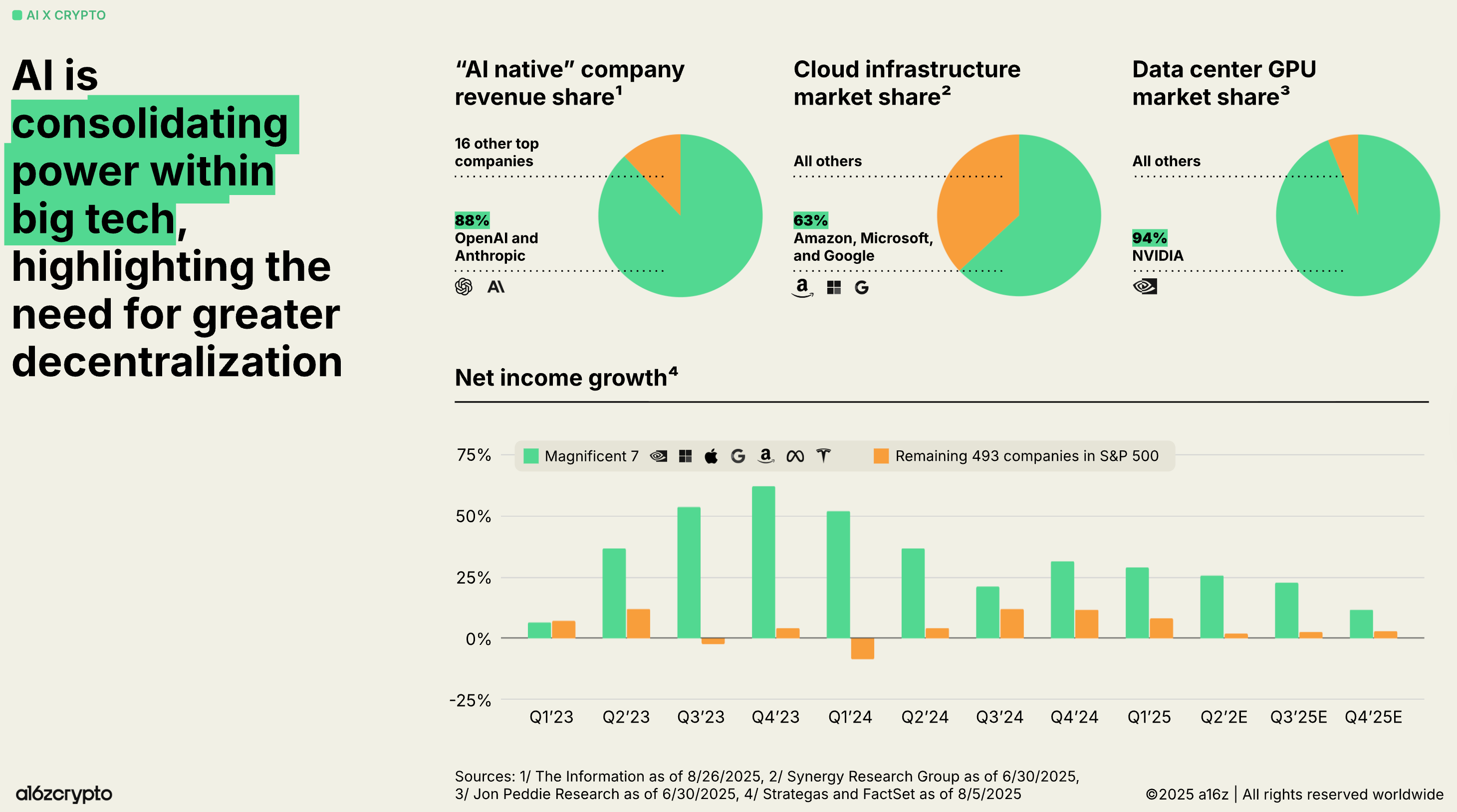
Any tech is, in the end, political, don’t you think?
Over the last fifteen years, a handful of companies have captured immense economic value, and now they control the digital infrastructure that powers our world. These actors perfectly played the transition of the global economy to the Internet. They absorbed most of the value in e-commerce, social interaction, cloud computing, storage, networking, and enterprise IT systems—layers that are now absolutely central to how modern economies function. Unsurprisingly, these companies sit at the very top of global market capitalizations today. They don’t just sell products or services; they control critical infrastructure and shape the rules of entire markets.
At the same time, we’re seeing growing attempts to control speech and behavior. We increasingly see attempts to censor individuals, regulate speech, or control behavior, often under the banner of protecting freedom or stability. Paradoxically, some of the loudest defenders of “free speech” are also willing to decide what people can or cannot say, where they can live, or how they can operate—even across borders.
In this context, decentralization becomes a profoundly political tool. I want to be very explicit about this: decentralization is not an abstract ideology. It is a practical mechanism to counter the centralization of capital, control, and, ultimately, freedom.
Owning your data, your assets, and your digital identity matters. Today, most of what we use is borrowed. We rent computing in the cloud. We rely on networks and machines owned by someone else. We operate inside systems whose rules can change overnight, without our consent.
We won’t be more cyber-resilient without a stronger ownership of the digital economy, where our economic power will secure our freedom.
The promise of crypto technology is precisely to invert that relationship. It is about ownership rather than permission. About holding assets rather than accessing them temporarily. About being able to act, transact, and interact without depending entirely on centralized intermediaries.
This does not mean rejecting institutions or regulation altogether, but it does mean rebalancing power. Crypto, at its core, offers a way to reintroduce individual and collective sovereignty into the digital world. And in an era where both corporate and governmental control are expanding, that promise is not marginal—it may be one of the most important technological and political questions of our time.
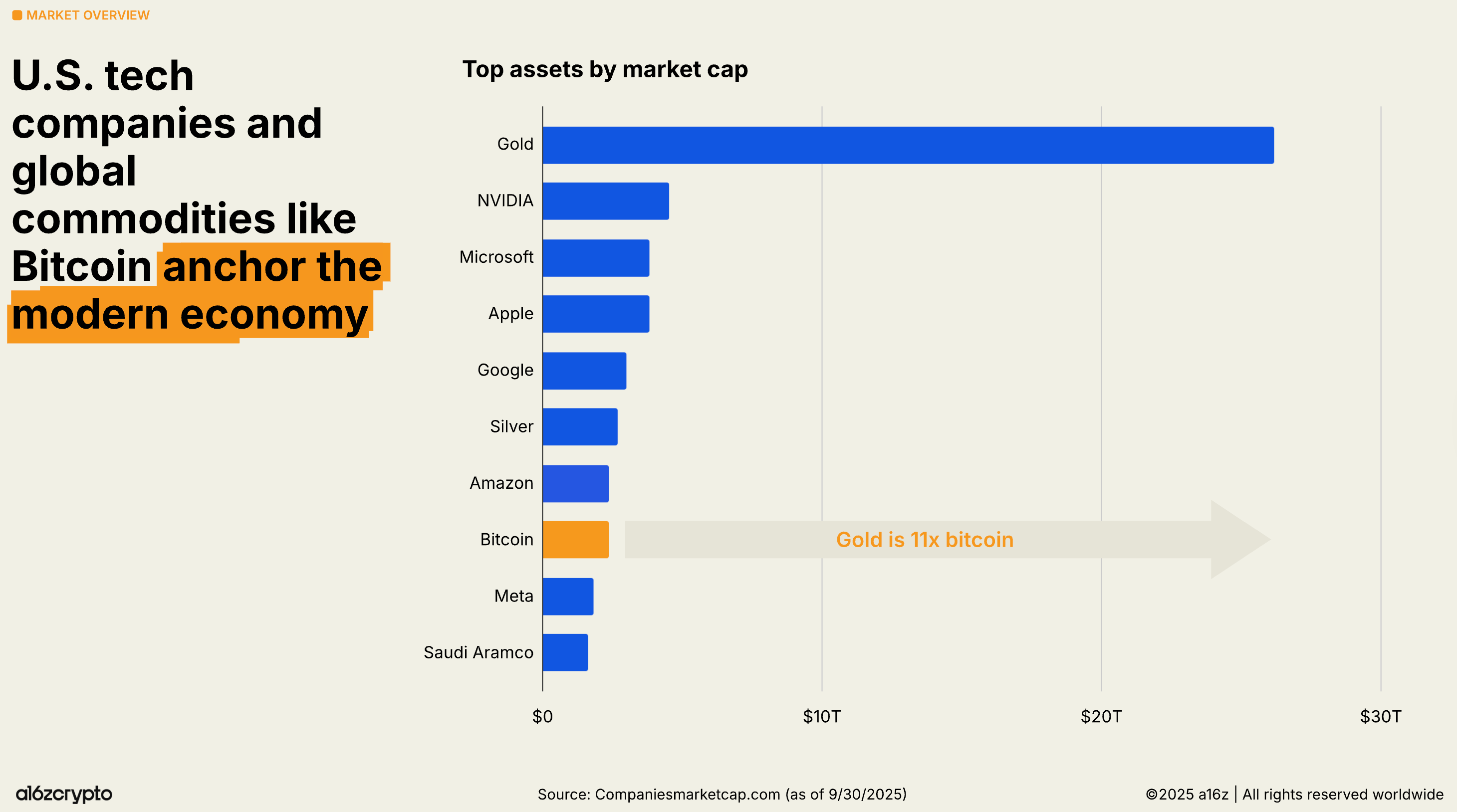
In 2025, the crypto market changed. It’s not just a fringe experiment anymore—it’s now a key part of the global economy. What stands out to me is seeing Bitcoin’s value shown alongside assets it has never been compared with before. Right after Gold and the Magnificent Seven, you’ll find Bitcoin. That alone says a lot. Bitcoin is now a major global asset, moving in line with the rest of the market. When the economy dips, Bitcoin is affected. When things pick up, it often recovers faster and stronger.
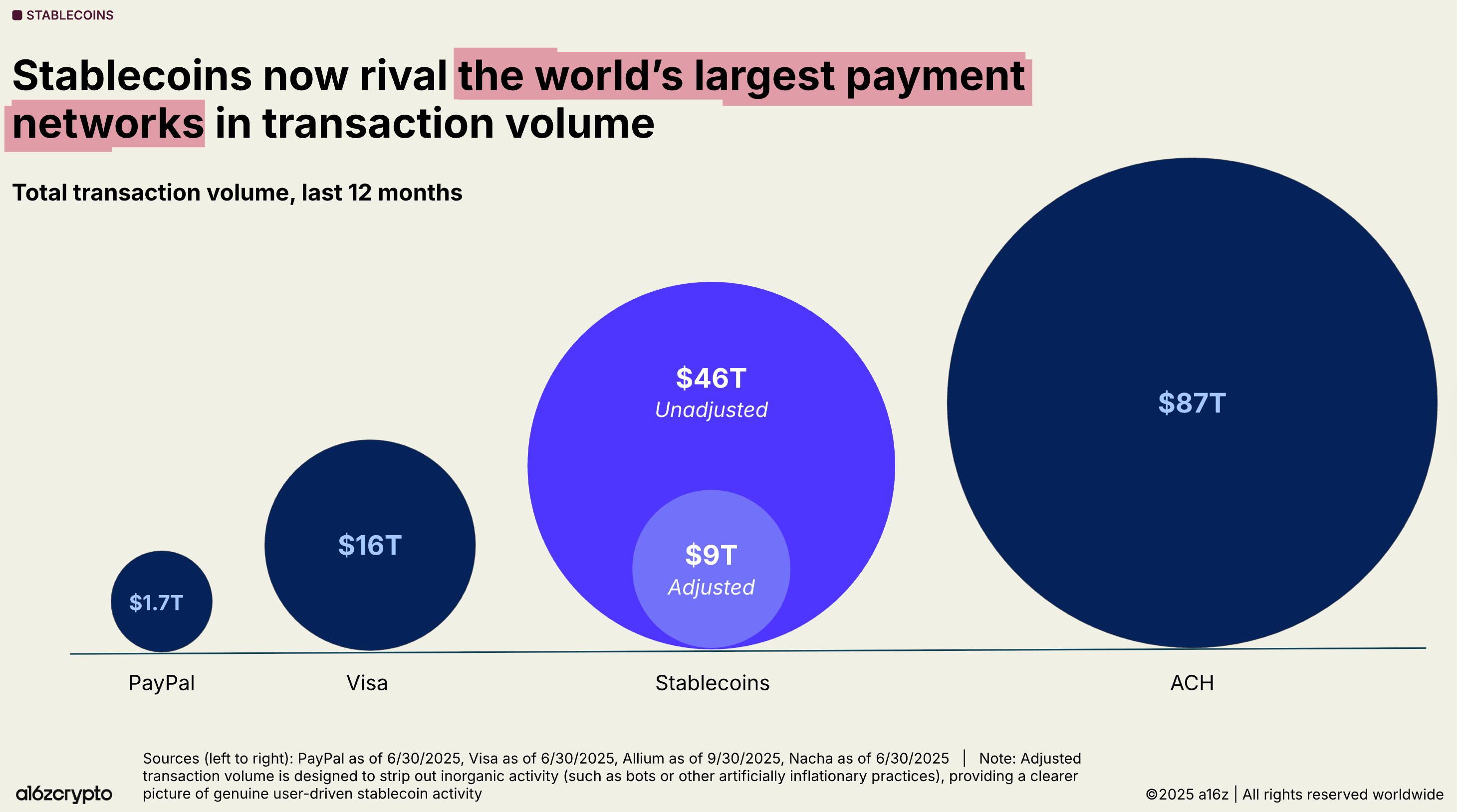
One of the most fascinating developments is the surge of stablecoins—crypto tokens pegged to a currency like the US dollar. The massive growth of these tokens was a real surprise, at least for me. Companies like Tether and Circle are issuing billions of dollars in digital assets backed by US Treasury bonds.
Stablecoin adoption creates a strange loop: private crypto companies are fueling demand for US debt, effectively strengthening the dollar’s dominance. USD stablecoins are reinforcing the US dollar’s supremacy over other currencies.
But beyond geopolitics, stablecoins might be one of crypto’s first true killer apps. They offer a way to move money with dramatically lower fees, sidestepping the traditional payment rails of Visa and Mastercard. At a global scale, saving a few percent on every transaction is anything but marginal.
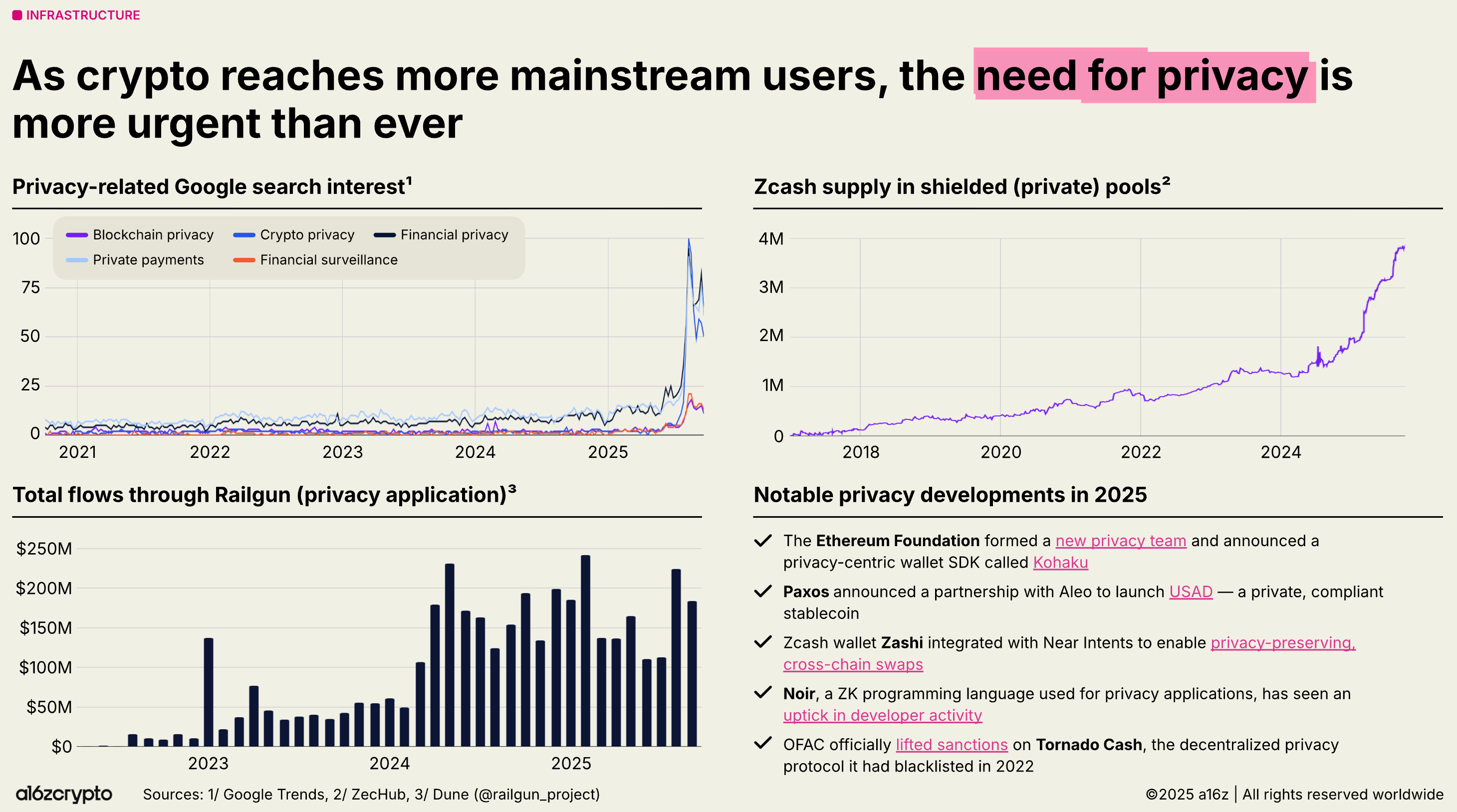
There’s a growing movement around privacy, driven by technologies like zero-knowledge proofs (ZK proofs). The idea is simple but powerful: you can prove something is true without revealing the underlying data.
You could prove you have enough funds for a contract without disclosing your bank balance, or prove you’re over 18 without showing your ID. In a world where our data is constantly monitored, ZK proofs offer a way to reclaim our privacy.
I’d love to see more cybersecurity founders embracing ZK technologies as they mature. I do think the crypto world tends to “bundle” ZK with blockchain, but aside from blockchain and the financial aspects, there are many other use cases for ZK.
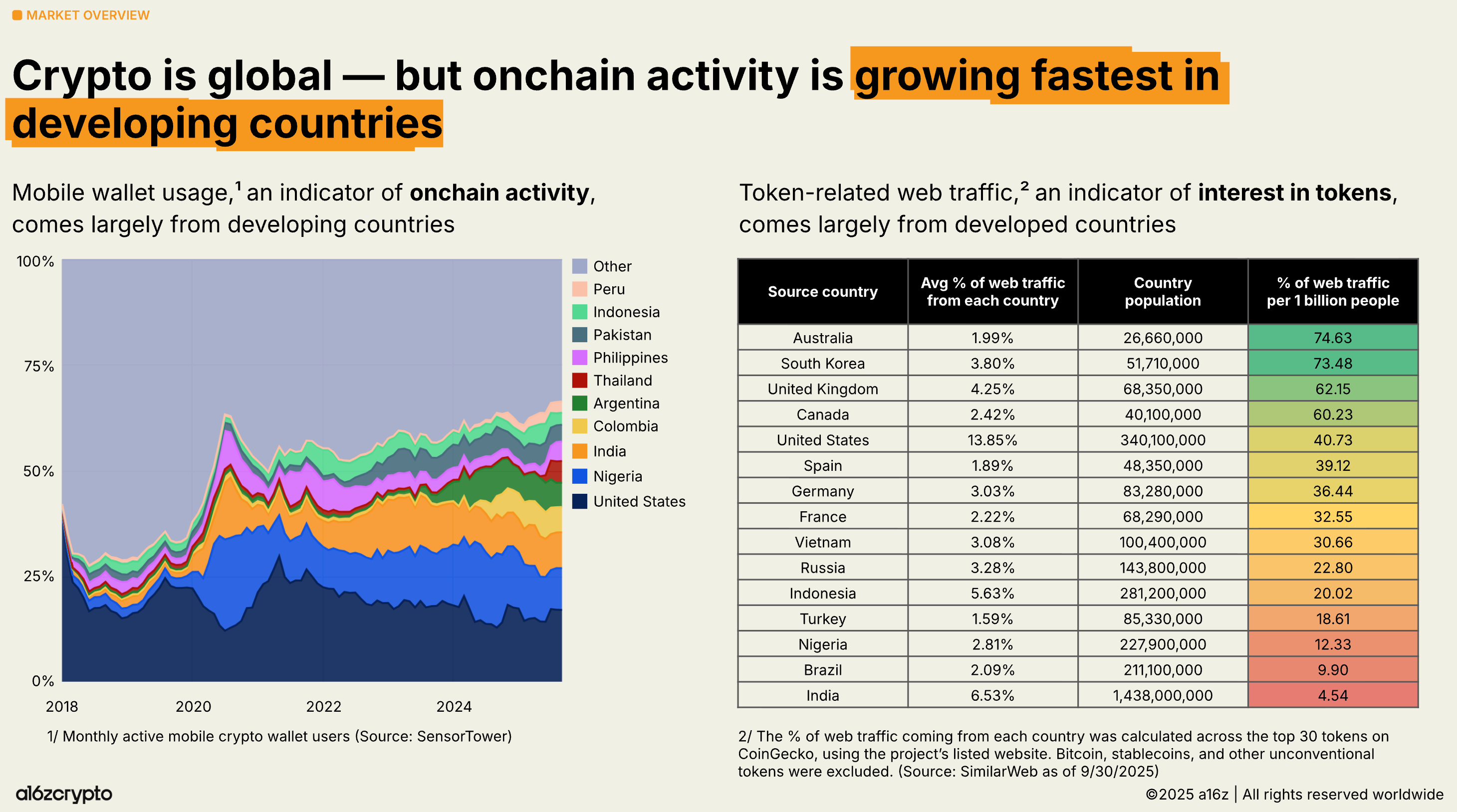
We often hear that Bitcoin was supposed to be a refuge, a counter-cyclical asset. But is that really true? The most telling evidence comes from crypto wallet usage, which is exploding not in the world’s financial capitals but in places like India, Argentina, Nigeria, and the Philippines.
In economies with shaky monetary stability and untrustworthy institutions, crypto isn’t just an investment—it’s essential infrastructure. It’s a shield against inflation, a cheaper way to send money home, and a lifeline when the traditional financial system fails.
Here in the West, we don’t feel these pressures as acutely, so we see crypto through a different lens.
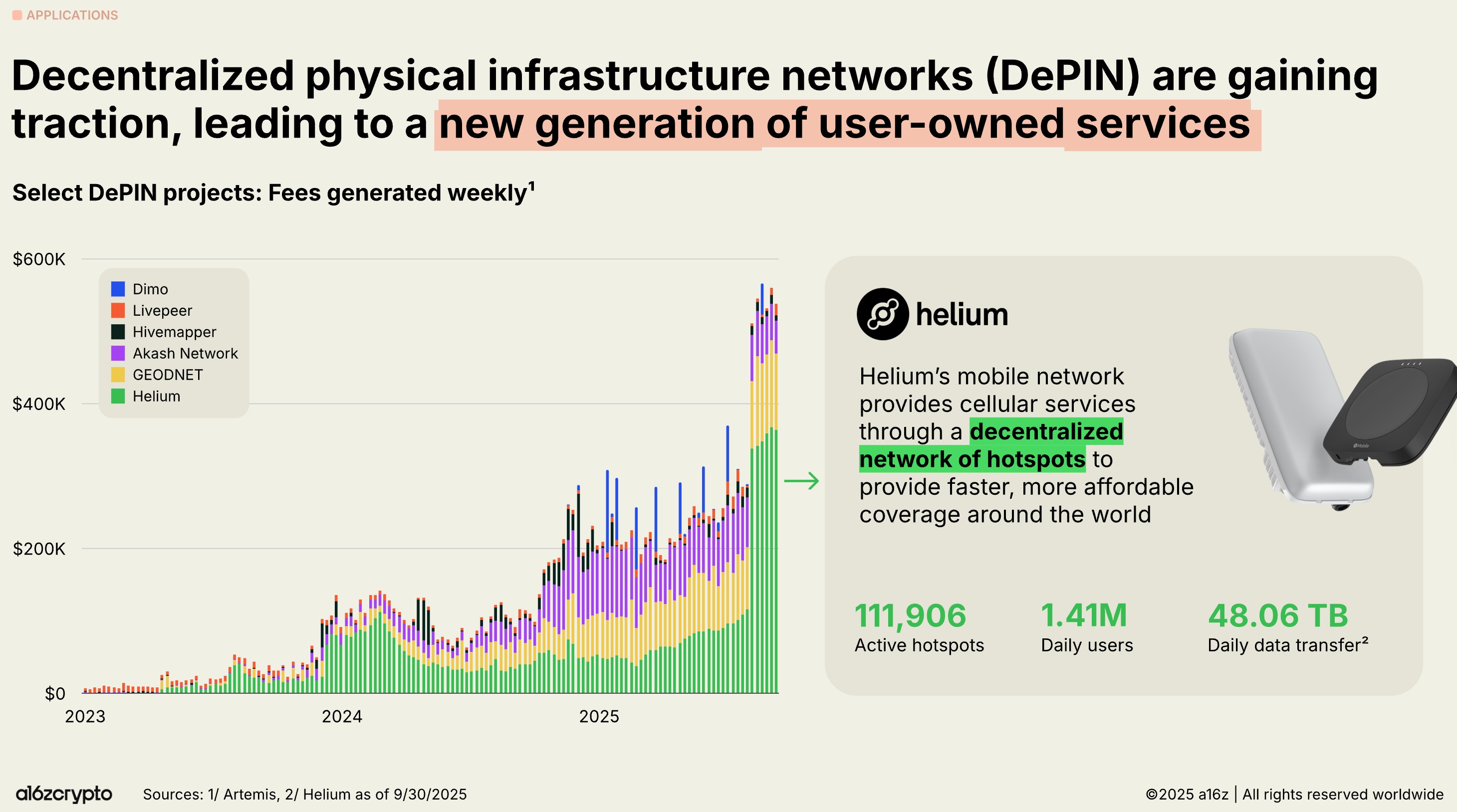
The real-world economy is starting to see blockchain as more than just a financial tool. It’s becoming the underlying infrastructure for new, decentralized systems. It’s an evolution of the traditional capital economy: how capital expenditures can be undertaken by a group of people who, in return, collect gains over time.
I’m particularly interested in DePIN (Decentralized Physical Infrastructure) projects like Helium, which is building a decentralized network for IoT and mobile devices. What’s fascinating here is that the network creation itself is decentralized. Users buy and deploy hardware, and in return, they’re rewarded for providing network coverage AND network traffic.
It’s a model that could be applied to storage, computing, AI, and more. This is all possible because the underlying technology has matured. Blockchains like Solana can now handle high transaction volumes at a low cost, opening the door to once-impossible applications.
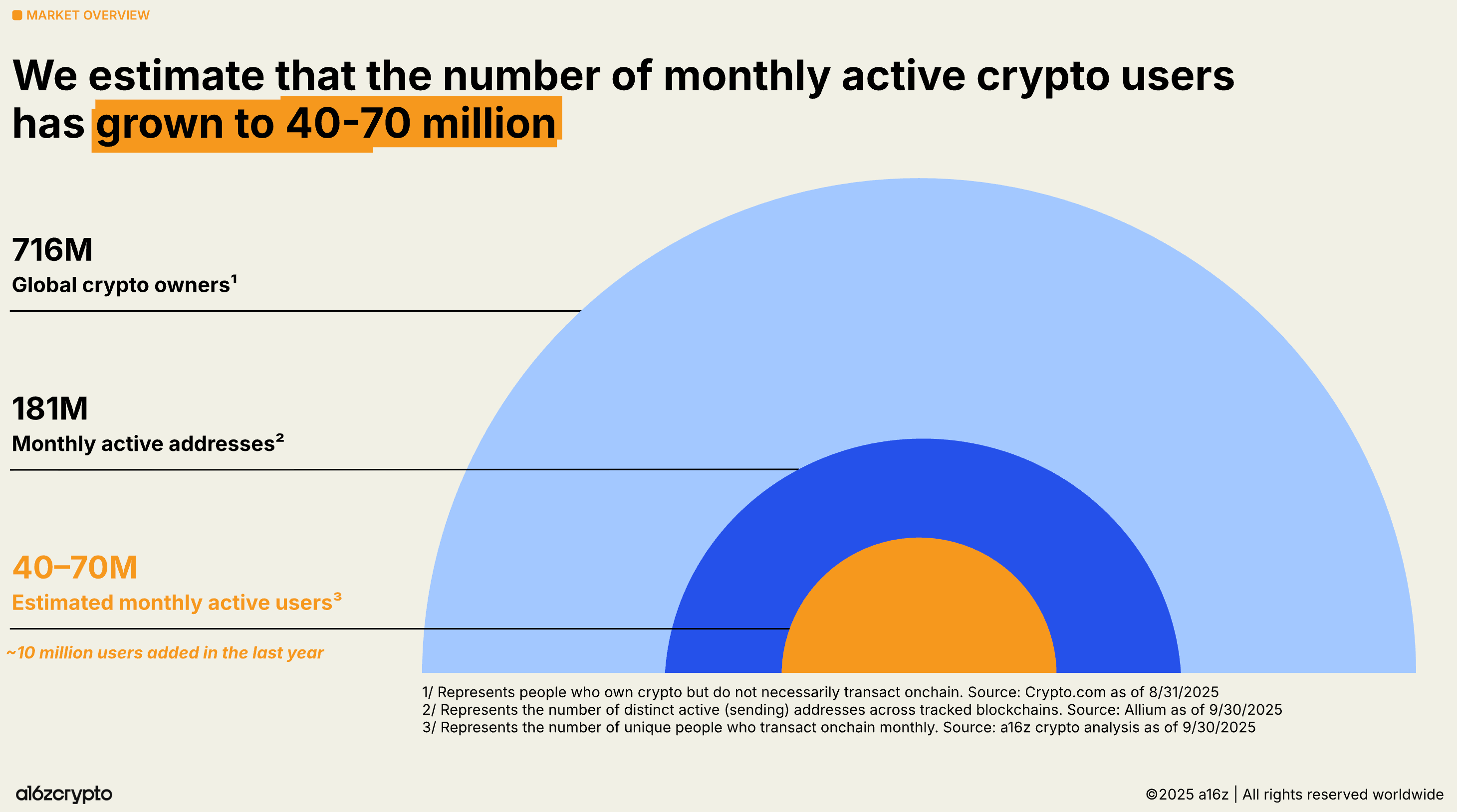
Crypto can still be seen as a very early-stage technology. Bitcoin was launched in 2008, and since then, it has gone through multiple cycles, massive hype, deep crashes, and broad public exposure. Yet, if you look at real usage today—and if you remove bots, on-chain noise, and AI-generated activity, whether on blockchains or social networks—you probably end up with something like 40 to 70 million active monthly users.
That number is strikingly similar to the number of internet users around 1995. I’m old enough to remember that time—I was 20—and it really felt like the very beginning of the Internet. Access was limited, slow, and constrained to specific places: public libraries, universities, Internet rooms, cyber cafés, where you often had to wait for a seat.
From that perspective, it’s easy to imagine how much crypto usage could still grow if the right incentives and applications start to compound. Today, developer activity is already concentrating around a few early giants like Coinbase, Solana, and Ethereum, which act as gravity centers for new applications.
The future of crypto hinges on one thing: real-world use cases. Right now, a large part of the activity still reflects what Chris Dixon calls a “casino culture,” driven by speculation.
Outside of emerging economies, we’re still waiting for the killer apps that will make crypto a part of our daily lives. Will it be in commerce? Social media? Messaging? The answer isn’t clear yet.
Building future will require more than just better technology; it will demand new incentives and experiences that go beyond a quick profit.
2026-2030 will be a fascinating period to live in tech.
Laurent 💚
