


Hello Cyber Builders 🖖,
The world’s heart beats in bytes, and right now, it is racing. Driven by AI and Digital Technologies (“Tech”), the global pulse is accelerating. Yet, here in Europe, it often feels like we are out of breath.
Imagine standing in a long queue at a busy European border crossing. While the digital world sprints, you are watching a single customs officer stamp passports by hand, echoing a past era. It feels like the system is struggling to keep up.
Society always moves forward; there is no way back to heavy files or horse-drawn carriages. But my fellow Europeans are often seen as reluctant to embrace the “tech cardio” needed to compete. This isn’t just inflexibility—it’s a complex mix of culture and history. But if we want to stay in the race, we need to understand it and fix it.
As an optimist, European entrepreneur, and engineer, I’ll break down why Europeans are reluctant to adopt digital technologies, why we need broader engagement, and how we can grow our economy.
Tech is not political by itself. It is how we use these technologies that matters. I believe that hardware, software, and digital services can help us tackle big challenges like inequality, the gender gap, access to education, demographic decline, and climate change.
In this post:
-
Tech is at the center of politics in the US and China. The US Tech-right and China’s techno-utilitarians use digital technologies differently, aligned with their political goals.
-
In this context, Europe has no role models and lacks leading companies in digital technologies. We do not have a software equivalent to the East India Company or even a decentralized version like Die Hanse.
-
The 19th and 20th centuries shaped how Europeans structured their democracies and values. In the twenty-first century, Tech is now at the center of foreign policies.
-
The heart of the world beats in bytes. Europe is losing economically. Europe’s digital technologies deficit with the US is €260 billion. Europe is trapped, trying to mimic ecosystems like Silicon Valley.
Here are some perspectives on how to invent a new European model. We should not copy others, but create something different, rooted in European culture.

In the USA, apparently from early 2024 but in reality for a decade, the Tech scene in the valley has aligned its interests with the right wing of the Republican Party. Peter Thiel and Elon Musk are often cited as being at the center of this shift.
The term itself, “Tech Right,” is confusing. It includes many different flavors:
But it would be too caricatural to classify ALL Tech Entrepreneurs, their investors, or their staff as right-leaning. I worked for a valley’s company, working with many teams. The blend of different cultures, people coming from all over the world, was powerful. They are willing to develop technologies AND build a better world, code software AND fight to address inequalities, sell Tech products AND bridge the gap with those who are not part of their world. It is not exclusive. Both can be done at the same time.
On the other end, some “effective accelerationists,” not politicians but entrepreneurs and investors, are very vocal. They are now creating podcasts, books, and blog posts to explain their views in great detail. If it’s not politics, it is very close.
The most significant one is Marc Andreessen, founder of Netscape in the 90s and now CEO of A16z, the world’s largest and most influential investment fund.
We believe markets lift people out of poverty – in fact, markets are by far the most effective way to lift vast numbers of people out of poverty, and always have been.
[…]
We believe markets are an inherently individualistic way to achieve superior collective outcomes.
The Techno-Optimist Manifesto is not simply advocacy for technology, but a normative manifesto that sees technology as the fundamental moral force for human progress and argues for accelerationism and market-driven innovation as the best means to achieve abundance and address existential challenges. Andreessen clearly values technology’s rapid deployment over a more careful, balanced societal approach.
In this vast range of opinions, Jasmine Sun an independent writer focused on tech culture and Silicon Valley politics offers a very balanced perspective. Her Tech Right piece attempts to clarify a muddy, contested label that surged in public discourse in 2024 as tech leaders (CEOs, investors, founders) began publicly aligning with right-wing politics — especially around the 2024 US election and the Trump administration.
The ‘Tech Right’ is just one faction in a rising alliance of thinkers, policymakers, and industrialists…united by their focus on accelerating American innovation to drive growth and global primacy…
Jasmine Sun (link)
If the American “Tech Right” illustrates how digital technologies relate to a hyper‑market, hyper‑individualist political project, China offers a very different, almost mirror‑image approach. Where Silicon Valley’s right‑leaning faction wraps Tech in the language of personal freedom, disruption, and private capital – at the cost of inequalities and poverty -, Beijing treats it primarily as an instrument of state power and collective outcomes. This is where the idea of “techno‑utilitarianism” in the Chinese context comes in.
The phrase “techno-utilitarianism” isn’t formally defined in a single Chinese policy document, but scholars and analysts use it to describe China’s pragmatic, outcome-focused embrace of Tech, in which technological adoption and deployment are pursued rapidly to achieve state goals, with less preoccupation with intermediate ethical or legal debates.
Tech is treated as a tool to achieve national outcomes — economic growth, global competitiveness, social control, and geopolitical influence. Technological risks (e.g., privacy or ethical concerns) are often addressed after deployment rather than before. The state plays an active role in directing resources, setting incentives, and providing structural support for prioritized technologies.
China’s large population, coupled with a willingness to organise society as efficiently as possible, means that Chinese citizens trade many of the democratic rights enjoyed by citizens in other countries in exchange for a better material life. With the rise of AI, Tech helps to build a social score, the Social Credit System, where each citizen is scored based on their behavior in the public space. The score is then used to “logically” order citizens for many public services or their corporate lives.
Note that many researchers have found that this system is highly dysfunctional but less dystopian than we might fear.
Both approaches are very frightening for Europe. Europe does not adopt the “move fast and break things” mindset. European citizens are conscientious about their privacy and rights, and are highly mindful whenever a new technology threatens to reverse what Europeans have achieved over centuries. Europeans don’t trade control for speed.
Europe is a continent with a long history of technological revolutions, imperialism, and the eventual rise of democracy.
In the 19th century, it experienced extensive manufacturing and later established social benefits and labor unions. During this period, Europe invented the steam engine, pioneered steel production, and developed electricity-based products. Advances in hygiene, led by figures such as Joseph Lister and Louis Pasteur, enabled Europeans to live longer. Vaccines and other medical progress further improved public health. The mining industry exploited a vast workforce, leading workers to unionize and eventually secure social benefits.
At the time, the United Kingdom, France, and Germany were at the forefront of modern societies. They pursued large-scale colonialism—the UK alone ruled over nearly half a billion people worldwide—and their populations rapidly escaped poverty. This period marked a significant step forward for many who had previously endured suffering and poor health.
The 19th century was, on balance, an age of extraordinary prosperity—creating new societies centered on industrial progress, manufacturing, and public health. We should not forget also the human cost of running a worldwide empire.
The 20th century turned into a century of trauma and backlash. Two world wars, the Holocaust and other genocides, the rise and fall of totalitarian regimes, and the long, painful end of colonial empires forced Europeans to confront the darkest possibilities of power, nationalism, and ideology.
Today, I don’t think any European is seriously looking for solutions rooted in colonialism or imperial expansion. Those paths are widely understood as moral and strategic dead ends. Yet even as empires unraveled, deep inequities and class divides persisted within Europe itself, and their legacy is still visible.
This combination of 19th‑century optimism and 20th‑century catastrophe profoundly shaped how Europeans think about politics, institutions, and technology. It explains why, when new waves of disruption arrive—whether nuclear power, genetic engineering, or now digital technologies—Europe’s first reflex is caution: to ask how power could be abused, whose rights might be trampled, and what guardrails are needed to prevent history from rhyming again.
This history has shaped how Europeans structured their democracies, laws, and institutions. That’s why they believe in multilateralism—a network of different states and cultures embodied by the European Union—and in the rule of law, collaboration, and conversation rather than the rule of power or the dominance of the strongest.
Europeans value freedom of speech, but the promotion of hate, genocide, and terrorism is strictly forbidden. They also uphold freedom of religion, though in France, there has been a strict separation between church and state for 120 years. Politically, most European countries have multiple parties—typically five to ten—rather than just one or two dominant parties.
Yes, this culture of trade-offs and discussion is slower than market-driven “blitzscaling” approaches, but it is deeply rooted in Europe’s long history over the past 200 years.
There is also a strong European culture of regulating and creating rules and laws for almost everything, including new software and digital technologies. For an entrepreneur and software engineer like me, this is often very frustrating. I know that technology takes time to reach its full potential—its ultimate use cases often emerge only after years—or even decades—of real-world use. Over-regulating too early can stifle entrepreneurs’ freedom to explore and apply technology across a wide range of use cases.
I believe we need more room for experimentation and innovation. But that doesn’t mean we should be unregulated. We still need laws to protect markets, prevent monopolies, and guard against hatred or far-right discourse. History has shown us where unchecked power can lead, especially when amplified at scale. The challenge is finding the right balance.
At the same time, Europe enters the digital age with an unusual handicap: it has no clear role models and very few “master companies” in digital technologies. In earlier eras, Europeans could look to dominant commercial structures like the East India Company or decentralized trade alliances such as the old Hanseatic League as blueprints for economic power.
Today, we have no software equivalent—no European cloud or AI company that plays a structuring role for our ecosystem, sets global standards, or anchors an entire value chain around it. Instead, our engineers and entrepreneurs grow up in a landscape where the reference points are almost entirely American or, increasingly, Chinese.
This absence of homegrown models matters: it limits our collective ambition, our regulatory reflexes, and even our imagination about what European tech could be.
Technology is now at the center of foreign policies. As our lives become increasingly digital, regulating digital technology means regulating our lives, our economy, our work, our jobs, and our democracy.
In February 2025, JD Vance, the Vice President of the USA, delivered a very aggressive speech against how Europe structures its democracy and freedom of speech, arguing against EU regulations.
Consider also what happened to the ICC judge who ruled against Netanyahu and, in retaliation, was banned from any American-based system by the Trump administration.
What does this mean if you are a French person living in the Netherlands? It means you cannot hold any payment system because Visa and Mastercard are US companies. It means you cannot connect on any social networks because Facebook, LinkedIn, and X—all of these platforms are US-based. You cannot even have a WhatsApp account to chat with your family across borders. Nor can you have an email because Outlook is owned by Microsoft, and the list goes on.
Last but not least, the Trump administration also targeted Thierry Breton, a former French entrepreneur, former Minister of the Economy of France, and EU commissioner who led the creation of regulations such as the Digital Service Act and the Digital Market Act. He was banned from traveling to the US as if he were a gangster or a terrorist. Why? What crime did he commit? He was probably the most vocal European politician against the US’s digital dominance.
The world’s heart beats in bytes, and Europe needs to wake up.
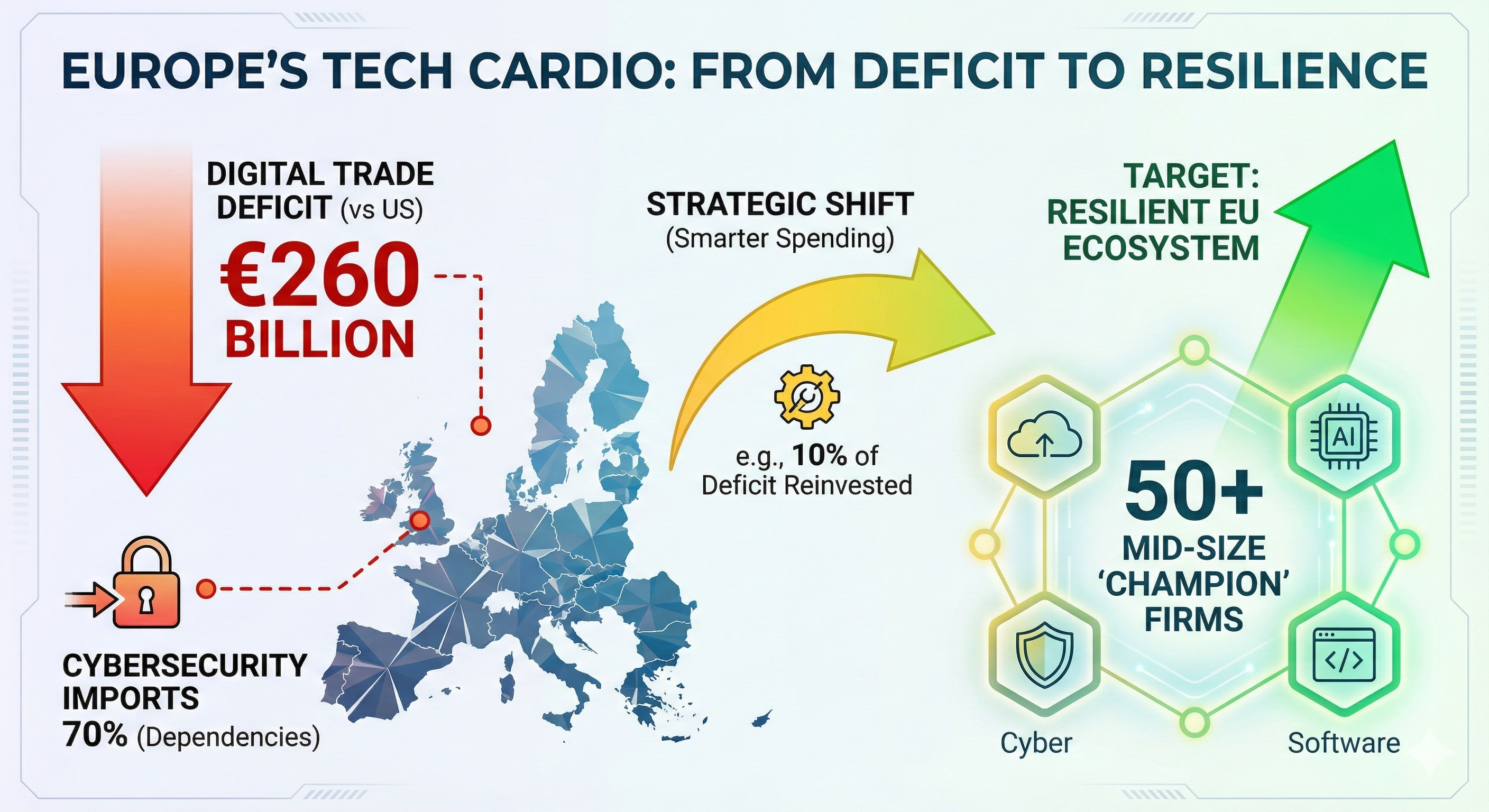
For those of you who are more analytically minded, let me give you two numbers. First, Europe’s digital service deficit—the balance between what we sell to the US and what we buy from the US, mostly from the Magnificent Seven and the tech industry—is €260 billion. That’s a lot of money.
What could we do if we just used 10% of that to buy products from EU companies? We would create hundreds of startups. What if we bought 50% of our supplies from EU companies instead of the US? We would restore our digital sovereignty. No additional money spent—just smarter spending.
Another number: Europe imports 70% of its cybersecurity products. We’re expected to invest more in our defense after the Ukraine invasion, yet we’re still failing to build a stronger cybersecurity industry. This industry would protect us against criminals on one side and state actors like North Korea or China on the other. It would make us more resilient, enable us to enforce our own rules and laws, and allow us to say what we want without fearing that our email access could be cut off yet again.
To restore our digital sovereignty, we need more autonomous technology from Europe. We must engage in this battle and create global companies rooted in European countries, whether in Tech, AI, or other critical sectors. Imagine a network where 50 mid-size firms share talent, capital, open-source components, and standards, creating a flywheel effect that strengthens our entire digital ecosystem. This interconnected approach, with many champions rather than reliance on a single giant, can lead to a sustainable and resilient technological frontier.
We have a few great companies like Black Forest Lab in Germany or Mistral in France, but we don’t have enough of them. We should have 50 companies like that if we want to be resilient. A company is a fragile “thing”—it can suffer leadership changes, economic struggles, or countless other challenges. If we rely on just one business in a critical area like this, what happens if it fails?
The digital economy isn’t about scaling vertically, like having one giant in nuclear energy or a handful of companies dominating the automotive industry. Instead, we need dozens, even hundreds, of cybersecurity, AI, and cloud software companies. We must create them.
Concrete levers include procurement from EU vendors, utilization of public–private funds, and participation in pan-European scaling programs.
This is a wake-up call. Let me be clear: there is no fatalism. There is no “it’s too late, and we should just live with it.” No topic is set in stone.
In other industries, arriving late has never been fatal. Take Japan. The modern car industry was born from European and American advances in combustion engines, steel, and other technologies. At the beginning of the 20th century, Japan was not a major player. Toyota – then Toyoda – was building weaving machines, almost an 18th‑century business. Yet through engineering excellence, science, and methods like lean manufacturing, they became the world’s largest car company and a pioneer in hybrid and electric vehicles. Nobody in Japan said, “It’s too late, we shouldn’t build cars.” They just built them, and eventually led. Korea has followed the same path.
Europe itself has already shown that it can move decisively in a strategic technology transition. With the REPowerEU Plan, the EU chose to phase out Russian fossil fuel imports, protect citizens and businesses from energy shocks, support Ukraine by weakening Russia’s war chest, and accelerate the shift to clean energy. In just a few years, the EU doubled solar generation since 2019, and channelled almost €110 billion into renewables in 2023 alone.
This is proof that when Europe treats technology as strategic – and combines regulation, investment, and industrial policy – we can move fast. But even here, we see the risks of a new dependency: over 95% of our solar PV modules come from China, and cheap imports are threatening EU manufacturers. We are on track to eliminate Russian gas, but we risk locking in a new structural reliance on Chinese hardware.
The lesson is clear: it is not too late for Europe to build leadership in digital technologies – cloud, AI, cybersecurity, and software. What we cannot afford is to repeat the same pattern of dependency.
We have the engineers. We have the talent. We have a market and are spending a lot already in Tech. We have the capital. What we need is the political courage and cultural shift to treat digital technologies as a core European project, not a niche for a few “nerdy, techy” people.
The world’s heart beats in bytes. We must develop our tech cardio.
We need to push for this change to happen faster. I’m committed to it and will support any initiative across Europe that advances it.
See you next week
Laurent 💚
