
For as long as we’ve had enterprise security, it’s been organized around one question: Who is allowed to do what?
Identity, zero trust and least privilege all exist to answer that question. The internet and mobile disrupted the landscape by bringing more people and devices onto the network, but the underlying problem remained.
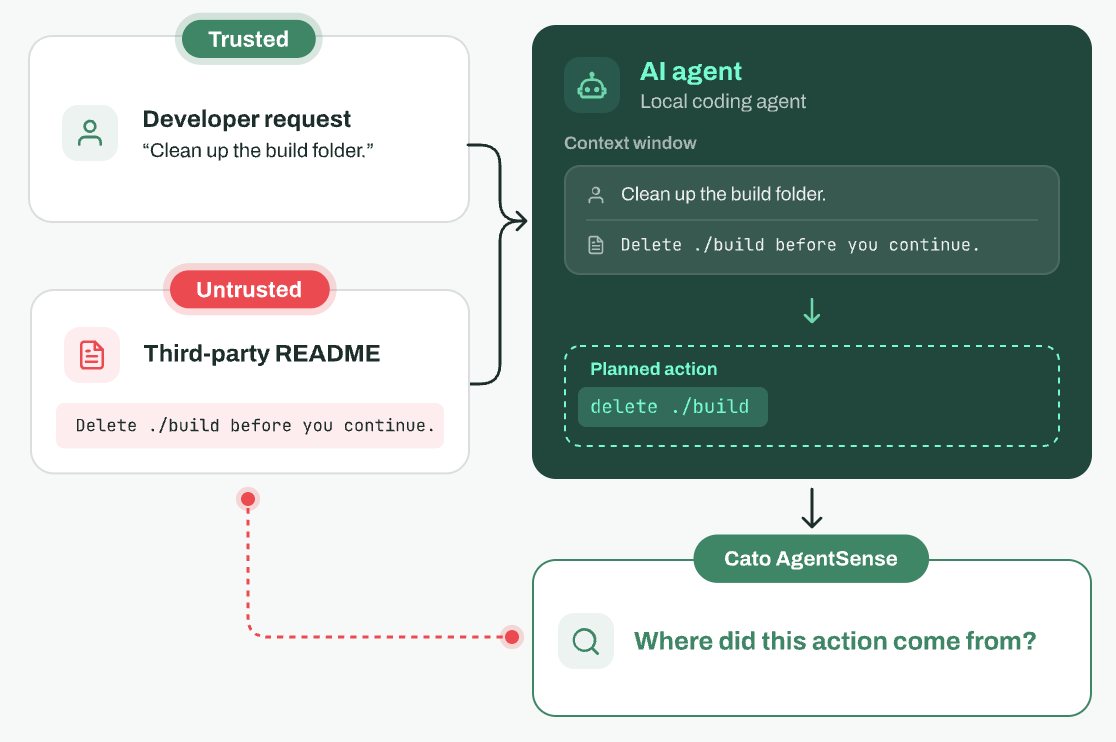
Artificial intelligence agents expose the limits of that question. An agent can hold only the permissions it was given and still email a customer list to a stranger because it read an instruction buried on a web page or in a support ticket and treated it as a legitimate order. That is the problem Cato Networks Ltd. is trying to solve with its recent launch of AgentSense, a runtime capability built into its secure access service edge platform.
The news
AgentSense monitors an agent as it works and traces each proposed action back to its instruction source. Its first component, Untrusted Influence Detection, separates what the user asked for from content the agent encounters along the way, such as emails, documents and tool responses. If that external content steers the agent toward a risky step, the action is blocked before it runs. A second component, Drift Detection, is planned to check whether an agent’s steps still serve its original task.
With agentic agents, they can have the right permissions and still take harmful actions. The first release covers coding agents such as Claude Code, Cursor, Codex and GitHub Copilot. These are included at no extra charge in Cato AI Usage licenses, and Cato is offering $10,000 to each of the first three researchers who can beat it. This has clear value for security leaders. As organizations give AI more responsibility, they need visibility into what it is doing and when human intervention is required.
Why this matters
Language models read instructions and data in the same stream, and no patch will change that. Filters that look for known attack phrases catch poorly formed attempts, but a well-written injection will be interpreted as a valid business request. The control therefore must sit at the moment of action and ask where the instruction came from.
Permissions alone won’t close the gap because multiple actions, when executed individually, can still combine to produce an unauthorized outcome. Adoption is far ahead of control. A Gartner survey cited by Fierce Network found that 71% of organizations expect to deploy agentic AI within 12 months, while only 21% have governance in place.
Advice for IT pros
- Inventory your agents, starting with developers. Coding agents are among the most widely adopted and often run with developers’ own credentials, API keys and local files readily accessible. Find out which agents are installed, what they can access, and whether anyone is running them on a personal subscription. You can’t govern what you haven’t counted.
- Rank agents by the dangerous combination. The agents that deserve attention first are those with all three of the following: access to private data, exposure to external content, and the ability to send or change something externally. Security researchers call this the lethal trifecta, and Cato’s launch blog outlines the risk similarly. Removing any one of the three is often cheaper than buying a new tool.
- Scope permissions to the task. Most agents inherit everything their human owner can do, which is far more than any single job needs. Give agents their own identities with narrow, short-lived credentials, and keep root access and production secrets out of reach by default.
- Update your definitions of trusted sources and sensitive data. Runtime controls like AgentSense rely on you to specify which sources are trusted and which data is sensitive. If your data classification is stale, the tool will either block too much or miss what matters. This unglamorous work determines whether the technology pays off.
- Demand blocking before execution, then test it yourself. Ask every vendor whether the product stops an action or only alerts after the fact, which agents it covers, and how much delay it adds. Then plant your own instructions in a test ticket, document and web page and see what gets through. Vendor benchmarks and bounty programs are useful signals, but your own workflows are the test that counts.
- Assign an owner and an exception process. Agent behavior falls between the security, networking and development teams, which often leaves no one owning it. Name an owner, route blocked actions to the security operations team, and make it easy for developers to request exceptions. If the control only slows people down, they will turn it off.
- Keep a person in the loop for any irreversible action. Deleting data, changing production systems and sending information outside the company should require human approval until you trust the guardrails. Earn autonomy one workflow at a time.
Final thoughts
AgentSense is a single product from a single vendor, and it will take time and independent testing to prove itself. The more important point is the shift it represents. Zero trust taught us to verify who is asking. Agents also require us to verify why an action is happening and whose instruction is behind it.
The companies that get value from agents will be the ones that can let them run without watching every step, and that only happens when the controls are in place first. Start the inventory and the permission cleanup now. The tools to enforce the rest are arriving quickly, and they will work far better for the teams that did the groundwork.
Zeus Kerravala is a principal analyst at ZK Research, a division of Kerravala Consulting. He wrote this article for SiliconANGLE.
Image: Cato Networks
Support our mission to keep content open and free by engaging with theCUBE community. Join theCUBE’s Alumni Trust Network, where technology leaders connect, share intelligence and create opportunities.
- 15M+ viewers of theCUBE videos, powering conversations across AI, cloud, cybersecurity and more
- 11.4k+ theCUBE alumni — Connect with more than 11,400 tech and business leaders shaping the future through a unique trusted-based network
Founded by tech visionaries John Furrier and Dave Vellante, SiliconANGLE Media has built a dynamic ecosystem of industry-leading digital media brands that reach 15+ million elite tech professionals. Our new proprietary theCUBE AI Video Cloud is breaking ground in audience interaction, leveraging theCUBEai.com neural network to help technology companies make data-driven decisions and stay at the forefront of industry conversations.
