

Washington has cleared a milestone in its effort to become a hub for lower-carbon jet fuel, unlocking tax incentives aimed at attracting production to the state.
Gov. Bob Ferguson announced Friday that Washington has reached the capacity to produce at least 20 million gallons of sustainable aviation fuel annually. That triggers incentives taking effect Jan. 1, including a tax credit starting at $1 per gallon for qualifying fuel. The credit rises to as much as $2 for fuels with greater emissions reductions.
The Department of Ecology recently surveyed potential producers and confirmed that Phillips 66’s Ferndale refinery alone has enough capacity to meet the threshold. The benchmark measures production capacity, not actual output.
@media (max-width: 600px) {
aside.callout { float:none !important; max-width:100% !important; margin-left:0 !important; margin-right:0 !important; }
aside.callout .callout-img { display:none !important; }
}
Sustainable aviation fuel, or SAF, is widely seen as one of the most promising near-term options for cutting aviation’s carbon emissions because it can be blended with conventional jet fuel and used in existing aircraft. But it remains more expensive than petroleum-based fuel, and production is orders of magnitude below the industry’s needs.
“We have so many unique assets in Washington that position us to be global leaders in the SAF transition, and this tax incentive is the final element needed to really unleash the tidal wave of opportunity,” said Jake Gentry, executive director of the Cascadia Sustainable Aviation Accelerator, in a GeekWire interview.
The accelerator launched in January, bringing together airlines, SAF producers, public officials, researchers and others to promote the industry in the Pacific Northwest. Its work includes helping producers secure financing, develop feedstock supplies and connect with customers.
Cleaner fuel, limited supply
SAF can be produced from used cooking oil, grease and fats, plants and agricultural waste, and captured carbon. Its climate benefits depend on the raw materials and energy used to make it.
The fuel still produces carbon dioxide when burned. But unlike petroleum-based jet fuel, which releases carbon that would otherwise stay trapped underground, SAF recycles carbon already in circulation in plants, animals and the atmosphere. Washington’s per-gallon tax credit requires emissions at least 50% below those of conventional jet fuel.
Washington’s production capacity is below that of some larger facilities elsewhere. A Diamond Green Diesel plant in Texas can produce up to 235 million gallons of SAF annually, according to its partner Valero. That figure also represents capacity, not actual production.
With the minimum threshold being met, all Washington SAF producers will be eligible for the tax credit regardless of their volumes.
Washington’s emerging producers
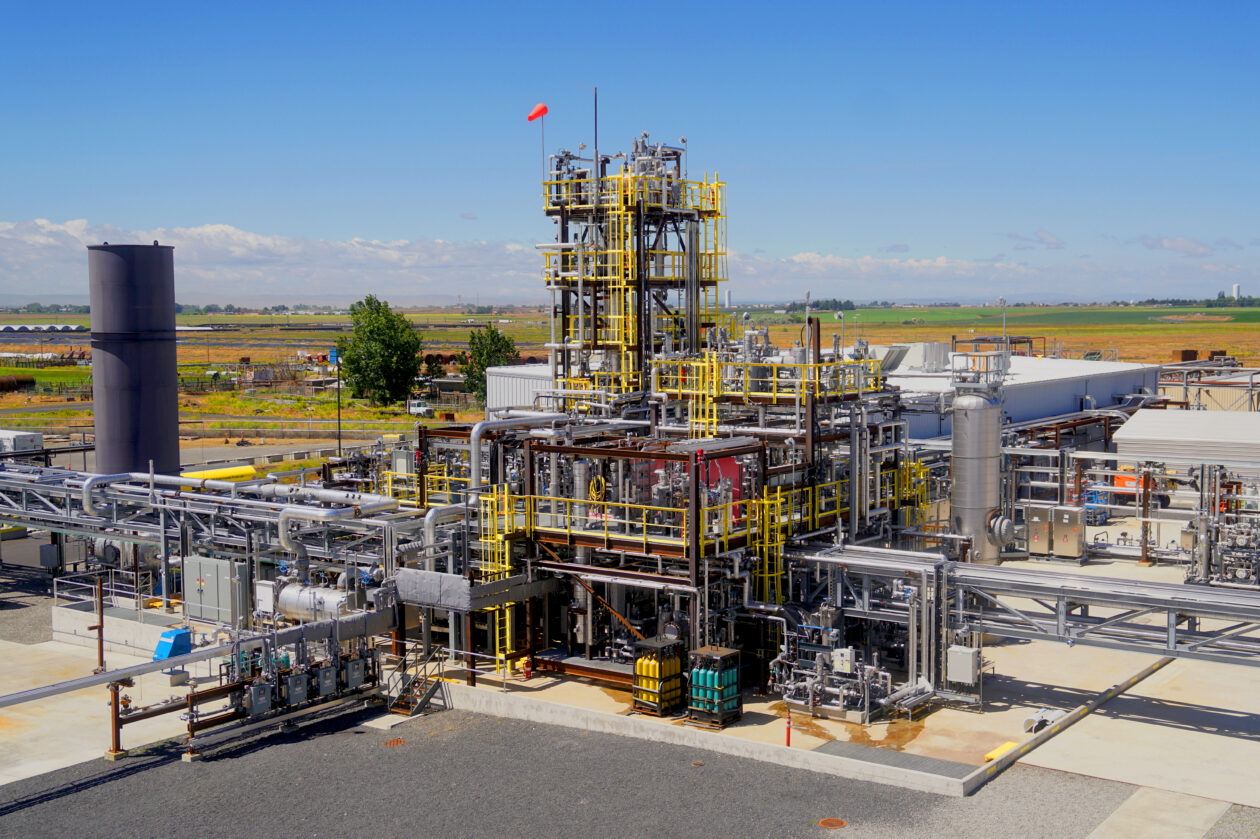
A startup called Twelve is already making the fuel in the central Washington city of Moses Lake. The company opened its AirPlant One facility last year and began commercially producing SAF this summer from captured carbon dioxide and water. The technology has the potential to create the most climate-friendly SAF available, potentially unlocking the largest state tax credits.
Nicholas Flanders, Twelve’s CEO and co-founder, welcomed the announcement.
“This is an extraordinary signal of support for our industry,” Flanders said via email. “Washington is building the leading foundation in the country for next-generation domestic fuel production, and Twelve is ready to build upon it.”
Twelve’s first-of-its-kind facility is designed to make up to 50,000 gallons of SAF per year. AirPlant Two, a much bigger plant that would make tens of millions of gallons a year, is in development. The company hasn’t said where it will be located.
Dutch-owned SkyNRG is building a SAF facility in Walla Walla, Wash., and plans to use renewable natural gas that’s captured at landfills and from dairy waste as a feedstock. Earlier this year, leaders said the company had secured key environmental approvals and plans to start commercial operations in 2030.
The economics of scaling up
Washington’s relatively affordable hydroelectric power has historically helped attract climate tech companies. But growing electricity demand, including from data centers, is putting pressure on the region’s power supply.
Washington also faces competition from other states offering SAF tax incentives. Illinois and Minnesota already offer credits, and Nebraska’s program starts next year. Meanwhile, a federal credit was reduced from $1.75 per gallon to $1 after President Donald Trump returned to office.
Washington leaders tout other perks that could attract SAF production. It’s the only state that offers both a SAF tax credit and a clean fuel standard. Together, the policies help make cleaner jet fuel more cost-competitive by providing tax benefits and allowing SAF producers to earn credits they can sell to other fuel suppliers that need to meet the state’s emissions requirements.
The accelerator also supports efforts with Washington State University to develop regional feedstock supplies, including waste from logging and agriculture.
“Between our long history of aviation innovation, our intentional investments into the sector and our climate-forward policies, we’re making sure Washington is the best state in the country to produce sustainable aviation fuels,” Ferguson said in a statement.
