

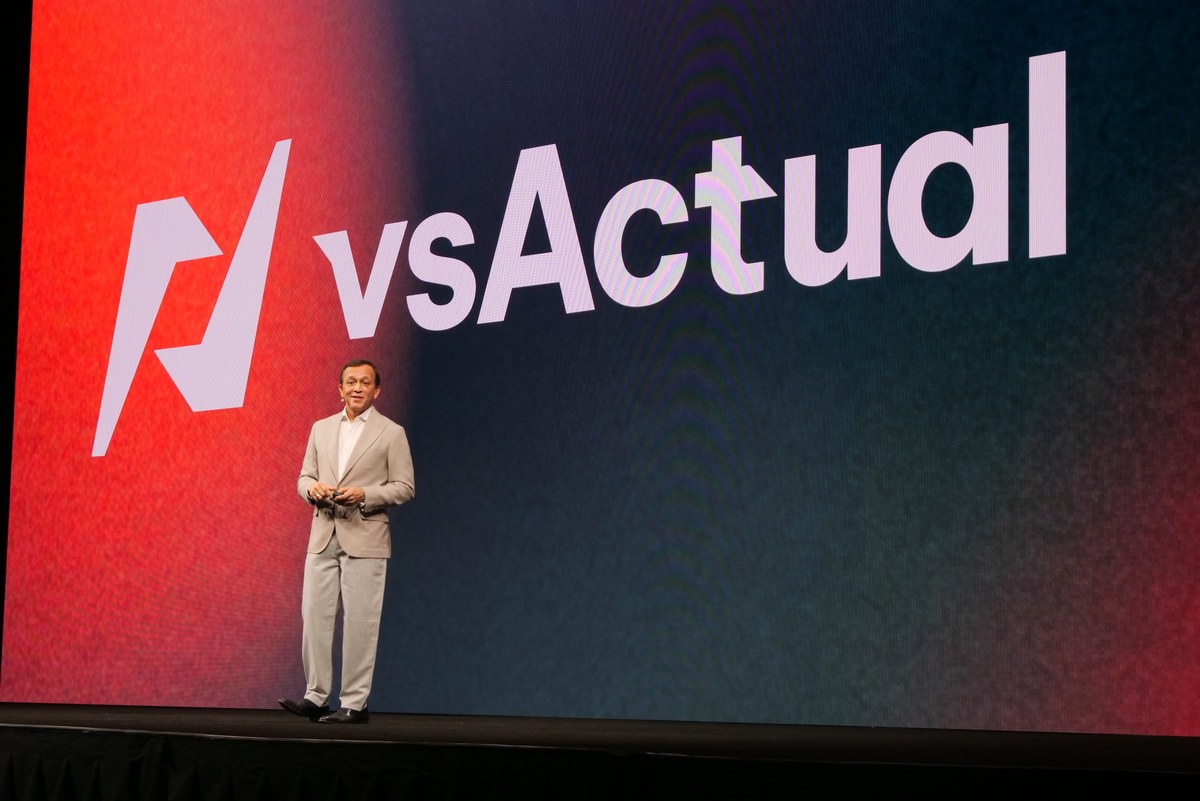
Smartsheet’s biggest new product in years doesn’t require Smartsheet.
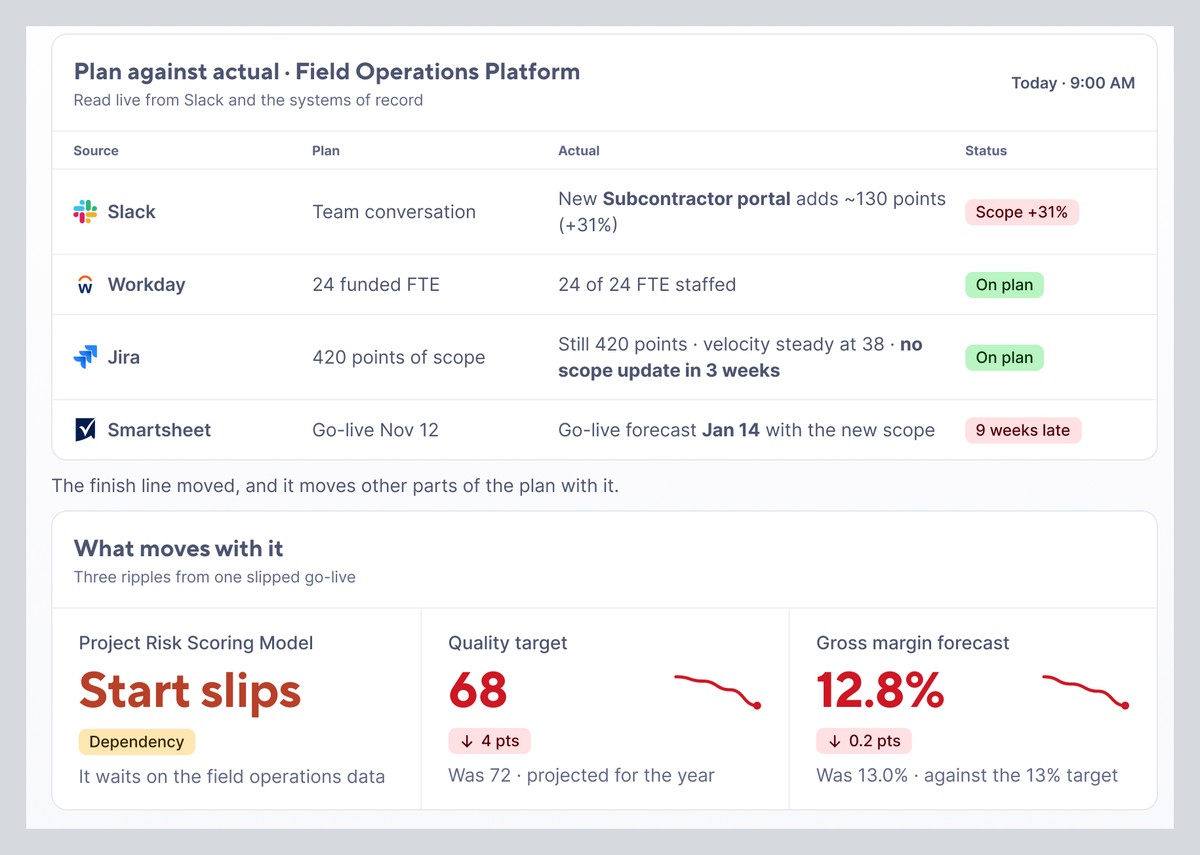
The Bellevue, Wash.-based company unveiled vsActual, as in “plan versus actual,” an AI product that reads a company’s strategy and budgets, tracks the work across tools such as Jira, Workday and Slack, and flags when projects drift off course.
It’s the first standalone product under CEO Raj Singh, the Concur co-founder who took over Smartsheet a year ago, and it’s aimed at CEOs, CFOs and COOs rather than the project managers who have long been Smartsheet’s core users.
At the company’s Engage conference in Seattle, Singh showed a slide from a year ago labeling Smartsheet “a product company,” with the company and its software in a single box.
“Smartsheet, the company, and Smartsheet, the product, were exactly the same thing — same box, same ceiling — an attractive ceiling, but still a ceiling,” he said. Now, he explained, Smartsheet is a multi-product company, with vsActual as a key milestone.
Singh was relaxed and at home on the stage, engaging warmly with the crowd and his fellow presenters like someone who’d been running Smartsheet for years. He went off script often enough that he paused at one point to reassure the teleprompter operator everything was OK, and his talk ultimately ran so long that it threw off the morning’s schedule.
In an interview with GeekWire after the keynote, Singh said the company has more room to grow by working with the software customers already use than by trying to move everything into its flagship product.
“Most of the competition is saying, ‘Well, if you move all your stuff onto my platform, you’ll be totally in control,’” he said. “I think every CIO is thinking, I’m never going to do that.”
Founded two decades ago, Smartsheet is best known for spreadsheet-style software that teams use to plan projects, track tasks and automate routine work.
It went public in 2018 and was taken private in January 2025 by Vista Equity Partners and Blackstone in an $8.4 billion deal, when it had more than $1 billion in annual revenue. Its rivals include Microsoft, Google and Salesforce, as well as Asana, Monday.com, Airtable and ClickUp.
Singh described vsActual as part of a broader product lineup that also includes Smartsheet’s flagship software and Brandfolder, the digital asset management service the company acquired in 2020.
All three draw on the same underlying data, built from 20 years of tracking how work gets planned, approved and done in Smartsheet, which the company calls its Execution Graph. Future products will be built the same way, Singh said.
“The Execution Graph is the long-term differentiated value of our company,” he said.
A change in pricing: Smartsheet is also moving away from charging by the user. Under a new consumption-based model, customers pay a base fee plus credits that are drawn down as people use the software, including its AI features, automations and API connections. Seat-based plans remain available.
Singh said customers balked at paying full price for people who use Smartsheet only occasionally. As an example, he said creating a dashboard might cost 50 cents, rather than a license that runs hundreds of dollars. Customers who switch won’t be charged for going over their credits, though he didn’t say for how long.
He said the net effect on revenue should be “nothing but positive,” describing the shift as a way to unlock demand from customers who held back under per-seat pricing.
“Agents are clearly going to be users moving forward,” he added.
Competition and risks: The new product enters a crowded field. Microsoft, ServiceNow, Workday and others are adding AI agents that plan and track work inside their own products, and AI-native startups are going after the same status-report busywork.
The software also depends on data from systems run by other companies, including rivals such as Asana. Singh said Smartsheet connects to them through APIs and the Model Context Protocol (MCP), an open standard for linking AI models to outside software, depending on how deep the integration goes.
The approach carries some risk: if companies can track their work through vsActual without moving it into Smartsheet, they have less reason to expand their use of the core software, the company’s main business.
Asked about that, Singh pointed to new AI features in Smartsheet itself, including its Smart Assist agent and an MCP server that lets customers use Smartsheet from AI assistants such as Claude and Copilot.
“The core keeps growing,” he said.
Keith Kirkpatrick, a Futurum Group analyst, wrote Wednesday that vsActual is “the company’s clearest move yet from managing tasks to governing strategy,” but said the strategy requires Smartsheet to sell to a different kind of buyer.
“Its sellers are also not used to finance-led deals with long evaluation cycles,” he wrote, adding that many executives still see Smartsheet as a “glorified Excel” project management tool.
Singh said Smartsheet’s sales force already knows how to sell to large enterprises, but acknowledged that the company will need people who understand corporate planning. It will build a team of vsActual specialists, as it has for Brandfolder.
Kirkpatrick also noted that vsActual requires a company to work from one official plan, unlike Smartsheet’s more flexible core software, and said the company will need to show that its Execution Graph offers the same depth for customers whose work lives mostly in other systems.
“Decoupling widens the market but strains the main differentiator,” he wrote.
Smartsheet hasn’t said when vsActual will be generally available or how it will be priced. It’s building the product with 12 enterprise design partners, including some of the world’s largest food service, financial services and health systems, Singh said.
From Concur to Smartsheet: Singh started Concur in the early 1990s with his brother, Steve Singh, and Mike Hilton, and the company grew into a top provider of corporate travel and expense software before SAP acquired it for $8.3 billion in 2014.
Raj Singh later led health benefits company Accolade through its IPO and sale, and took over as Smartsheet CEO in October 2025, after longtime CEO Mark Mader retired and Apptio co-founder Sunny Gupta served as acting CEO.
Smartsheet cut jobs that month and again in February. Singh has since rebuilt the leadership team, including several executives he worked with at Concur and Accolade.
Singh said the leadership team is now fully assembled and the company is hiring, though AI means headcount won’t grow the way it once did.
He didn’t disclose revenue but said the business is growing, especially internationally and with government customers, and that retention remains strong despite fears that AI would lead companies to abandon traditional software. More than 100 customers now pay Smartsheet at least $1 million a year, a record, he said.
He credited Smartsheet’s founders and past leaders with building a successful tool for project managers, calling former CEO Mark Mader and co-founder Brent Frei friends.
Singh said the bigger opportunity is to help businesses run better, and he sees no reason Smartsheet can’t become one of the most important software companies in the world.
“I’m 58 years old,” he said. “I’m not doing this because I need to make an extra buck. I’m doing this because I think there’s a very important company in here, and we just have to unearth it, and then we have to get to customers and make them see that new vision.”
