

Lithium-ion batteries are the leading choice in today’s electric vehicle and battery energy storage system industries, but they contain a number of critical minerals — including lithium, cobalt, nickel, and graphite — that are considered essential for economic and national security reasons, and therefore vulnerable to supply chain disruptions. As renewable energy, electrified infrastructure, and high-power digital technologies continue to grow, there is an increasing need for energy storage systems that are low-cost, resource-abundant, and capable of fast charging and discharging.
That need, among other reasons, has motivated a group of researchers — based at MIT and led by Ju Li, the Carl Richard Soderberg Professor of Power Engineering in the departments of Nuclear Science and Engineering (NSE) and Materials Science and Engineering — to develop complementary energy storage solutions.
The team is looking, in particular, at sodium-metal batteries, which offer several attractive features. Sodium is about 1,000 times more abundant than lithium and, pound for pound, about one-hundredth the cost. A key challenge, however, is that sodium metal is highly reactive, making it difficult for these batteries to achieve both long-term stability and fast cycling.
A new paper in the journal Joule — written by 15 members of the MIT team and published online this week — shows how this dilemma can be addressed by finding the right electrolyte for this battery system.
Electrolytes behaving badly
An electrolyte is one of three main components of a battery, along with the negative electrode (the anode) and the positive electrode (the cathode). The electrolyte acts like the “blood” of the battery, allowing electrically charged ions to move between the two electrodes. “The electrolyte is supposed to just transmit those ions,” explains Li. “It’s supposed to be an ion conductor.” But unfortunately, most electrolytes get involved in unwanted chemical reactions with the electrodes, which can greatly undermine battery stability.
The consequences of these “side reactions” can be severe, says Weiyin Chen, a postdoc in NSE and one of four lead authors of the Joule paper. Insoluble compounds produced during the reactions can build up on the electrodes, creating a barrier that blocks ion transport and can eventually cause the battery to fail.
Until recently, Chen says, no electrolyte used in sodium-metal batteries was fully stable against these unwanted reactions at both the anode and cathode, even though such stability is essential for rechargeable batteries to achieve a long cycle life. An initial breakthrough occurred in 2021, when the Li group and their collaborators identified a “sulfonamide” molecule — consisting of sulfur, oxygen, and nitrogen atoms — that, when used as a solvent, “is magically stable at both electrodes in lithium batteries,” according to Li. This molecule is known as DMTMSA.
Building on that discovery, Li and his colleagues set out to see if related molecules could improve sodium batteries. The goal was not only to maintain stability, but also to enable fast charging and discharging. If charging is too slow, it could take all night to recharge, and if discharging is too slow, the battery cannot deliver much power when needed.
How did the solvent cross the road?
Chen explains the idea with an analogy: Suppose you need to cross a street jam-packed with pedestrians, much like ions traveling from one electrode to another. “You can move more quickly through the crowd with a small backpack that is snug against your body, rather than dragging a bulky suitcase on wheels,” Chen says.
A similar situation occurs in batteries: When sodium ions are surrounded by smaller solvents, they can move faster than when they are surrounded by larger, bulkier solvents. Faster ion transport enables more-rapid charging and discharging. The team’s goal, accordingly, was to identify solvent molecules that are small enough to improve ion transport while still maintaining electrolyte stability.
There is, however, a complicating factor — a trade-off to be addressed: Faster ion transport often comes at the expense of electrolyte stability. Many highly conductive electrolytes react more easily with the electrodes, shortening battery life. Fortunately for their plan, Li says, “reducing the size of solvents provides a new pathway to overcome this trade-off.”
The question then becomes how to find a smaller solvent that has other desirable properties. The idea they adopted is to look for molecules that are “congeneric,” says Li, “meaning that they belong to a similar family and are molecularly similar.” In particular, they searched for molecules related to DMTMSA, hoping to find candidates that were smaller but could retain the stability that made DMTMSA so promising.
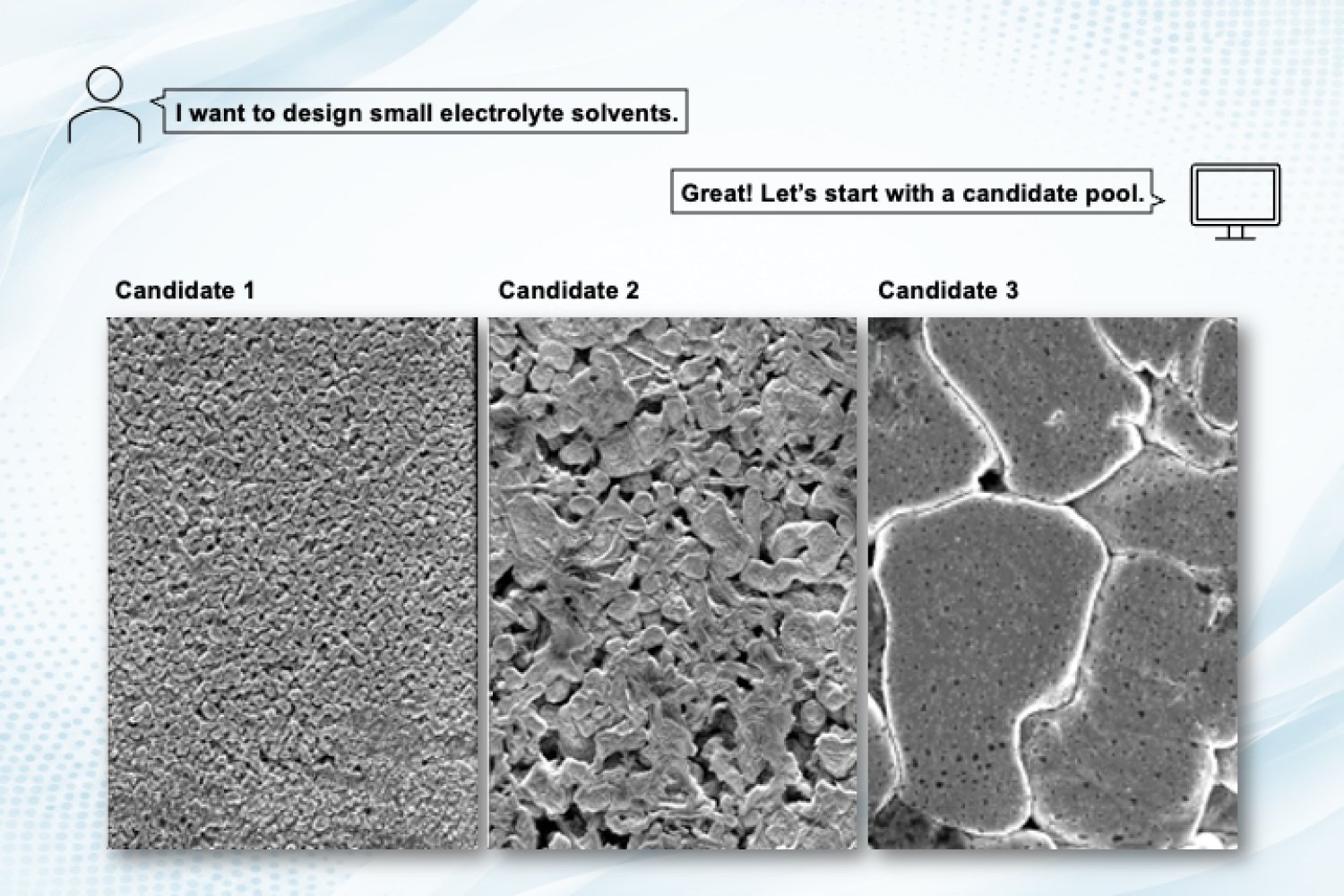
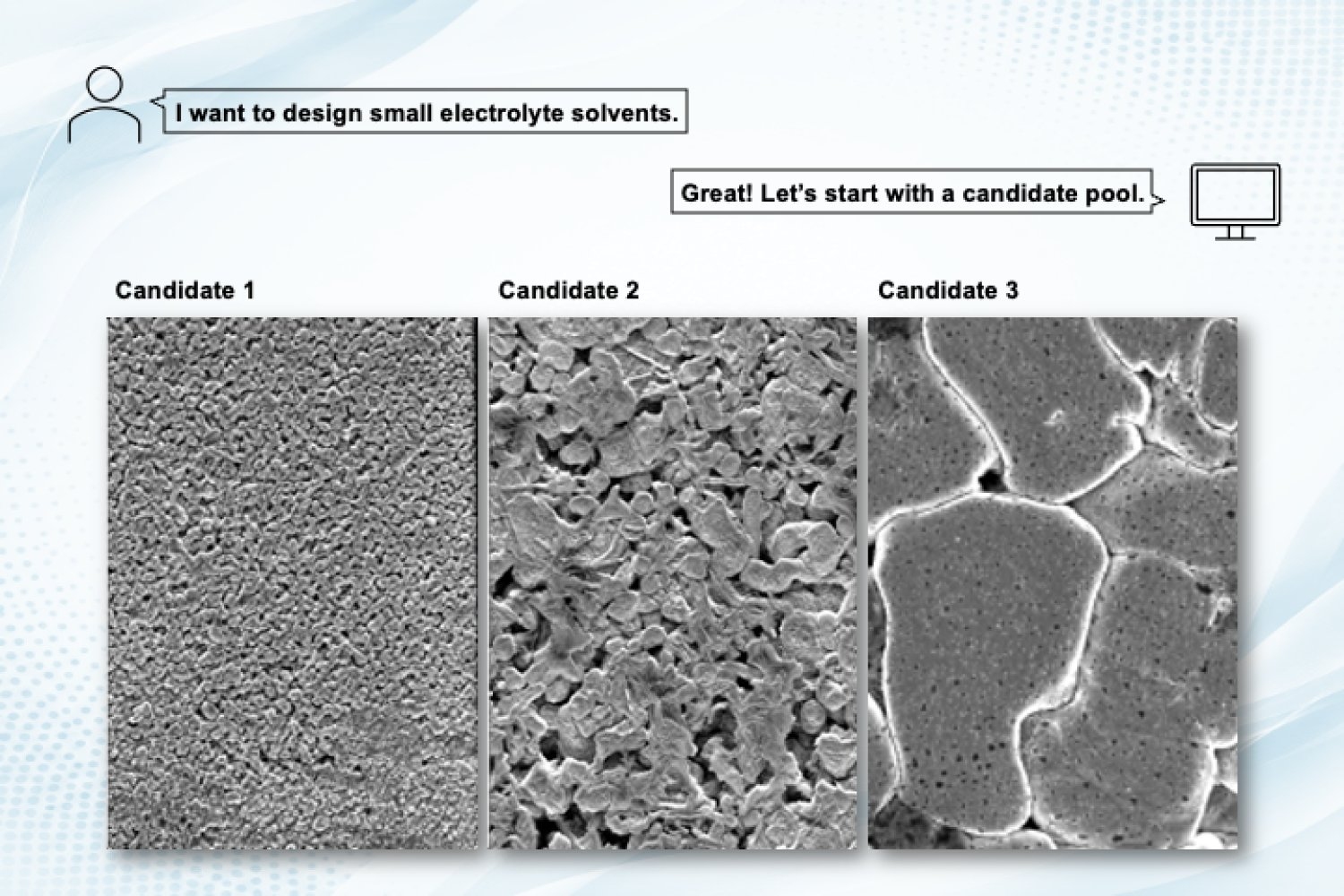
Chia-Wei Hsu, an MIT PhD student in materials science and engineering, created an AI-guided algorithm, which designed 100,000 candidate molecules on his computer within 24 hours. Hsu then narrowed down the pool to 200 candidates by applying a set of technical criteria — including similarity in shape to DMTMSA and comparable electronic properties. Twenty-seven representative candidates covering the full range of possibilities were selected for experimental tests.
“We tested them all under the same conditions to make it a fair, head-to-head competition,” Chen says. A clear winner emerged, a solvent called DMFSA, which was both the smallest and the best.
Small is beautiful
This work, claims Jinhyuk Lee, an associate professor of materials engineering at McGill University who is not part of the study, “addresses one of the most persistent challenges in battery research: improving battery performance at high charging and discharging rates without sacrificing long-term stability. By carefully tailoring the size of solvent molecules, the authors demonstrate a new design strategy that could enable lower-cost, higher performance batteries.”
The group is not done. A new search is underway to find an even better solvent. This time, the approach is similar, but DMFSA (rather than the larger DMTMSA molecule) serves as the starting point. Chen believes the new solvents they are uncovering could eventually lead to rechargeable sodium-metal batteries that combine low-cost, abundant materials with fast charging and high-power performance, opening the door to broader energy storage applications.
The overriding goal of this work, the authors emphasize, is not only to advance sodium batteries. It’s also to introduce a new approach to electrolyte design that uses solvent size and molecular similarity as the key guideposts. Viewing the research in this light, sodium-metal batteries serve as a model system for demonstrating a more general design principle.
“Because the concept is broadly applicable,” Lee comments, “its impact could extend well beyond sodium batteries and influence the design of a wide range of future energy storage technologies.”
This work was supported, in part, by a National Research Foundation of Korea grant funded by the government of Korea government, as well as U.S. National Science Foundation graduate research fellowship. The characterization equipment used in this project is partly from the MIT.nano Characterization Facilities.
