
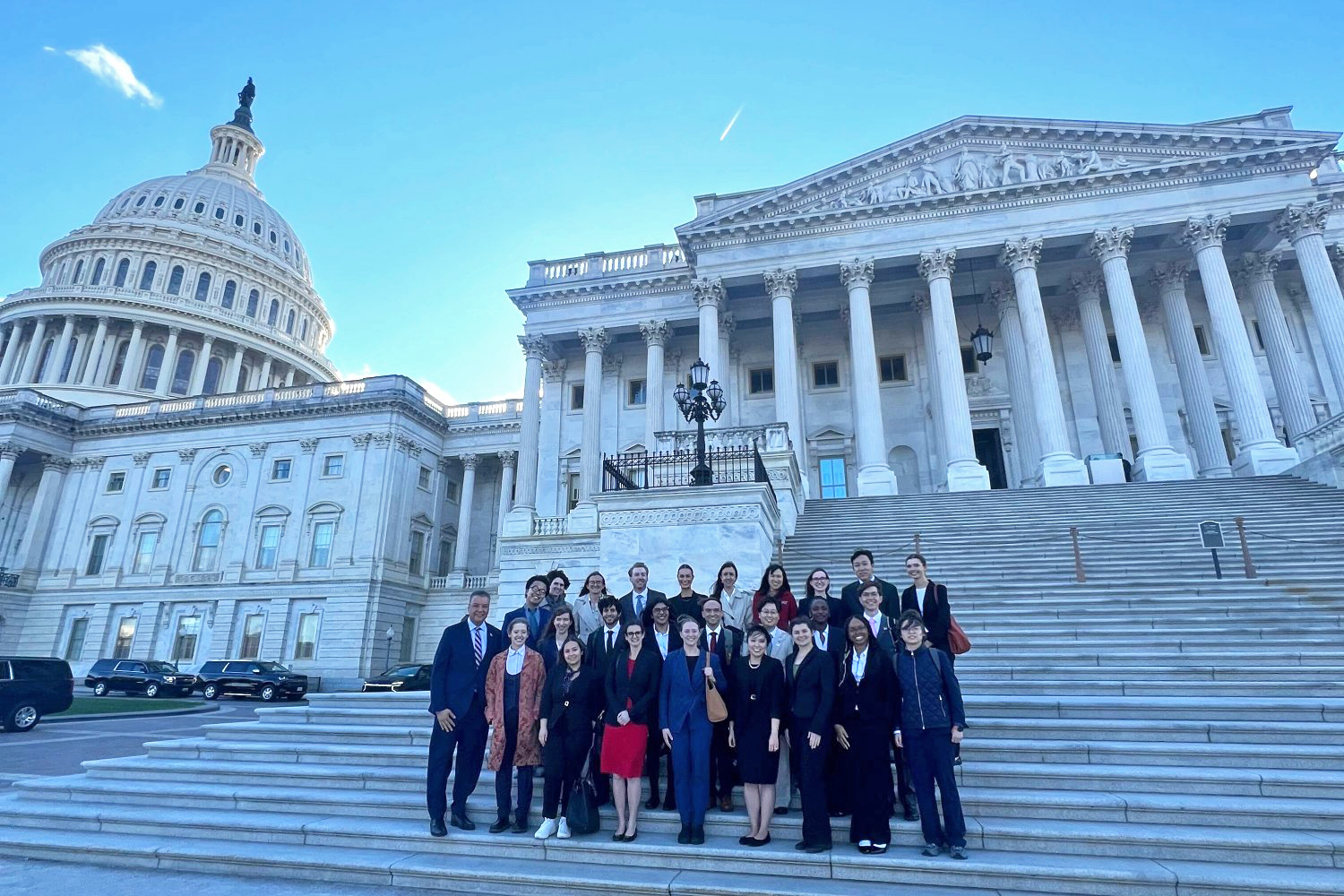
This spring, 25 MIT students and postdocs traveled to Washington to meet with congressional staffers and advocate for sustained federal investment in scientific research.
With recent cuts to National Science Foundation programs and continued uncertainty surrounding the federal research budget, these conversations were especially timely. Over the course of just two days, participants met with 62 congressional offices representing 32 states to discuss the importance of federal support for scientific research, higher education, and other policy concerns related to their individual research areas.
Each spring, the MIT Science Policy Initiative (SPI) organizes Congressional Visit Days (CVD), a program that introduces graduate students and postdocs to the federal policymaking process while demonstrating the many ways scientists can engage in policy advocacy. In addition to meeting with congressional offices, participants connect with Washington-based MIT alumni and members of the MIT Washington Office to learn about careers at the intersection of science and public policy.
This year’s CVD was co-organized by Audrey Parker, a PhD student in civil and environmental engineering at MIT, and Ian Robertson, a PhD student in physical oceanography at MIT and the Woods Hole Oceanographic Institution (WHOI). Robertson reflects on the experience:
“Having attended the trip as a participant last year, stepping into the role of a co-leader this year was a big commitment that was well worth the payoff. It was rewarding to build on the work of past leaders, strengthening the CVD experience for participants by training and encouraging them to discuss not just general science funding advocacy in their meetings, but also specific policies tied to their research. I look forward to the future success of the CVD program in continuing to provide students and postdocs a template for science policy conversations with Congress and helping them realize the various avenues in which they can connect research to policy throughout their careers.”
To prepare for the trip, participants attended three training sessions led by SPI in collaboration with the MIT Washington Office and the MIT Policy Lab. These sessions provided background on the federal appropriations process, the role of congressional staff in shaping legislation, and practical strategies for communicating scientific expertise to policymakers. The training sessions also gave participants a chance to practice sharing their research and policy pitches with each other in mock “Hill meetings.”
While on the Hill, students advocated for both general science funding for the upcoming fiscal year as well as specific policies tied to their research in artificial intelligence, environmental science and engineering, energy, space, and health. They encouraged offices to edit language in bills, support bills already on the floor, or sponsor new bills. Staffers on both sides of the aisle were particularly interested in discussing AI privacy and security across disciplines. They also expressed strong interest in hot environmental topics, such as deep-sea mining, and were eager to learn more about its associated environmental consequences. In many cases, conversations about participants’ research and science-based policy priorities reinforced the need for continued federal funding of science, enabling staffers to connect abstract funding decisions with the researchers and projects they support.
The experience proved valuable for both the MIT delegation and the congressional offices they visited. Rodrigo Zuniga, a first-year PhD student participant, highlights:
“Going to Washington, D.C., offered a whole new perspective of the role of science in politics for me. In today’s news and social media landscape, it’s really easy to see Washington as irreversibly polarized, but in talking to staffers from both the majority and minority parties, I saw a general desire for bipartisanship and widespread support for science. What’s most clear to me after this experience with CVD is that there is a lot of room and pressing need for humans with scientific training and expertise to participate proactively in local, state, and federal government.”
As scientific and technological issues continue to shape public policy, opportunities for researchers to engage with policymakers have never been more important. Programs like Congressional Visit Days help equip the next generation of scientists with the knowledge and confidence to communicate the value of research beyond the laboratory, strengthening connections between the scientific community and the policymakers whose decisions shape its future.
