

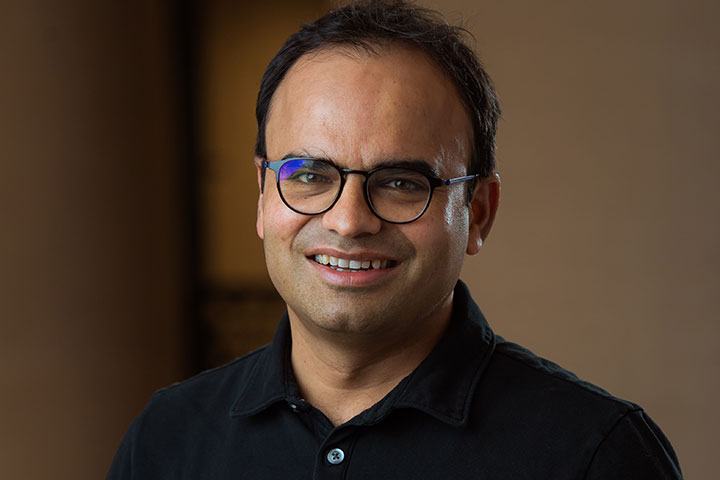
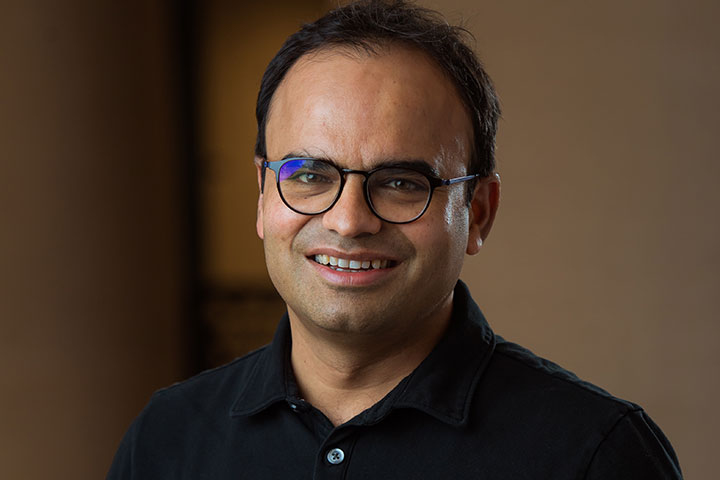
Systems using artificial intelligence to enhance forecasting, planning, and decision-making in businesses have been proliferating in recent years, but in many cases, they lack the detailed, specific information about the organization itself, limiting the usefulness of those tools.
Devavrat Shah, a principal investigator at MIT’s Laboratory for Information and Decision Systems (LIDS), faculty member with the department of Electrical Engineering and Computer Science (EECS), and member of the Institute for Data, Systems, and Society (IDSS), has been focused on how to design methods that can handle second-by-second decision-making using limited computational resources.
“In a sense, with a small amount of resource, you have to do a lot of heavy lifting,” he says. As a researcher, “my interest is in the ability to develop methods that can extract information from data at scale in as effective a manner as possible.”
The Andrew (1956) and Erna Viterbi Professor has been teaching at MIT since 2005.
In 2019, he also co-founded a spinoff company called Ikigai Labs. Ikigai built a foundation model for tabular, time series data based on years of research in Shah’s lab, which was patented and licensed by MIT to the company. This model can take input from enterprise data from varied sources, continuously and at scale, so that it learns as it goes along by testing its predictions against real outcomes.
Shah explains that the system is an extension of the kind of graphical models that are used, for example, by GPS devices to convert a sparse amount of data received from satellites into an accurate model of a position on the Earth’s surface, or by communication system like that in a digital watch that communicates at high speed in an energy-efficient manner.
“My interest was: How does one design such graphical models for generic, tabular data?” he says.
While most AI models have been taught using text and images, this system takes tabular data as its input — structured data such as the familiar kind of row-and-column format used in spreadsheets. And then it provides the kind of real-time planning, on a vastly larger scale.
The idea for Ikigai was to provide forecasting and decision-making technology for large businesses, such as consumer goods manufacturers and pharmaceutical companies.
Shah gives the example of how a consumer electronics company might use this system.
“Let’s say you’re making headphones and all sorts of different things. And each of the products that you manufacture has lots of small pieces that come from different parts of the world. And once the device is sold, it needs to be supported and maintained. And you have to come up with new versions of the product, you have to market them, you have to price them … So the questions you would typically ask would be: If I were to sell these next quarter or next year, how many will be sold in different places, and what would happen to demand if I change the price, or if I introduce promotion?”
He adds that all of these processes are interdependent, and at every stage of the processes decisions have to be made that have implications over time. “At some level,” he says, “digitizing these processes and being able to do predictions and constantly optimize is what leads to ultimately better business operations.”
Ikigai was recently acquired by the international firm Celonis, where Shah is now chief scientist in addition to his roles at MIT. Ultimately, he hopes the model he developed for Ikigai will help Celonis deliver tools that can integrate with a company’s own data and business processes in order to provide real-world analyses that can help make forecasts, plans, and decisions.
Shah adds that Celonis has specialized in digitizing and automating operations for more than 1,400 large companies around the world. Now that these systems are fully digitized, they provide a platform for Ikigai’s software to take the next step, reading the data from these digitized systems in order to provide detailed models to allow simulation of different options, predict optimum strategies, and forecast the results of a given set of decisions.
“Once the digital layer of these processes exists and this information layer exists,” Shah says, “now, on top of it, we can put the Ikigai stack to enable decision-making at a much larger scale than otherwise.”
While so many companies are working on various aspects of AI, “we are very much focused on part of the domain that the rest of the world is not paying attention to,” which is the area of structured or time-domain data. By starting from such data, he says, it provides a very cost-effective version of AI.
“A narrower focus comes with sharper technology,” he says, “but it’s broad enough that it’s very valuable.”
Shah adds, “The recent buzzword that’s become pertinent in the modern AI popular press is a ‘world model.’ In a sense, this is trying to build the enterprise process world model, so to speak.”
